 Add to Chrome
 Add to Firefox
 Add to Edge
Looking under the Wrong Lamppost: On the Limitations of Automated Translation Quality Estimation
Aug 04, 2026
Automation of Translation Quality Estimation (QE) has emerged as a widely discussed approach to managing translation quality at scale, and a growing number of tools and technologies have been released in pursuit of this goal. However, the proliferation of new QE systems has not always been accompanied by robust, transparent, and reproducible research and testing. This gap deserves critical scrutiny. This paper examines some fundamental limitations of the QE technology from both theoretical and empirical perspectives, arguing that current QE systems are structurally ill-equipped to serve as reliable standalone tools in real-world translation workflows. The reviewed evidence suggests that QE suffers from a range of interrelated and largely unresolved limitations. Most fundamentally, the evaluation of the quality of translation at the level of isolated segments is problematic because it tends to miss out on cohesion, coherence, and stylistic and rhetorical text features. In addition, empirical research documents several other limitations and flaws, including failure to generalize, systematic biases, overfitting and distribution collapse, performance gaps, error annotation challenges, and data scarcity. These are structural limitations arising from the complexity of human language and translation as a cognitive and communicative act - limitations that more data and better architectures have so far not overcome. Consequently, segment-level QE scores should not be used as a standalone basis for routing, release, or review bypass in production; we argue future work should focus on automating human evaluation grounded in MQM.

The Multi-Range Theory of Translation Quality Measurement: MQM scoring models and Statistical Quality Control
May 29, 2024
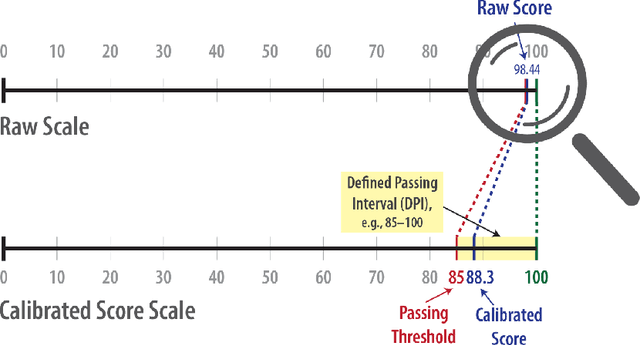
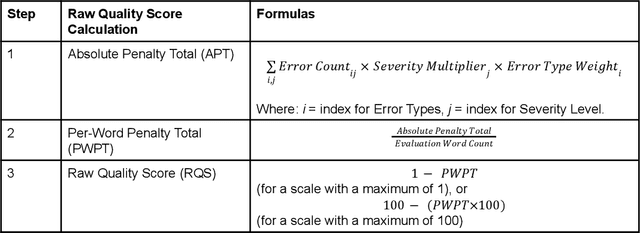
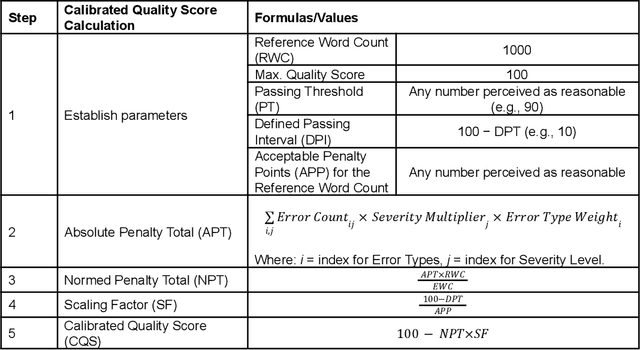
The year 2024 marks the 10th anniversary of the Multidimensional Quality Metrics (MQM) framework for analytic translation quality evaluation. The MQM error typology has been widely used by practitioners in the translation and localization industry and has served as the basis for many derivative projects. The annual Conference on Machine Translation (WMT) shared tasks on both human and automatic translation quality evaluations used the MQM error typology. The metric stands on two pillars: error typology and the scoring model. The scoring model calculates the quality score from annotation data, detailing how to convert error type and severity counts into numeric scores to determine if the content meets specifications. Previously, only the raw scoring model had been published. This April, the MQM Council published the Linear Calibrated Scoring Model, officially presented herein, along with the Non-Linear Scoring Model, which had not been published before. This paper details the latest MQM developments and presents a universal approach to translation quality measurement across three sample size ranges. It also explains why Statistical Quality Control should be used for very small sample sizes, starting from a single sentence.