 Add to Chrome
 Add to Firefox
 Add to Edge
COHORT: Hybrid RL for Collaborative Large DNN Inference on Multi-Robot Systems Under Real-Time Constraints
Mar 11, 2026
Large deep neural networks (DNNs), especially transformer-based and multimodal architectures, are computationally demanding and challenging to deploy on resource-constrained edge platforms like field robots. These challenges intensify in mission-critical scenarios (e.g., disaster response), where robots must collaborate under tight constraints on bandwidth, latency, and battery life, often without infrastructure or server support. To address these limitations, we present COHORT, a collaborative DNN inference and task-execution framework for multi-robot systems built on the Robotic Operating System (ROS). COHORT employs a hybrid offline-online reinforcement learning (RL) strategy to dynamically schedule and distribute DNN module execution across robots. Our key contributions are threefold: (a) Offline RL policy learning combined with Advantage-Weighted Regression (AWR), trained on auction-based task allocation data from heterogeneous DNN workloads across distributed robots, (b) Online policy adaptation via Multi-Agent PPO (MAPPO), initialized from the offline policy and fine-tuned in real time, and (c) comprehensive evaluation of COHORT on vision-language model (VLM) inference tasks such as CLIP and SAM, analyzing scalability with increasing robot/workload and robustness under . We benchmark COHORT against genetic algorithms and multiple RL baselines. Experimental results demonstrate that COHORT reduces battery consumption by 15.4% and increases GPU utilization by 51.67%, while satisfying frame-rate and deadline constraints 2.55 times of the time.

Unsupervised Domain Adaptation for Action Recognition via Self-Ensembling and Conditional Embedding Alignment
Oct 23, 2024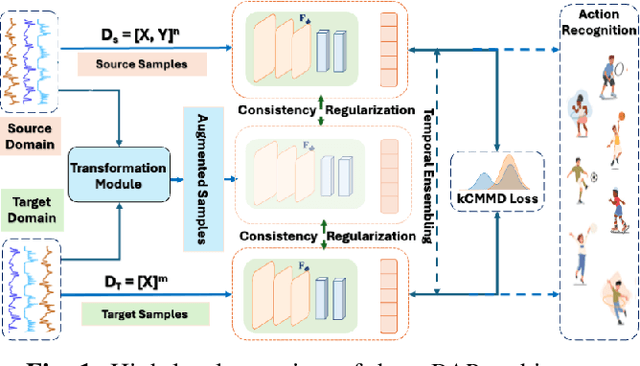


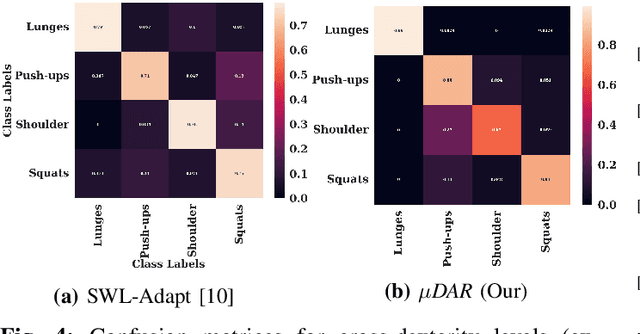
Recent advancements in deep learning-based wearable human action recognition (wHAR) have improved the capture and classification of complex motions, but adoption remains limited due to the lack of expert annotations and domain discrepancies from user variations. Limited annotations hinder the model's ability to generalize to out-of-distribution samples. While data augmentation can improve generalizability, unsupervised augmentation techniques must be applied carefully to avoid introducing noise. Unsupervised domain adaptation (UDA) addresses domain discrepancies by aligning conditional distributions with labeled target samples, but vanilla pseudo-labeling can lead to error propagation. To address these challenges, we propose $\mu$DAR, a novel joint optimization architecture comprised of three functions: (i) consistency regularizer between augmented samples to improve model classification generalizability, (ii) temporal ensemble for robust pseudo-label generation and (iii) conditional distribution alignment to improve domain generalizability. The temporal ensemble works by aggregating predictions from past epochs to smooth out noisy pseudo-label predictions, which are then used in the conditional distribution alignment module to minimize kernel-based class-wise conditional maximum mean discrepancy ($k$CMMD) between the source and target feature space to learn a domain invariant embedding. The consistency-regularized augmentations ensure that multiple augmentations of the same sample share the same labels; this results in (a) strong generalization with limited source domain samples and (b) consistent pseudo-label generation in target samples. The novel integration of these three modules in $\mu$DAR results in a range of $\approx$ 4-12% average macro-F1 score improvement over six state-of-the-art UDA methods in four benchmark wHAR datasets
HeteroEdge: Addressing Asymmetry in Heterogeneous Collaborative Autonomous Systems
May 05, 2023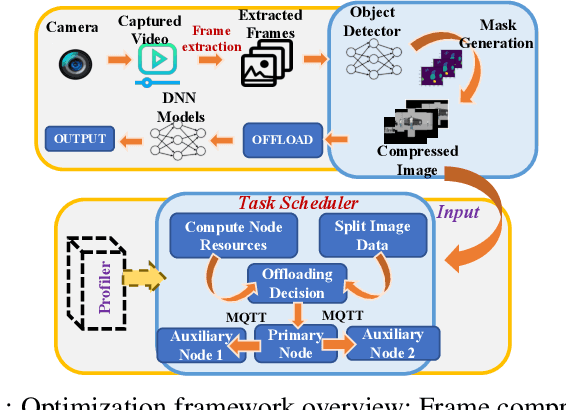
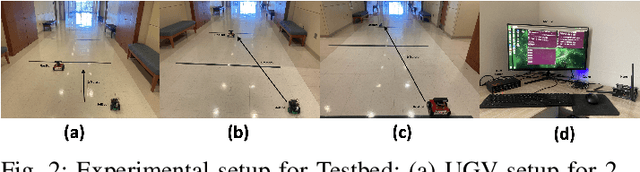

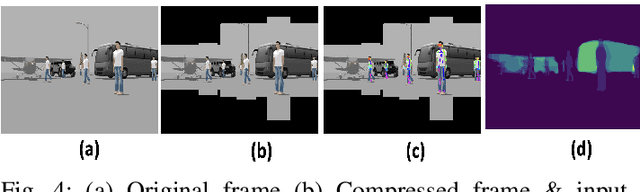
Gathering knowledge about surroundings and generating situational awareness for IoT devices is of utmost importance for systems developed for smart urban and uncontested environments. For example, a large-area surveillance system is typically equipped with multi-modal sensors such as cameras and LIDARs and is required to execute deep learning algorithms for action, face, behavior, and object recognition. However, these systems face power and memory constraints due to their ubiquitous nature, making it crucial to optimize data processing, deep learning algorithm input, and model inference communication. In this paper, we propose a self-adaptive optimization framework for a testbed comprising two Unmanned Ground Vehicles (UGVs) and two NVIDIA Jetson devices. This framework efficiently manages multiple tasks (storage, processing, computation, transmission, inference) on heterogeneous nodes concurrently. It involves compressing and masking input image frames, identifying similar frames, and profiling devices to obtain boundary conditions for optimization.. Finally, we propose and optimize a novel parameter split-ratio, which indicates the proportion of the data required to be offloaded to another device while considering the networking bandwidth, busy factor, memory (CPU, GPU, RAM), and power constraints of the devices in the testbed. Our evaluations captured while executing multiple tasks (e.g., PoseNet, SegNet, ImageNet, DetectNet, DepthNet) simultaneously, reveal that executing 70% (split-ratio=70%) of the data on the auxiliary node minimizes the offloading latency by approx. 33% (18.7 ms/image to 12.5 ms/image) and the total operation time by approx. 47% (69.32s to 36.43s) compared to the baseline configuration (executing on the primary node).
Domain Adaptation for Inertial Measurement Unit-based Human Activity Recognition: A Survey
Apr 07, 2023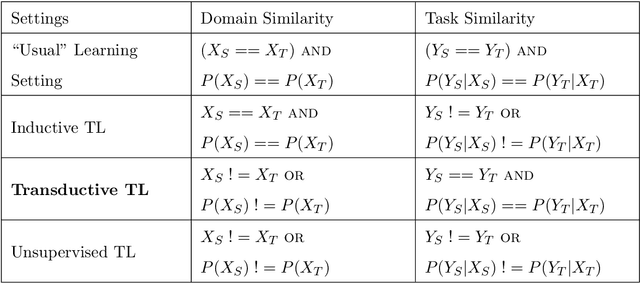
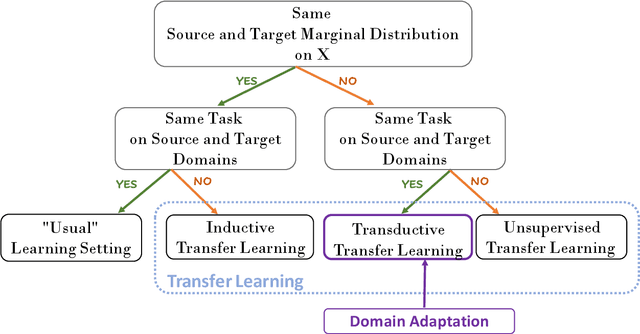

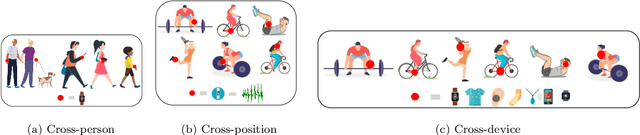
Machine learning-based wearable human activity recognition (WHAR) models enable the development of various smart and connected community applications such as sleep pattern monitoring, medication reminders, cognitive health assessment, sports analytics, etc. However, the widespread adoption of these WHAR models is impeded by their degraded performance in the presence of data distribution heterogeneities caused by the sensor placement at different body positions, inherent biases and heterogeneities across devices, and personal and environmental diversities. Various traditional machine learning algorithms and transfer learning techniques have been proposed in the literature to address the underpinning challenges of handling such data heterogeneities. Domain adaptation is one such transfer learning techniques that has gained significant popularity in recent literature. In this paper, we survey the recent progress of domain adaptation techniques in the Inertial Measurement Unit (IMU)-based human activity recognition area, discuss potential future directions.