 Add to Chrome
 Add to Firefox
 Add to Edge
COHORT: Hybrid RL for Collaborative Large DNN Inference on Multi-Robot Systems Under Real-Time Constraints
Mar 11, 2026
Large deep neural networks (DNNs), especially transformer-based and multimodal architectures, are computationally demanding and challenging to deploy on resource-constrained edge platforms like field robots. These challenges intensify in mission-critical scenarios (e.g., disaster response), where robots must collaborate under tight constraints on bandwidth, latency, and battery life, often without infrastructure or server support. To address these limitations, we present COHORT, a collaborative DNN inference and task-execution framework for multi-robot systems built on the Robotic Operating System (ROS). COHORT employs a hybrid offline-online reinforcement learning (RL) strategy to dynamically schedule and distribute DNN module execution across robots. Our key contributions are threefold: (a) Offline RL policy learning combined with Advantage-Weighted Regression (AWR), trained on auction-based task allocation data from heterogeneous DNN workloads across distributed robots, (b) Online policy adaptation via Multi-Agent PPO (MAPPO), initialized from the offline policy and fine-tuned in real time, and (c) comprehensive evaluation of COHORT on vision-language model (VLM) inference tasks such as CLIP and SAM, analyzing scalability with increasing robot/workload and robustness under . We benchmark COHORT against genetic algorithms and multiple RL baselines. Experimental results demonstrate that COHORT reduces battery consumption by 15.4% and increases GPU utilization by 51.67%, while satisfying frame-rate and deadline constraints 2.55 times of the time.

A Survey on Efficient Vision-Language Models
Apr 13, 2025


Vision-language models (VLMs) integrate visual and textual information, enabling a wide range of applications such as image captioning and visual question answering, making them crucial for modern AI systems. However, their high computational demands pose challenges for real-time applications. This has led to a growing focus on developing efficient vision language models. In this survey, we review key techniques for optimizing VLMs on edge and resource-constrained devices. We also explore compact VLM architectures, frameworks and provide detailed insights into the performance-memory trade-offs of efficient VLMs. Furthermore, we establish a GitHub repository at https://github.com/MPSCUMBC/Efficient-Vision-Language-Models-A-Survey to compile all surveyed papers, which we will actively update. Our objective is to foster deeper research in this area.
SERN: Simulation-Enhanced Realistic Navigation for Multi-Agent Robotic Systems in Contested Environments
Oct 22, 2024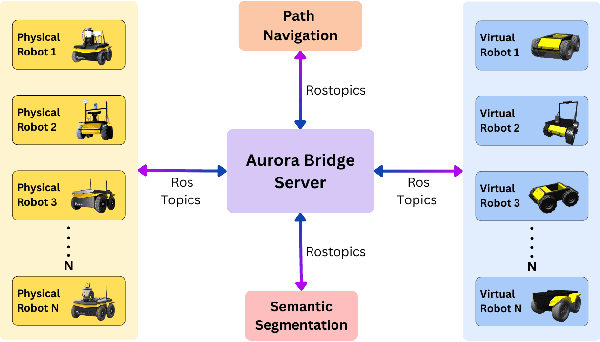


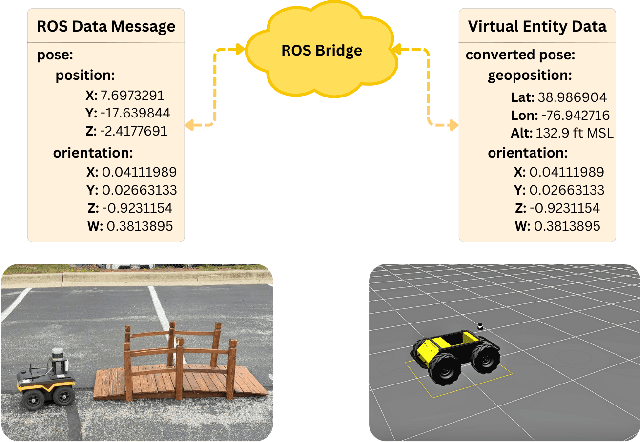
The increasing deployment of autonomous systems in complex environments necessitates efficient communication and task completion among multiple agents. This paper presents SERN (Simulation-Enhanced Realistic Navigation), a novel framework integrating virtual and physical environments for real-time collaborative decision-making in multi-robot systems. SERN addresses key challenges in asset deployment and coordination through a bi-directional communication framework using the AuroraXR ROS Bridge. Our approach advances the SOTA through accurate real-world representation in virtual environments using Unity high-fidelity simulator; synchronization of physical and virtual robot movements; efficient ROS data distribution between remote locations; and integration of SOTA semantic segmentation for enhanced environmental perception. Our evaluations show a 15% to 24% improvement in latency and up to a 15% increase in processing efficiency compared to traditional ROS setups. Real-world and virtual simulation experiments with multiple robots demonstrate synchronization accuracy, achieving less than 5 cm positional error and under 2-degree rotational error. These results highlight SERN's potential to enhance situational awareness and multi-agent coordination in diverse, contested environments.