 Add to Chrome
 Add to Firefox
 Add to Edge
Splat-Based Metal Artifact Reduction in Cone-Beam CT via Compact Attenuation Modeling
Aug 05, 2026
X-ray computed tomography (CT) suffers from severe metal artifacts when high-attenuation objects such as dental fillings or orthopedic implants are present. These artifacts originate from the polychromatic nature of X-rays, where attenuation varies strongly with photon energy and material composition, breaking the monochromatic assumption used by conventional reconstruction algorithms. Recent neural rendering approaches attempt to address this mismatch through differentiable polychromatic projection models, but they still struggle with smoothness bias, loss of fine structures, and prohibitive computation when extended to large-scale cone-beam CT. We introduce a splat-based metal artifact reduction framework that incorporates a physically grounded polychromatic forward model into a continuous Gaussian representation for cone-beam CT. Each Gaussian encodes the energy-dependent attenuation of the underlying material using a compact material parameterization, which enables efficient joint optimization of geometric and material properties without relying on a metal mask. This compact attenuation formulation captures the essential variation across biological tissues and metallic implants, allowing our model to explain metal-induced nonlinearity while preserving high-frequency structure. Experiments on simulated and real cone-beam CT scans show that our method converges significantly faster and suppresses metal artifacts more effectively than existing reconstruction and neural field-based approaches.

Revisiting Pose Sensitivity in Splat-based Computed Tomography under Sparse-view Reconstruction
Aug 05, 2026X-ray computed tomography (CT) reconstructs volumetric representations of objects from projection images obtained by transmitting X-rays through a target. Recent splat-based tomography, which represents a volume as a continuous distribution of 3D Gaussians, has demonstrated both high reconstruction quality and fast convergence in cone-beam sparse-view CT. However, when deployed in real CT systems with limited and non-uniform view distributions, we observe distinctive streak and strip artifacts that are far more pronounced than in conventional reconstruction methods. Through detailed analysis, we show that these artifacts primarily originate from pose inaccuracies in the acquisition geometry rather than from view sparsity itself. We revisit pose sensitivity in the splatting formulation and derive a stable gradient-based framework that jointly refines geometric parameters during reconstruction. Our study not only identifies how pose perturbations propagate through the differentiable projection operator but also reveals why splat-based CT is particularly vulnerable to geometric misalignment. The resulting formulation remains lightweight and easily integrable into existing pipelines while substantially improving reconstruction fidelity under real-world sparse-view conditions.
Self-Calibrating, Fully Differentiable NLOS Inverse Rendering
Sep 26, 2023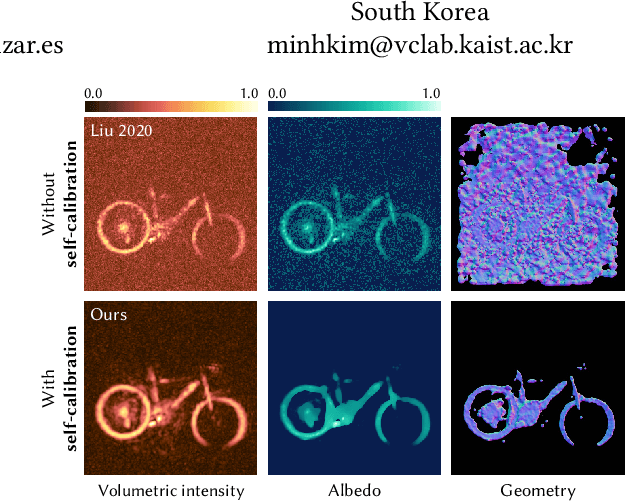
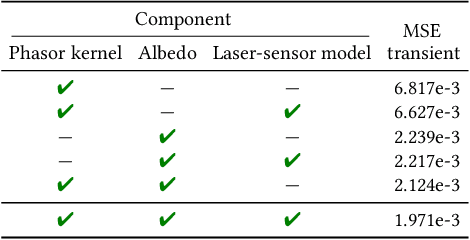
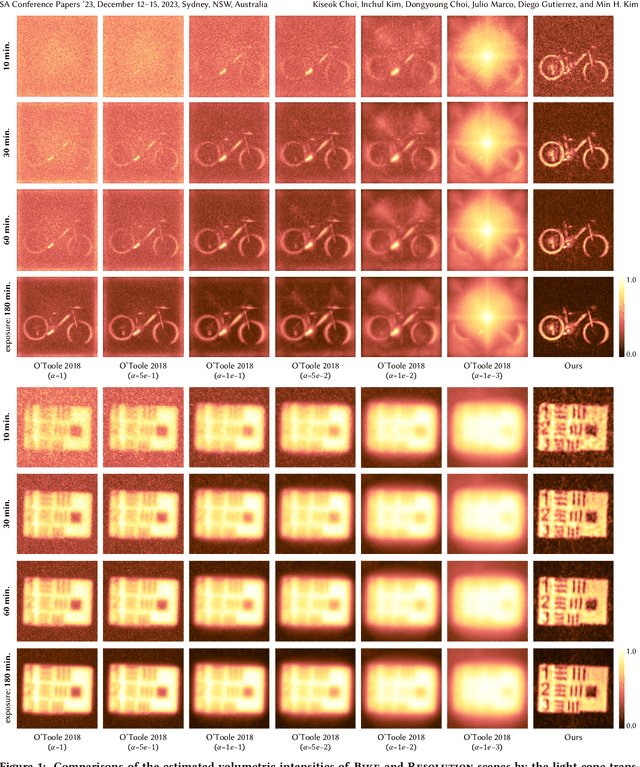
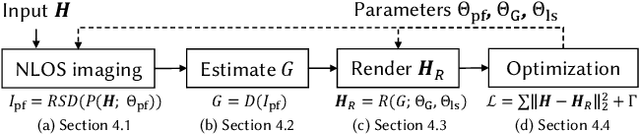
Existing time-resolved non-line-of-sight (NLOS) imaging methods reconstruct hidden scenes by inverting the optical paths of indirect illumination measured at visible relay surfaces. These methods are prone to reconstruction artifacts due to inversion ambiguities and capture noise, which are typically mitigated through the manual selection of filtering functions and parameters. We introduce a fully-differentiable end-to-end NLOS inverse rendering pipeline that self-calibrates the imaging parameters during the reconstruction of hidden scenes, using as input only the measured illumination while working both in the time and frequency domains. Our pipeline extracts a geometric representation of the hidden scene from NLOS volumetric intensities and estimates the time-resolved illumination at the relay wall produced by such geometric information using differentiable transient rendering. We then use gradient descent to optimize imaging parameters by minimizing the error between our simulated time-resolved illumination and the measured illumination. Our end-to-end differentiable pipeline couples diffraction-based volumetric NLOS reconstruction with path-space light transport and a simple ray marching technique to extract detailed, dense sets of surface points and normals of hidden scenes. We demonstrate the robustness of our method to consistently reconstruct geometry and albedo, even under significant noise levels.