 Add to Chrome
 Add to Firefox
 Add to Edge
Anatomy-Grounded Synthetic Coronary Angiography for Geometry-Informed Multi-View Matching
Jun 26, 2026
Accurate correspondence matching across multiple angiographic views is the prerequisite for 3D coronary reconstruction and interventional guidance. However, the development of robust deep learning models for this task has been stifled by a fundamental data bottleneck. Obtaining ground truth for matching tasks in angiography pairs is prohibitively expensive and hard to scale. To overcome this barrier, we introduce a physically-grounded data generation framework that synthesizes high-fidelity Digital Reconstructed Radiographs (DRRs) from 3D Coronary CT Angiography (CCTA) volumes. Our framework generates dense, highly accurate 3D-to-2D projection labels by simulating realistic C-arm acquisition geometry on patient anatomy at zero human cost. Leveraging this dense supervision, we propose a Geometry-Informed Matching Module (GIMM) that integrates global feature and anatomical structure into correspondence learning. Unlike real angiography where assessment relies on subjective human annotation, our dataset provides 2D correspondence labels with paired images, allowing human-free evaluation. We comprehensively evaluate our method on the proposed CT-derived DRR dataset and demonstrate improvements over other matching baseline models.

MPSeg : Multi-Phase strategy for coronary artery Segmentation
Nov 17, 2023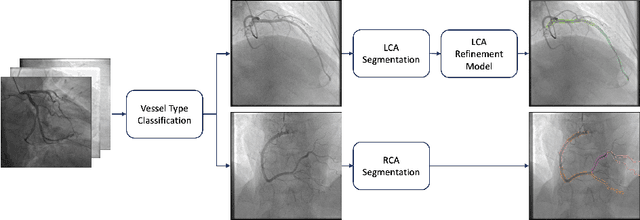
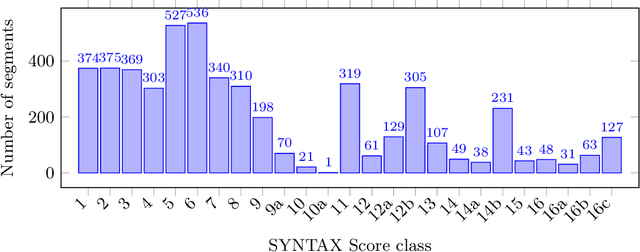
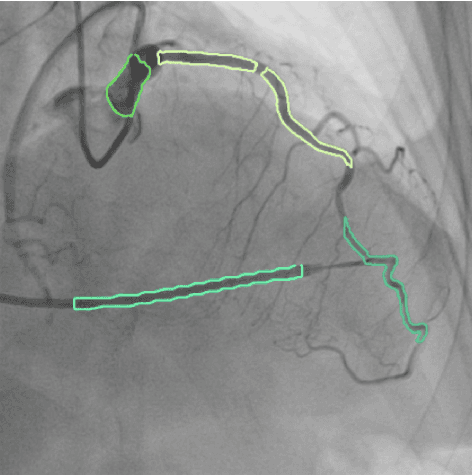
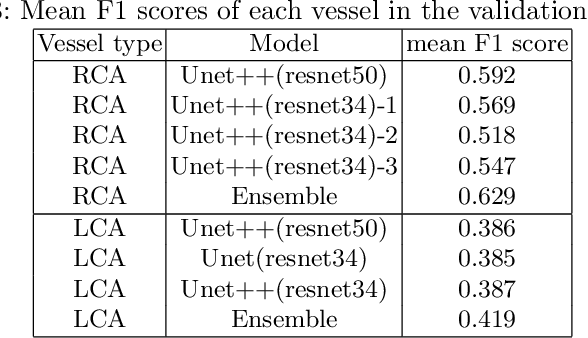
Accurate segmentation of coronary arteries is a pivotal process in assessing cardiovascular diseases. However, the intricate structure of the cardiovascular system presents significant challenges for automatic segmentation, especially when utilizing methodologies like the SYNTAX Score, which relies extensively on detailed structural information for precise risk stratification. To address these difficulties and cater to this need, we present MPSeg, an innovative multi-phase strategy designed for coronary artery segmentation. Our approach specifically accommodates these structural complexities and adheres to the principles of the SYNTAX Score. Initially, our method segregates vessels into two categories based on their unique morphological characteristics: Left Coronary Artery (LCA) and Right Coronary Artery (RCA). Specialized ensemble models are then deployed for each category to execute the challenging segmentation task. Due to LCA's higher complexity over RCA, a refinement model is utilized to scrutinize and correct initial class predictions on segmented areas. Notably, our approach demonstrated exceptional effectiveness when evaluated in the Automatic Region-based Coronary Artery Disease diagnostics using x-ray angiography imagEs (ARCADE) Segmentation Detection Algorithm challenge at MICCAI 2023.
SSASS: Semi-Supervised Approach for Stenosis Segmentation
Nov 17, 2023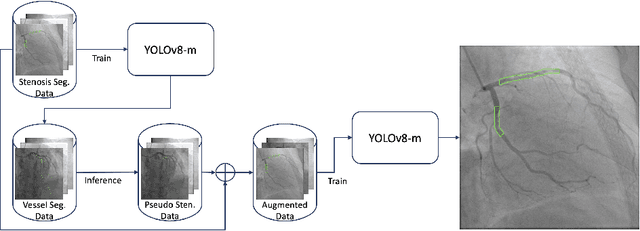
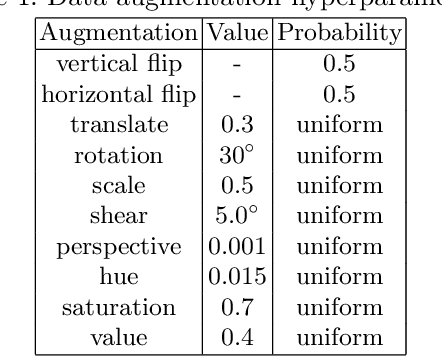
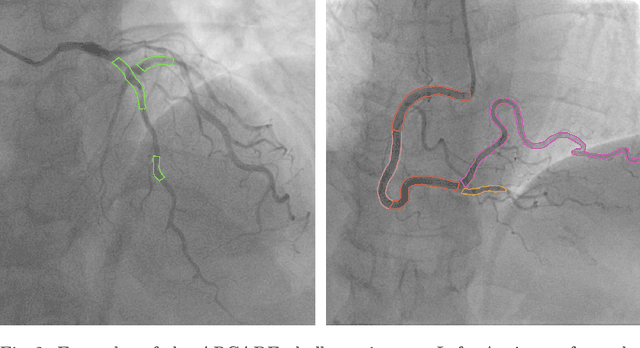
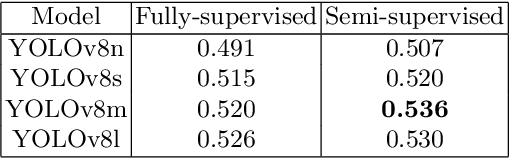
Coronary artery stenosis is a critical health risk, and its precise identification in Coronary Angiography (CAG) can significantly aid medical practitioners in accurately evaluating the severity of a patient's condition. The complexity of coronary artery structures combined with the inherent noise in X-ray images poses a considerable challenge to this task. To tackle these obstacles, we introduce a semi-supervised approach for cardiovascular stenosis segmentation. Our strategy begins with data augmentation, specifically tailored to replicate the structural characteristics of coronary arteries. We then apply a pseudo-label-based semi-supervised learning technique that leverages the data generated through our augmentation process. Impressively, our approach demonstrated an exceptional performance in the Automatic Region-based Coronary Artery Disease diagnostics using x-ray angiography imagEs (ARCADE) Stenosis Detection Algorithm challenge by utilizing a single model instead of relying on an ensemble of multiple models. This success emphasizes our method's capability and efficiency in providing an automated solution for accurately assessing stenosis severity from medical imaging data.