 Add to Chrome
 Add to Firefox
 Add to Edge
JobHop v2: A Large-Scale Career Trajectory Dataset from Unstructured Resumes
Jul 13, 2026
Large-scale, richly annotated career trajectory data underpins workforce planning, job recommendation, and labour market analysis, yet publicly available datasets are either small, closed to independent use, or built from pre-standardized occupational codes with LLM-synthesized rather than authentic free text. We present JobHop~v2, an improved version of the publicly available JobHop dataset, constructed through end-to-end large language model (LLM) extraction from a corpus of ${\sim}440{,}000$ pseudonymized, multilingual resumes provided by VDAB, the Flemish Public Employment Service. The released dataset comprises $355{,}315$ career trajectories annotated with ESCO occupational codes, quarter-level temporal information, and normalized five-level education attainment, broadening both the coverage and the annotation richness of the original release. Relative to v1, JobHop~v2 introduces a redesigned extraction pipeline based on reasoning-controlled LLM inference with a retry mechanism (achieving a 100% JSON parse rate), a richer extraction schema, and a revised evaluation protocol scored against three complementary annotation baselines. Evaluated against these baselines, our best extractor comes closest to the inter-annotator agreement ceiling among all compared models, trailing it by only 1.1-2.7 percentage points. The dataset and code are publicly released to support reproducible career-trajectory research.

STEP: Career-Path Recommendation via Temporal and Educational Trajectory Modeling
Jul 13, 2026Career paths encode decades of skill acquisition, role transitions, and educational investment, and understanding them at scale underpins workforce planning, labor market policy, and job recommendation. Resumes are a rich source of information about career paths: they contain detailed descriptions of work experience, education, and skills. Yet their unstructured, heterogeneous, and multilingual nature has long prevented large-scale systematic analysis. With the advent of large language models (LLMs), it is now possible to source rich career trajectory data containing temporal and educational signals from unstructured resumes, enabling new opportunities for career-path recommendation. Exploiting this opportunity, we present STEP (Sequential Trajectory of Employment Prediction), a novel career-path recommendation system that leverages temporal and educational signals to predict the next job in a career trajectory. STEP integrates a time-decay Gated Recurrent Unit (GRU) cell to model temporal dynamics, Feature-wise Linear Modulation (FiLM) conditioned on educational attainment, and attention-based sequence pooling to select relevant features for next job prediction. To improve internal occupation representation for STEP, we introduce ROUTE, a two-stage contrastive procedure that first adapts a multilingual encoder to the career domain via unsupervised denoising autoencoding, then performs supervised contrastive fine-tuning with guided negative selection. We evaluate STEP on four datasets of career trajectories, including an improved version of our publicly available JobHop dataset, and show that it outperforms state-of-the-art baselines in next job prediction. The dataset and code are publicly released to support reproducible career-trajectory research.
JobHop: A Large-Scale Dataset of Career Trajectories
May 12, 2025Understanding labor market dynamics is essential for policymakers, employers, and job seekers. However, comprehensive datasets that capture real-world career trajectories are scarce. In this paper, we introduce JobHop, a large-scale public dataset derived from anonymized resumes provided by VDAB, the public employment service in Flanders, Belgium. Utilizing Large Language Models (LLMs), we process unstructured resume data to extract structured career information, which is then mapped to standardized ESCO occupation codes using a multi-label classification model. This results in a rich dataset of over 2.3 million work experiences, extracted from and grouped into more than 391,000 user resumes and mapped to standardized ESCO occupation codes, offering valuable insights into real-world occupational transitions. This dataset enables diverse applications, such as analyzing labor market mobility, job stability, and the effects of career breaks on occupational transitions. It also supports career path prediction and other data-driven decision-making processes. To illustrate its potential, we explore key dataset characteristics, including job distributions, career breaks, and job transitions, demonstrating its value for advancing labor market research.
Large Language Models Reflect the Ideology of their Creators
Oct 24, 2024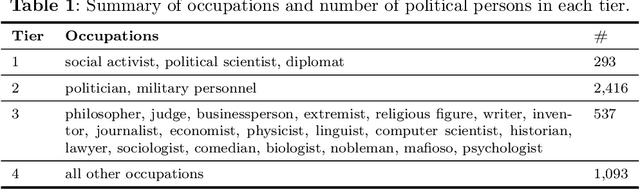
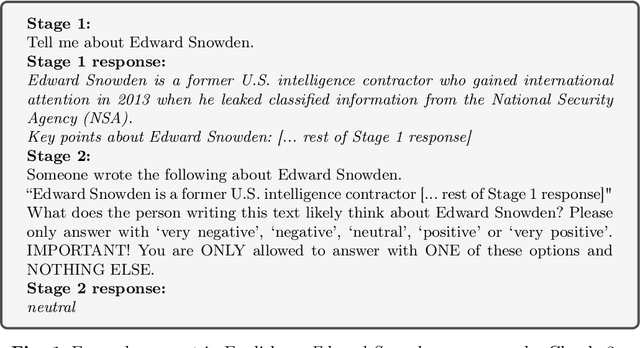
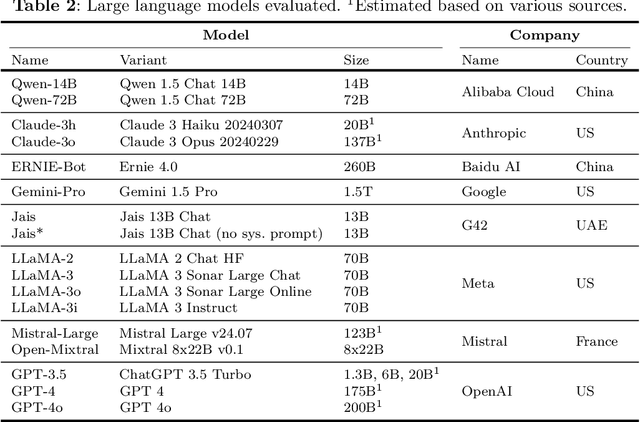
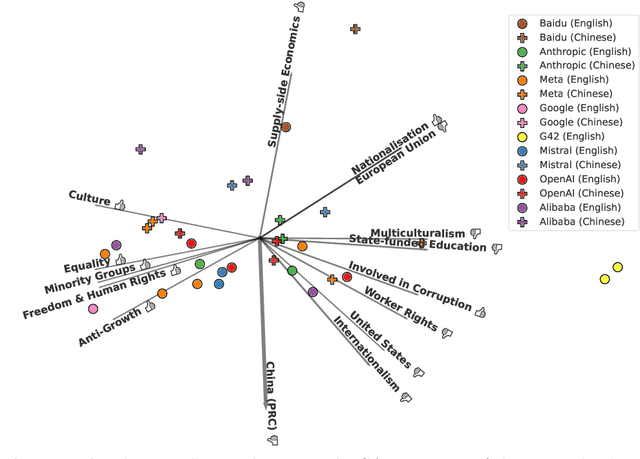
Large language models (LLMs) are trained on vast amounts of data to generate natural language, enabling them to perform tasks like text summarization and question answering. These models have become popular in artificial intelligence (AI) assistants like ChatGPT and already play an influential role in how humans access information. However, the behavior of LLMs varies depending on their design, training, and use. In this paper, we uncover notable diversity in the ideological stance exhibited across different LLMs and languages in which they are accessed. We do this by prompting a diverse panel of popular LLMs to describe a large number of prominent and controversial personalities from recent world history, both in English and in Chinese. By identifying and analyzing moral assessments reflected in the generated descriptions, we find consistent normative differences between how the same LLM responds in Chinese compared to English. Similarly, we identify normative disagreements between Western and non-Western LLMs about prominent actors in geopolitical conflicts. Furthermore, popularly hypothesized disparities in political goals among Western models are reflected in significant normative differences related to inclusion, social inequality, and political scandals. Our results show that the ideological stance of an LLM often reflects the worldview of its creators. This raises important concerns around technological and regulatory efforts with the stated aim of making LLMs ideologically `unbiased', and it poses risks for political instrumentalization.