 Add to Chrome
 Add to Firefox
 Add to Edge
DSP-SLAM++: A Unified Framework for Multi-Class, High-Fidelity Object SLAM in the Wild
Jun 24, 2026
Existing object-aware SLAM systems force a trade-off between real-time performance, multi-class support, and the generation of high-fidelity, semantically coherent object models. To address this trade-off, we present DSP-SLAM++, which extends the DSP-SLAM framework with an asynchronous mapping pipeline for real-time performance and dedicated sensor fusion adaptations for a monocular fisheye-LiDAR suite. Experiments demonstrate that our system generates fine-grained, geometrically-complete shapes for multiple object classes while eliminating severe mapping thread bottlenecks by reducing maximum object processing latency by up to 70\% compared to the state-of-the-art baseline, enabling robust, real-time performance on a challenging 25 Hz multi-class datasets. This work makes high-fidelity, multi-class object SLAM more practical for real-world applications like autonomous driving and robotic manipulation by enabling its use on platforms with common fisheye-LiDAR sensor setups. The open-source code is available at: [github.com/AUBVRL/DSP-SLAMpp].

MaskUno: Switch-Split Block For Enhancing Instance Segmentation
Jul 31, 2024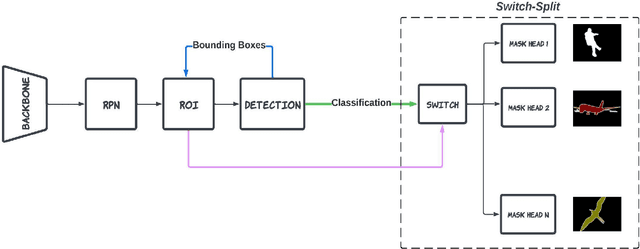
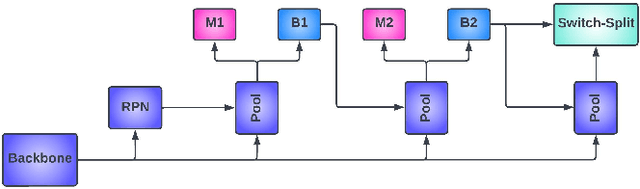
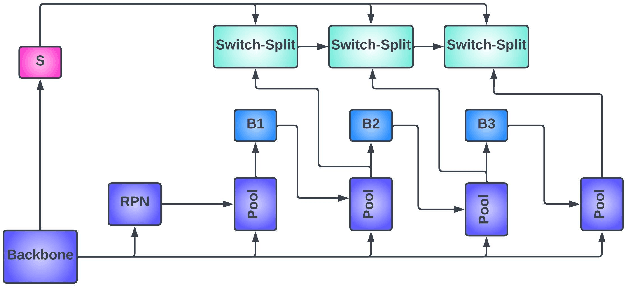
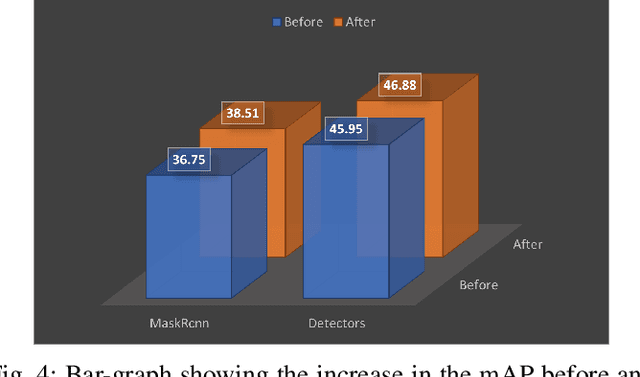
Instance segmentation is an advanced form of image segmentation which, beyond traditional segmentation, requires identifying individual instances of repeating objects in a scene. Mask R-CNN is the most common architecture for instance segmentation, and improvements to this architecture include steps such as benefiting from bounding box refinements, adding semantics, or backbone enhancements. In all the proposed variations to date, the problem of competing kernels (each class aims to maximize its own accuracy) persists when models try to synchronously learn numerous classes. In this paper, we propose mitigating this problem by replacing mask prediction with a Switch-Split block that processes refined ROIs, classifies them, and assigns them to specialized mask predictors. We name the method MaskUno and test it on various models from the literature, which are then trained on multiple classes using the benchmark COCO dataset. An increase in the mean Average Precision (mAP) of 2.03% was observed for the high-performing DetectoRS when trained on 80 classes. MaskUno proved to enhance the mAP of instance segmentation models regardless of the number and typ