 Add to Chrome
 Add to Firefox
 Add to Edge
Conceptors for Semantic Steering
May 06, 2026
Activation-based steering provides control of LLM behavior at inference time, but the dominant paradigm reduces each concept to a single direction whose geometry is left largely unexamined. Rather than selecting a single steering direction, we use conceptors: soft projection matrices estimated from activations pooled across both poles of a bipolar concept, which preserve the concept's full multidimensional subspace. A geometric analysis shows the bipolar subspace strictly subsumes the single-vector baseline. We further show that the conceptor quota provides a parameter-free layer-selection diagnostic, predicting concept separability with Pearson correlations up to r=0.96 across three instruction-tuned models and three semantic dimensions. Beyond selection, conceptors admit a closed-form Boolean algebra (AND, OR, NOT): we evaluate conceptor compositionality on thematically related sub-concepts. Across a systematic five-axis design-space evaluation, conceptors match or outperform additive baselines at layers where concept subspaces are multi-dimensional while producing substantially fewer degenerate outputs. Conceptor steering is a geometrically principled, compositional, and practically safer alternative to single-direction steering from a limited number of contrastive pairs.

Learning to Pay Attention: Unsupervised Modeling of Attentive and Inattentive Respondents in Survey Data
Mar 02, 2026The integrity of behavioral and social-science surveys depends on detecting inattentive respondents who provide random or low-effort answers. Traditional safeguards, such as attention checks, are often costly, reactive, and inconsistent. We propose a unified, label-free framework for inattentiveness detection that scores response coherence using complementary unsupervised views: geometric reconstruction (Autoencoders) and probabilistic dependency modeling (Chow-Liu trees). While we introduce a "Percentile Loss" objective to improve Autoencoder robustness against anomalies, our primary contribution is identifying the structural conditions that enable unsupervised quality control. Across nine heterogeneous real-world datasets, we find that detection effectiveness is driven less by model complexity than by survey structure: instruments with coherent, overlapping item batteries exhibit strong covariance patterns that allow even linear models to reliably separate attentive from inattentive respondents. This reveals a critical ``Psychometric-ML Alignment'': the same design principles that maximize measurement reliability (e.g., internal consistency) also maximize algorithmic detectability. The framework provides survey platforms with a scalable, domain-agnostic diagnostic tool that links data quality directly to instrument design, enabling auditing without additional respondent burden.
Interpreting and Mitigating Unwanted Uncertainty in LLMs
Oct 26, 2025Despite their impressive capabilities, Large Language Models (LLMs) exhibit unwanted uncertainty, a phenomenon where a model changes a previously correct answer into an incorrect one when re-prompted. This behavior undermines trust and poses serious risks in high-stakes domains. In this work, we investigate the mechanisms that drive this phenomenon. We adapt the Needle-in-a-Haystack retrieval framework and integrate a Flip-style re-evaluation prompt to simulate realistic answer-flipping scenarios. We find that retrieval heads are not primarily responsible for avoiding uncertainty. Instead, we identify a small set of non-retrieval attention heads that disproportionately attend to misleading tokens in uncertain contexts. Masking these heads yields significant improvements, reducing flip behavior by up to 15% without introducing incoherence or overcorrection. However, when tested for downstream tasks, we observe trade-offs with flip behavior. Our findings contribute to the growing field of mechanistic interpretability and present a simple yet effective technique for mitigating uncertainty-driven failure modes in LLMs.
Depression detection in social media posts using affective and social norm features
Mar 24, 2023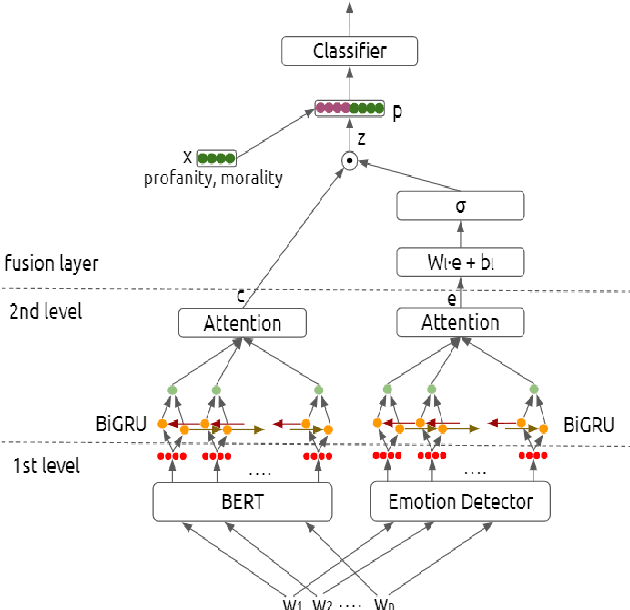
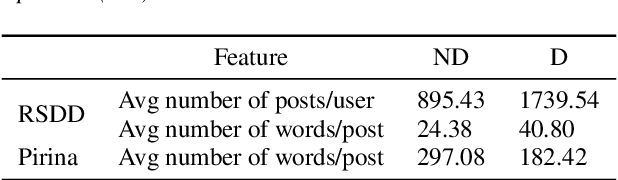

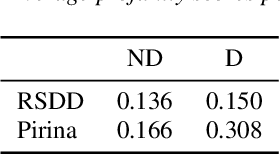
We propose a deep architecture for depression detection from social media posts. The proposed architecture builds upon BERT to extract language representations from social media posts and combines these representations using an attentive bidirectional GRU network. We incorporate affective information, by augmenting the text representations with features extracted from a pretrained emotion classifier. Motivated by psychological literature we propose to incorporate profanity and morality features of posts and words in our architecture using a late fusion scheme. Our analysis indicates that morality and profanity can be important features for depression detection. We apply our model for depression detection on Reddit posts on the Pirina dataset, and further consider the setting of detecting depressed users, given multiple posts per user, proposed in the Reddit RSDD dataset. The inclusion of the proposed features yields state-of-the-art results in both settings, namely 2.65% and 6.73% absolute improvement in F1 score respectively. Index Terms: Depression detection, BERT, Feature fusion, Emotion recognition, profanity, morality