 Add to Chrome
 Add to Firefox
 Add to Edge
Integrated Altruistic and Fairness Preference Induces Advanced Mutual Cooperation in Sequential Social Dilemmas
Jul 06, 2026
Inducing cooperation among distributed agents is still a difficult problem in the field of multi-agent reinforcement learning (MARL), particularly in social dilemma situations. There, individual interests are misaligned with the common good and individual rationality leads to suboptimal group outcomes. In contrast, humans are able to achieve cooperation with one another in such situations. A common explanation for such cooperative behavior is that individuals have social preferences. In order to achieve cooperation in MARL, we design a new utility function integrating altruistic preferences (incentive for other's reward) and fairness preferences (incentive for equality) from social psychology and behavioral economics, namely, Altruistic and Fairness Preference (AFP), a reward-sharing mechanism which converts one's own and other's rewards to incentives for cooperative behavior. We performed comparative experiments with standard RL and inequity aversion agents in two challenging sequential social dilemma games, and showed that AFP agents successfully achieved mutual cooperation with more collective rewards and higher equity than the baselines. To further understand the progression of AFP during training, we subsequently explore the effects of altruistic preferences and fairness preferences on agents' behavior. The results suggest that altruistic preferences encourage agents to contribute to the public goods, and fairness preferences induce mutual behavior between agents.

A unified strategy for implementing curiosity and empowerment driven reinforcement learning
Jun 18, 2018
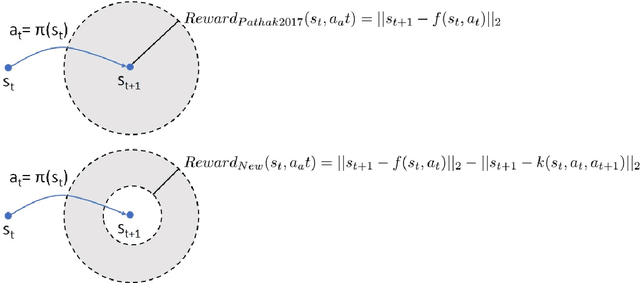
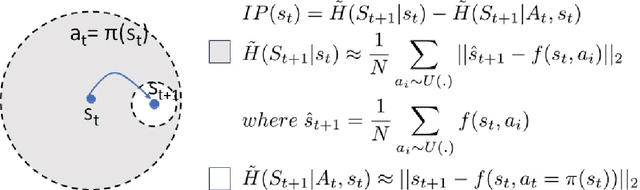
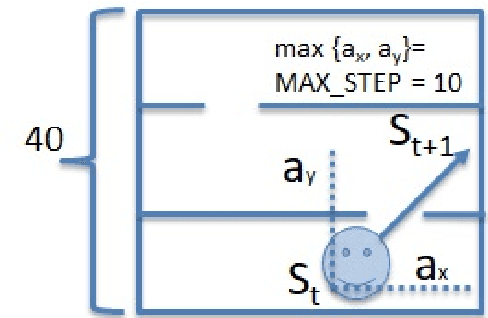
Although there are many approaches to implement intrinsically motivated artificial agents, the combined usage of multiple intrinsic drives remains still a relatively unexplored research area. Specifically, we hypothesize that a mechanism capable of quantifying and controlling the evolution of the information flow between the agent and the environment could be the fundamental component for implementing a higher degree of autonomy into artificial intelligent agents. This paper propose a unified strategy for implementing two semantically orthogonal intrinsic motivations: curiosity and empowerment. Curiosity reward informs the agent about the relevance of a recent agent action, whereas empowerment is implemented as the opposite information flow from the agent to the environment that quantifies the agent's potential of controlling its own future. We show that an additional homeostatic drive is derived from the curiosity reward, which generalizes and enhances the information gain of a classical curious/heterostatic reinforcement learning agent. We show how a shared internal model by curiosity and empowerment facilitates a more efficient training of the empowerment function. Finally, we discuss future directions for further leveraging the interplay between these two intrinsic rewards.
Curiosity-driven reinforcement learning with homeostatic regulation
Feb 07, 2018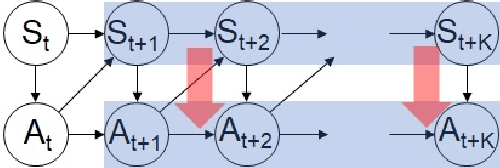
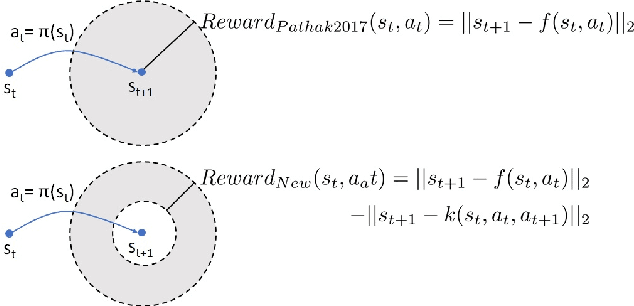
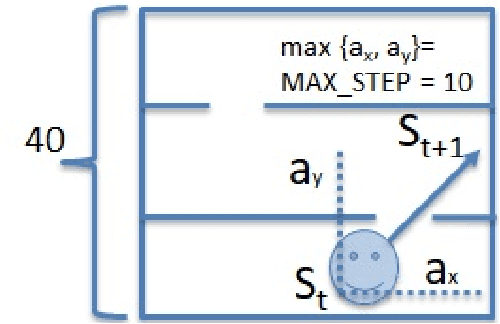
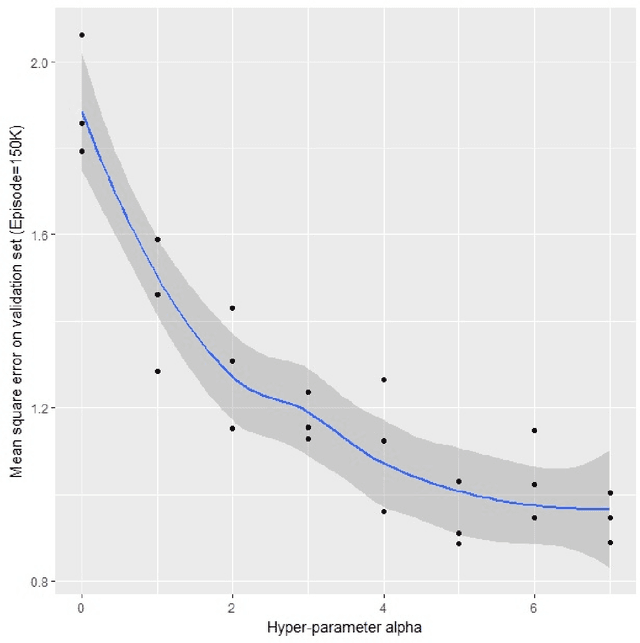
We propose a curiosity reward based on information theory principles and consistent with the animal instinct to maintain certain critical parameters within a bounded range. Our experimental validation shows the added value of the additional homeostatic drive to enhance the overall information gain of a reinforcement learning agent interacting with a complex environment using continuous actions. Our method builds upon two ideas: i) To take advantage of a new Bellman-like equation of information gain and ii) to simplify the computation of the local rewards by avoiding the approximation of complex distributions over continuous states and actions.