 Add to Chrome
 Add to Firefox
 Add to Edge
Linearly Constrained Deep Beamformer for Multi-Speaker Scenarios
May 20, 2026
We propose a deep beamforming framework for enhancing target speaker(s) in multi-speaker environments. A deep neural network (DNN) is trained to estimate beamforming weights directly from noisy multichannel inputs while satisfying linear spatial constraints through an adaptive multi-term loss inspired by the augmented Lagrangian framework. The loss combines signal reconstruction with penalties that enforce a distortionless response toward the target and suppress the interference subspace. The model is further guided by the target relative transfer function (RTF) and the estimated interference subspace. The proposed model can direct a beam toward the target speaker while directing nulls toward the interfering sources, achieving superior overall enhancement performance compared with the classical LCMV beamformer constructed by the same estimated spatial signatures. Furthermore, compared with the LCMV beamformer, the proposed model produces more controlled sidelobes and improved background-noise attenuation.

A Study of Binaural Deep Beamforming With Interpretable Beampatterns Guided by Time-Varying RTF
Nov 13, 2025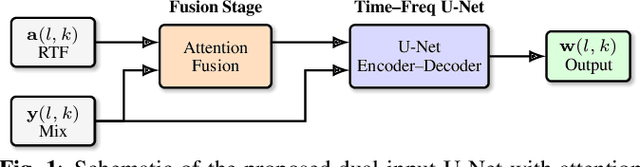
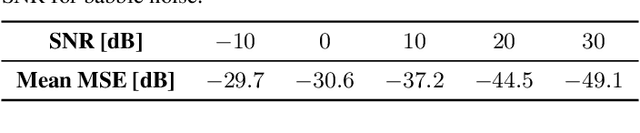
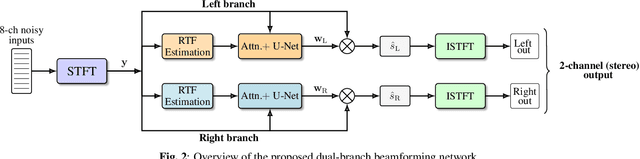
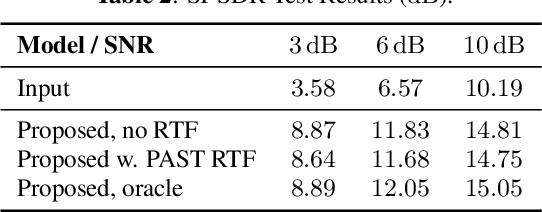
In this work, a deep beamforming framework for speech enhancement in dynamic acoustic environments is studied. The time-varying beamformer weights are estimated from the noisy multichannel signals by minimizing an SI-SDR loss. The estimation is guided by the continuously tracked relative transfer functions (RTFs) of the moving target speaker. The spatial behavior of the network is evaluated through both narrowband and wideband beampatterns under three settings: (i) oracle guidance using true RTFs, (ii) estimated RTFs obtained by a subspace tracking method, and (iii) without the RTF guidance. Results show that RTF-guided models produce smoother, spatially consistent beampatterns that accurately track the target's direction of arrival. In contrast, the model fails to maintain a clear spatial focus when guidance is absent. Using the estimated RTFs as guidance closely matches the oracle RTF behavior, confirming the effectiveness of the tracking scheme. The model also outputs a binaural signal to preserve the speaker's spatial cues, which promotes hearing aid and hearables applications.