 Add to Chrome
 Add to Firefox
 Add to Edge
Multi-Agent Debate and Visual Information Extraction for SeePhys Pro: A 1st-Place Technical Report from ICML 2026 AI4Math Track 3 Challenge
Jul 24, 2026
This technical report presents our approach to Challenge Track~3: SeePhys Pro at the 3rd AI for Math Workshop, where the task is to answer college-level physics questions whose statement and figure may be given partly or entirely as an image. Visual physics problems become substantially harder for large language models when the decisive information resides in a figure rather than in the text, and this modality gap widens as more of the problem migrates into the image. We address the task with a two-stage framework: a visual information extraction stage that re-expresses figure content as solver-readable text to close the modality gap, and a reasoning stage that orchestrates three heterogeneous solvers through multi-agent debate. Our analysis yields two findings: the gain from orchestration comes from reliable answer selection rather than from additional debate, and the value of a figure aid scales with how much of the problem is locked inside the image. The resulting pipeline improves overall accuracy over a single-agent baseline from 0.643 to 0.802 on the public split, and won 1st place on both the public and the private leaderboard (private overall 0.743).

Prompt-Based Safety Guidance Is Ineffective for Unlearned Text-to-Image Diffusion Models
Nov 06, 2025Recent advances in text-to-image generative models have raised concerns about their potential to produce harmful content when provided with malicious input text prompts. To address this issue, two main approaches have emerged: (1) fine-tuning the model to unlearn harmful concepts and (2) training-free guidance methods that leverage negative prompts. However, we observe that combining these two orthogonal approaches often leads to marginal or even degraded defense performance. This observation indicates a critical incompatibility between two paradigms, which hinders their combined effectiveness. In this work, we address this issue by proposing a conceptually simple yet experimentally robust method: replacing the negative prompts used in training-free methods with implicit negative embeddings obtained through concept inversion. Our method requires no modification to either approach and can be easily integrated into existing pipelines. We experimentally validate its effectiveness on nudity and violence benchmarks, demonstrating consistent improvements in defense success rate while preserving the core semantics of input prompts.
Efficient Episodic Memory Utilization of Cooperative Multi-Agent Reinforcement Learning
Mar 07, 2024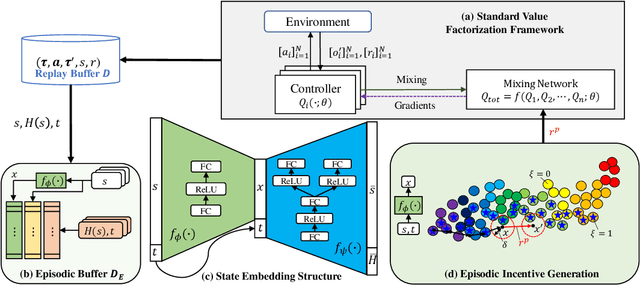
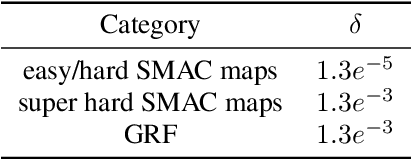
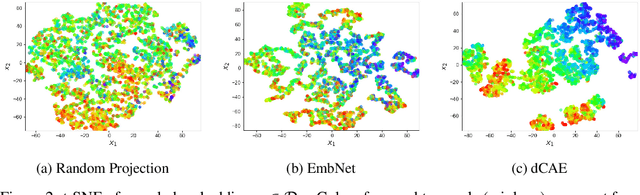
In cooperative multi-agent reinforcement learning (MARL), agents aim to achieve a common goal, such as defeating enemies or scoring a goal. Existing MARL algorithms are effective but still require significant learning time and often get trapped in local optima by complex tasks, subsequently failing to discover a goal-reaching policy. To address this, we introduce Efficient episodic Memory Utilization (EMU) for MARL, with two primary objectives: (a) accelerating reinforcement learning by leveraging semantically coherent memory from an episodic buffer and (b) selectively promoting desirable transitions to prevent local convergence. To achieve (a), EMU incorporates a trainable encoder/decoder structure alongside MARL, creating coherent memory embeddings that facilitate exploratory memory recall. To achieve (b), EMU introduces a novel reward structure called episodic incentive based on the desirability of states. This reward improves the TD target in Q-learning and acts as an additional incentive for desirable transitions. We provide theoretical support for the proposed incentive and demonstrate the effectiveness of EMU compared to conventional episodic control. The proposed method is evaluated in StarCraft II and Google Research Football, and empirical results indicate further performance improvement over state-of-the-art methods.