 Add to Chrome
 Add to Firefox
 Add to Edge
Applications of Intuitionistic Temporal Logic to Temporal Answer Set Programming
Mar 16, 2026
The relationship between intuitionistic or intermediate logics and logic programming has been extensively studied, prominently featuring Pearce's equilibrium logic and Osorio's safe beliefs. Equilibrium logic admits a fixpoint characterization based on the logic of here-and-there, akin to theory completion in default and autoepistemic logics. Safe beliefs are similarly defined via a fixpoint operator, albeit under the semantics of intuitionistic or other intermediate logics. In this paper, we investigate the logical foundations of Temporal Answer Set Programming through the lens of Temporal Equilibrium Logic, a formalism combining equilibrium logic with linear-time temporal operators. We lift the seminal approaches of Pearce and Osorio to the temporal setting, establishing a formal correspondence between temporal intuitionistic logic and temporal logic programming. Our results deepen the theoretical underpinnings of Temporal Answer Set Programming and provide new avenues for research in temporal reasoning.

Quantified Constraint Handling Rules
Sep 18, 2019


We shift the QCSP (Quantified Constraint Satisfaction Problems) framework to the QCHR (Quantified Constraint Handling Rules) framework by enabling dynamic binder and access to user-defined constraints. QCSP offers a natural framework to express PSPACE problems as finite two-players games. But to define a QCSP model, the binder must be formerly known and cannot be built dynamically even if the worst case won't occur. To overcome this issue, we define the new QCHR formalism that allows to build the binder dynamically during the solving. Our QCHR models exhibit state-of-the-art performances on static binder and outperforms previous QCSP approaches when the binder is dynamic.
* In Proceedings ICLP 2019, arXiv:1909.07646
ASPeRiX, a First Order Forward Chaining Approach for Answer Set Computing
Nov 16, 2016
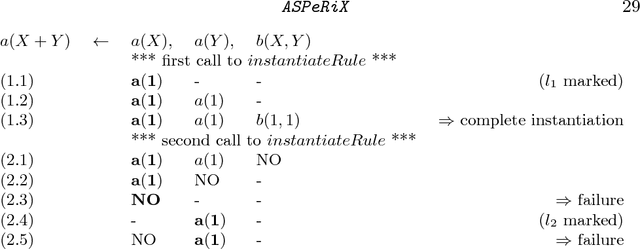

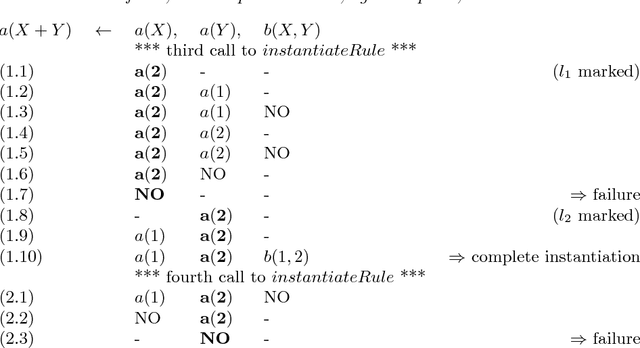
The natural way to use Answer Set Programming (ASP) to represent knowledge in Artificial Intelligence or to solve a combinatorial problem is to elaborate a first order logic program with default negation. In a preliminary step this program with variables is translated in an equivalent propositional one by a first tool: the grounder. Then, the propositional program is given to a second tool: the solver. This last one computes (if they exist) one or many answer sets (stable models) of the program, each answer set encoding one solution of the initial problem. Until today, almost all ASP systems apply this two steps computation. In this article, the project ASPeRiX is presented as a first order forward chaining approach for Answer Set Computing. This project was amongst the first to introduce an approach of answer set computing that escapes the preliminary phase of rule instantiation by integrating it in the search process. The methodology applies a forward chaining of first order rules that are grounded on the fly by means of previously produced atoms. Theoretical foundations of the approach are presented, the main algorithms of the ASP solver ASPeRiX are detailed and some experiments and comparisons with existing systems are provided.