 Add to Chrome
 Add to Firefox
 Add to Edge
Pre-Training for Simulation-Based Science: A Study on Jet Foundation Model Training Objectives
Jun 12, 2026
Foundation models (FMs) trained on large datasets and fine-tuned on downstream tasks have emerged as a powerful paradigm in AI for science. Industrial FMs are typically trained using self-supervision with masking due to the lack of labels. In many scientific domains, accurate simulations are plentiful and facilitate large, labeled datasets. This opens up new possibilities for pre-training. We present a systematic comparison of pre-training methods using the OmniLearned High Energy Physics FM framework. We test supervised classification, flow-matching generation, and self-supervised masked particle modeling. All models are pre-trained on the JetClass dataset and fine-tuned on two representative downstream tasks, top jet classification and JetNet conditional generation. Among other observations, for classification tasks, we find that pure classifier pre-training is optimal when downstream labels and model capacity are plentiful, but combining it with self-supervised masked particle modeling (MPM) is uniquely powerful in the low-finetuning label regime. Flow matching-based generative pre-training seems to provide little benefit for downstream classification, and interestingly, for downstream generation, we find that flow matching must be in the pre-training objective to see a significant finetuning advantage, hinting at the orthogonality of classification and generation tasks. That is, for a model to transfer to both generative and classification downstream tasks, it must be pre-trained on both. This study provides a template for controlled scaling analysis of pre-training objectives for foundation models in simulation-based sciences.

FAIR Universe Weak Lensing ML Uncertainty Challenge: Handling Uncertainties and Distribution Shifts for Precision Cosmology
Apr 15, 2026Weak gravitational lensing, the correlated distortion of background galaxy shapes by foreground structures, is a powerful probe of the matter distribution in our universe and allows accurate constraints on the cosmological model. In recent years, high-order statistics and machine learning (ML) techniques have been applied to weak lensing data to extract the nonlinear information beyond traditional two-point analysis. However, these methods typically rely on cosmological simulations, which poses several challenges: simulations are computationally expensive, limiting most realistic setups to a low training data regime; inaccurate modeling of systematics in the simulations create distribution shifts that can bias cosmological parameter constraints; and varying simulation setups across studies make method comparison difficult. To address these difficulties, we present the first weak lensing benchmark dataset with several realistic systematics and launch the FAIR Universe Weak Lensing Machine Learning Uncertainty Challenge. The challenge focuses on measuring the fundamental properties of the universe from weak lensing data with limited training set and potential distribution shifts, while providing a standardized benchmark for rigorous comparison across methods. Organized in two phases, the challenge will bring together the physics and ML communities to advance the methodologies for handling systematic uncertainties, data efficiency, and distribution shifts in weak lensing analysis with ML, ultimately facilitating the deployment of ML approaches into upcoming weak lensing survey analysis.
Generative models on phase space
Apr 02, 2026Deep generative models such as diffusion and flow matching are powerful machine learning tools capable of learning and sampling from high-dimensional distributions. They are particularly useful when the training data appears to be concentrated on a submanifold of the data embedding space. For high-energy physics data, consisting of collections of relativistic energy-momentum 4-vectors, this submanifold can enforce extremely strong physically-motivated priors, such as energy and momentum conservation. If these constraints are learned only approximately, rather than exactly, this can inhibit the interpretability and reliability of such generative models. To remedy this deficiency, we introduce generative models which are, by construction, confined at every step of their sampling trajectory to the manifold of massless N-particle Lorentz-invariant phase space in the center-of-momentum frame. In the case of diffusion models, the "pure noise" forward process endpoint corresponds to the uniform distribution on phase space, which provides a clear starting point from which to identify how correlations among the particles emerge during the reverse (de-noising) process. We demonstrate that our models are able to learn both few-particle and many-particle distributions with various singularity structures, paving the way for future interpretability studies using generative models trained on simulated jet data.
Contrastive Normalizing Flows for Uncertainty-Aware Parameter Estimation
May 13, 2025Estimating physical parameters from data is a crucial application of machine learning (ML) in the physical sciences. However, systematic uncertainties, such as detector miscalibration, induce data distribution distortions that can erode statistical precision. In both high-energy physics (HEP) and broader ML contexts, achieving uncertainty-aware parameter estimation under these domain shifts remains an open problem. In this work, we address this challenge of uncertainty-aware parameter estimation for a broad set of tasks critical for HEP. We introduce a novel approach based on Contrastive Normalizing Flows (CNFs), which achieves top performance on the HiggsML Uncertainty Challenge dataset. Building on the insight that a binary classifier can approximate the model parameter likelihood ratio, we address the practical limitations of expressivity and the high cost of simulating high-dimensional parameter grids by embedding data and parameters in a learned CNF mapping. This mapping yields a tunable contrastive distribution that enables robust classification under shifted data distributions. Through a combination of theoretical analysis and empirical evaluations, we demonstrate that CNFs, when coupled with a classifier and established frequentist techniques, provide principled parameter estimation and uncertainty quantification through classification that is robust to data distribution distortions.
Uncertainty Quantification From Scaling Laws in Deep Neural Networks
Mar 07, 2025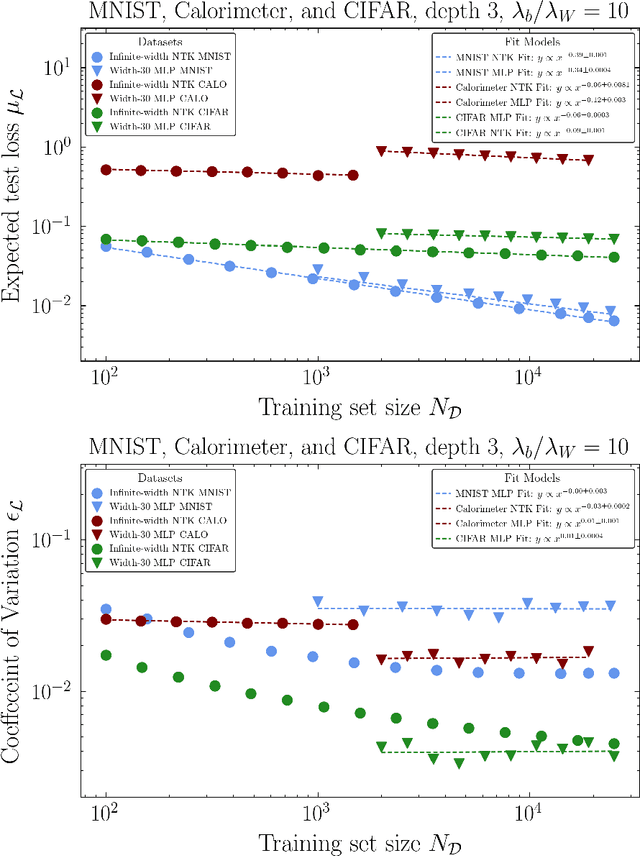
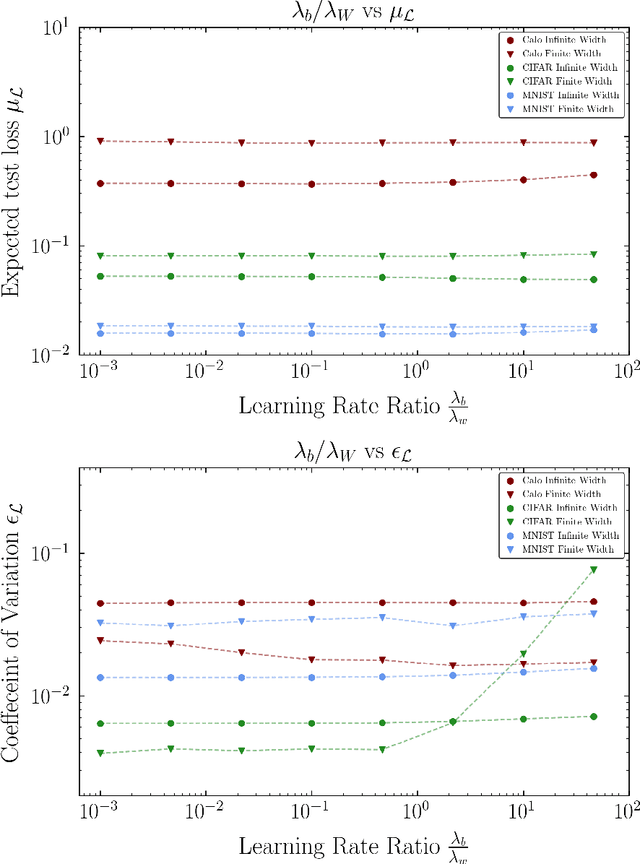
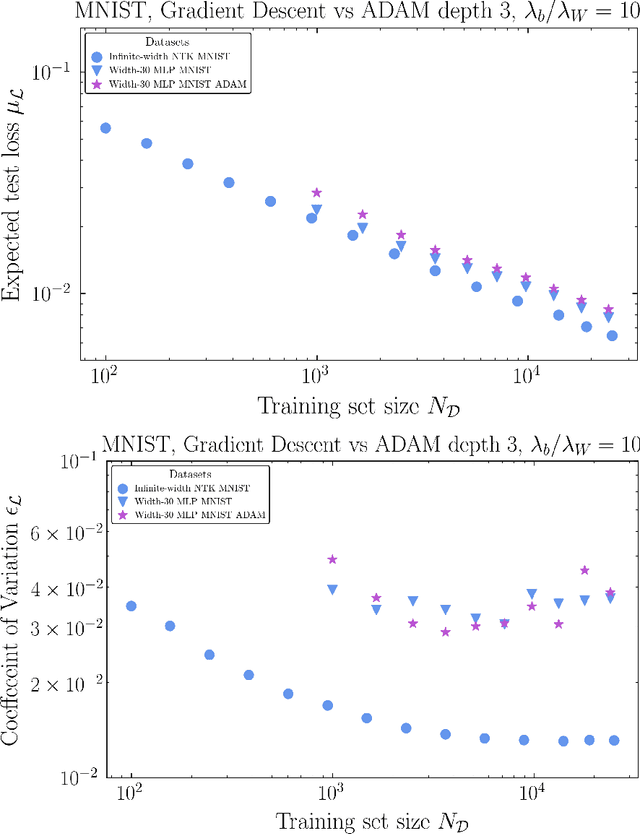
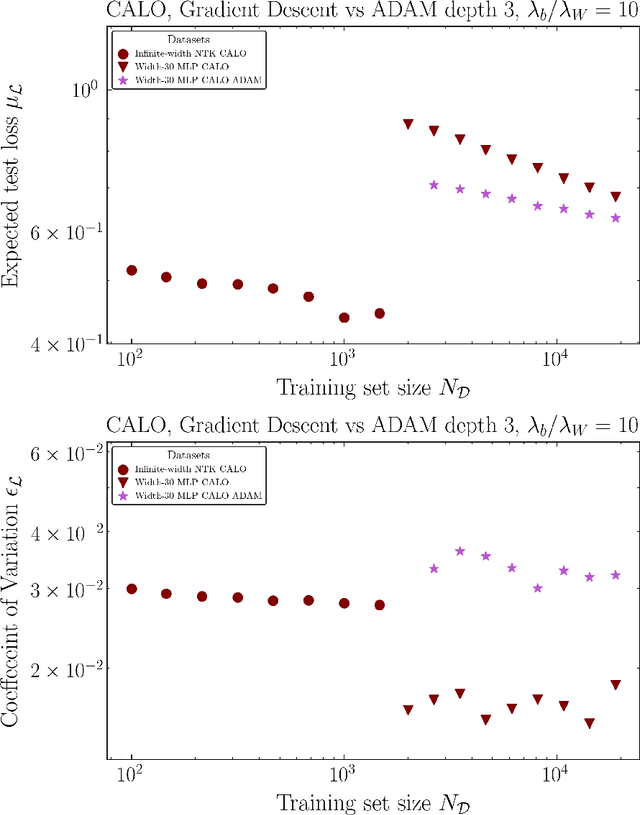
Quantifying the uncertainty from machine learning analyses is critical to their use in the physical sciences. In this work we focus on uncertainty inherited from the initialization distribution of neural networks. We compute the mean $\mu_{\mathcal{L}}$ and variance $\sigma_{\mathcal{L}}^2$ of the test loss $\mathcal{L}$ for an ensemble of multi-layer perceptrons (MLPs) with neural tangent kernel (NTK) initialization in the infinite-width limit, and compare empirically to the results from finite-width networks for three example tasks: MNIST classification, CIFAR classification and calorimeter energy regression. We observe scaling laws as a function of training set size $N_\mathcal{D}$ for both $\mu_{\mathcal{L}}$ and $\sigma_{\mathcal{L}}$, but find that the coefficient of variation $\epsilon_{\mathcal{L}} \equiv \sigma_{\mathcal{L}}/\mu_{\mathcal{L}}$ becomes independent of $N_\mathcal{D}$ at both infinite and finite width for sufficiently large $N_\mathcal{D}$. This implies that the coefficient of variation of a finite-width network may be approximated by its infinite-width value, and may in principle be calculable using finite-width perturbation theory.