 Add to Chrome
 Add to Firefox
 Add to Edge
Understanding Dynamic Compute Allocation in Recurrent Transformers
Feb 09, 2026
Token-level adaptive computation seeks to reduce inference cost by allocating more computation to harder tokens and less to easier ones. However, prior work is primarily evaluated on natural-language benchmarks using task-level metrics, where token-level difficulty is unobservable and confounded with architectural factors, making it unclear whether compute allocation truly aligns with underlying complexity. We address this gap through three contributions. First, we introduce a complexity-controlled evaluation paradigm using algorithmic and synthetic language tasks with parameterized difficulty, enabling direct testing of token-level compute allocation. Second, we propose ANIRA, a unified recurrent Transformer framework that supports per-token variable-depth computation while isolating compute allocation decisions from other model factors. Third, we use this framework to conduct a systematic analysis of token-level adaptive computation across alignment with complexity, generalization, and decision timing. Our results show that compute allocation aligned with task complexity can emerge without explicit difficulty supervision, but such alignment does not imply algorithmic generalization: models fail to extrapolate to unseen input sizes despite allocating additional computation. We further find that early compute decisions rely on static structural cues, whereas online halting more closely tracks algorithmic execution state.

MT-Ranker: Reference-free machine translation evaluation by inter-system ranking
Jan 30, 2024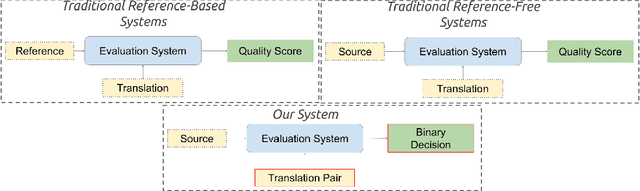
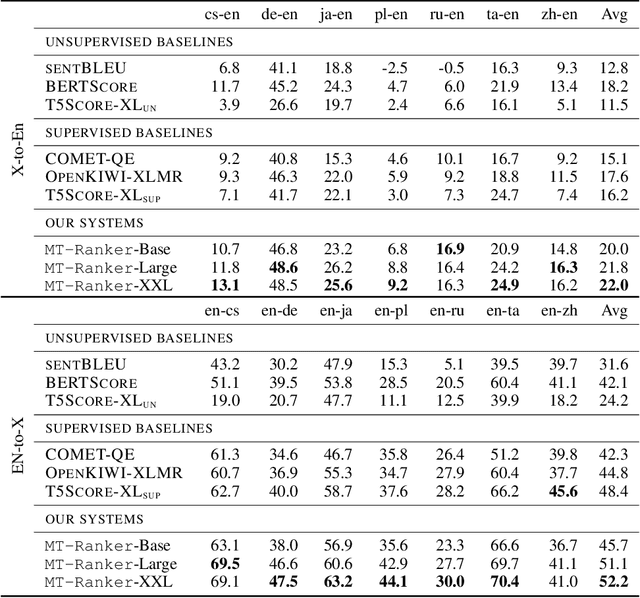
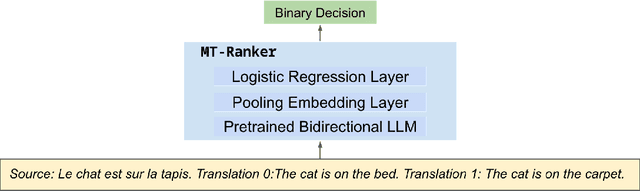
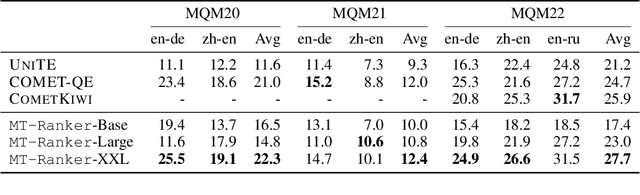
Traditionally, Machine Translation (MT) Evaluation has been treated as a regression problem -- producing an absolute translation-quality score. This approach has two limitations: i) the scores lack interpretability, and human annotators struggle with giving consistent scores; ii) most scoring methods are based on (reference, translation) pairs, limiting their applicability in real-world scenarios where references are absent. In practice, we often care about whether a new MT system is better or worse than some competitors. In addition, reference-free MT evaluation is increasingly practical and necessary. Unfortunately, these two practical considerations have yet to be jointly explored. In this work, we formulate the reference-free MT evaluation into a pairwise ranking problem. Given the source sentence and a pair of translations, our system predicts which translation is better. In addition to proposing this new formulation, we further show that this new paradigm can demonstrate superior correlation with human judgments by merely using indirect supervision from natural language inference and weak supervision from our synthetic data. In the context of reference-free evaluation, MT-Ranker, trained without any human annotations, achieves state-of-the-art results on the WMT Shared Metrics Task benchmarks DARR20, MQM20, and MQM21. On a more challenging benchmark, ACES, which contains fine-grained evaluation criteria such as addition, omission, and mistranslation errors, MT-Ranker marks state-of-the-art against reference-free as well as reference-based baselines.
Does Transliteration Help Multilingual Language Modeling?
Jan 29, 2022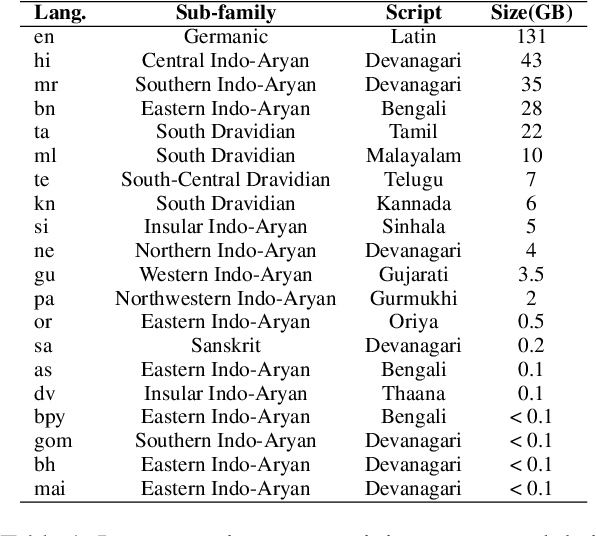
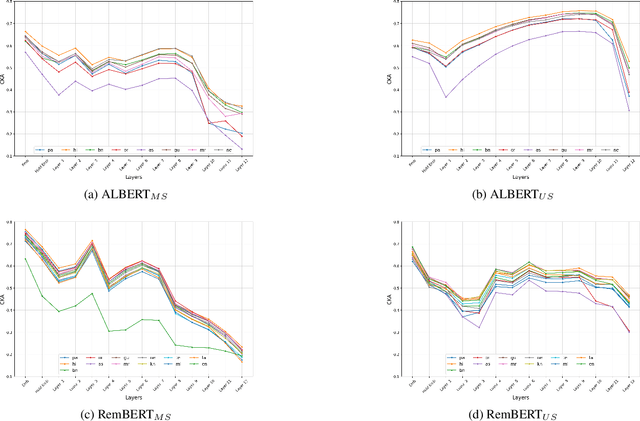
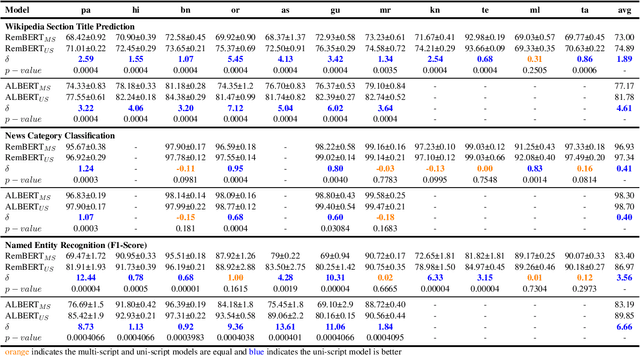
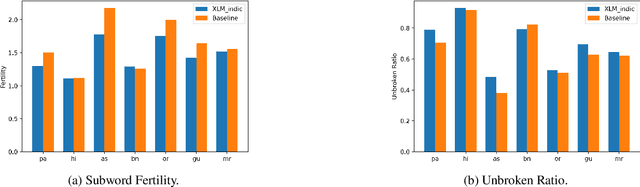
As there is a scarcity of large representative corpora for most languages, it is important for Multilingual Language Models (MLLM) to extract the most out of existing corpora. In this regard, script diversity presents a challenge to MLLMs by reducing lexical overlap among closely related languages. Therefore, transliterating closely related languages that use different writing scripts to a common script may improve the downstream task performance of MLLMs. In this paper, we pretrain two ALBERT models to empirically measure the effect of transliteration on MLLMs. We specifically focus on the Indo-Aryan language family, which has the highest script diversity in the world. Afterward, we evaluate our models on the IndicGLUE benchmark. We perform Mann-Whitney U test to rigorously verify whether the effect of transliteration is significant or not. We find that transliteration benefits the low-resource languages without negatively affecting the comparatively high-resource languages. We also measure the cross-lingual representation similarity (CLRS) of the models using centered kernel alignment (CKA) on parallel sentences of eight languages from the FLORES-101 dataset. We find that the hidden representations of the transliteration-based model have higher and more stable CLRS scores. Our code is available at Github (github.com/ibraheem-moosa/XLM-Indic) and Hugging Face Hub (huggingface.co/ibraheemmoosa/xlmindic-base-multiscript and huggingface.co/ibraheemmoosa/xlmindic-base-uniscript).