 Add to Chrome
 Add to Firefox
 Add to Edge
Manifold-Guided Attention Steering
May 20, 2026
Large language models frequently produce errors in reasoning tasks despite possessing the underlying knowledge required for correct reasoning. One possible approach to improve reasoning consistency is through activation steering. However, existing activation steering approaches apply fixed, pre-computed correction vectors, ignoring where the model currently sits along its generation trajectory; the result is indiscriminate perturbation that disrupts already-correct steps as freely as erroneous ones. We propose Manifold-Guided Attention Steering (MAGS), a trajectory-aware inference-time intervention grounded in a geometric observation: the output activations of specific attention heads diverge from a low-dimensional correctness manifold at the point of error, and this deviation compounds through subsequent steps. For each identified attention head, we learn a low-dimensional subspace from contrastive pairs of correct and incorrect traces that capture the directions along which error behavior deviates from correct behavior. During inference, we monitor each head's proximity to this manifold and apply a targeted projection correction when deviation exceeds a learned threshold, steering the attention output back toward the correct subspace before the error propagates. MAGS consistently outperforms both unsteered baselines and static steering approaches across benchmarks spanning mathematical reasoning (MATH-500, GSM8K), code generation (HumanEval, MBPP), and molecular generation (SMILES), suggesting that correctness manifolds are a general feature of LLM attention geometry.

Boundless: Generating Photorealistic Synthetic Data for Object Detection in Urban Streetscapes
Sep 04, 2024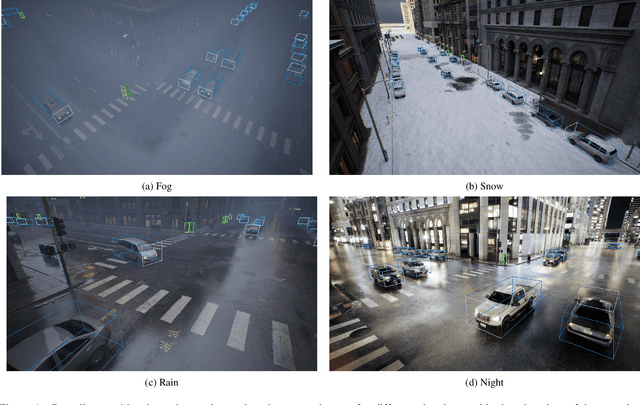
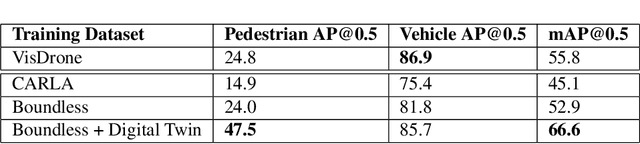
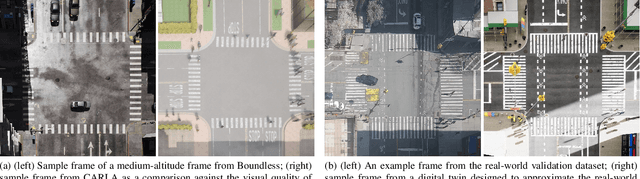
We introduce Boundless, a photo-realistic synthetic data generation system for enabling highly accurate object detection in dense urban streetscapes. Boundless can replace massive real-world data collection and manual ground-truth object annotation (labeling) with an automated and configurable process. Boundless is based on the Unreal Engine 5 (UE5) City Sample project with improvements enabling accurate collection of 3D bounding boxes across different lighting and scene variability conditions. We evaluate the performance of object detection models trained on the dataset generated by Boundless when used for inference on a real-world dataset acquired from medium-altitude cameras. We compare the performance of the Boundless-trained model against the CARLA-trained model and observe an improvement of 7.8 mAP. The results we achieved support the premise that synthetic data generation is a credible methodology for training/fine-tuning scalable object detection models for urban scenes.