 Add to Chrome
 Add to Firefox
 Add to Edge
A Proper Scoring Rule for Virtual Staining
Feb 26, 2026
Generative virtual staining (VS) models for high-throughput screening (HTS) can provide an estimated posterior distribution of possible biological feature values for each input and cell. However, when evaluating a VS model, the true posterior is unavailable. Existing evaluation protocols only check the accuracy of the marginal distribution over the dataset rather than the predicted posteriors. We introduce information gain (IG) as a cell-wise evaluation framework that enables direct assessment of predicted posteriors. IG is a strictly proper scoring rule and comes with a sound theoretical motivation allowing for interpretability, and for comparing results across models and features. We evaluate diffusion- and GAN-based models on an extensive HTS dataset using IG and other metrics and show that IG can reveal substantial performance differences other metrics cannot.

Can virtual staining for high-throughput screening generalize?
Jul 09, 2024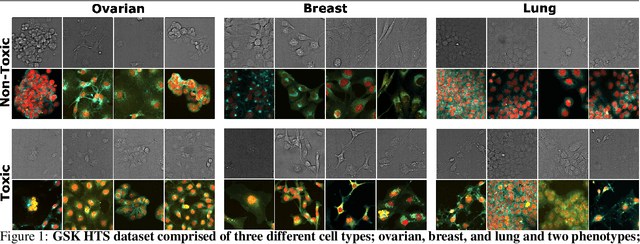
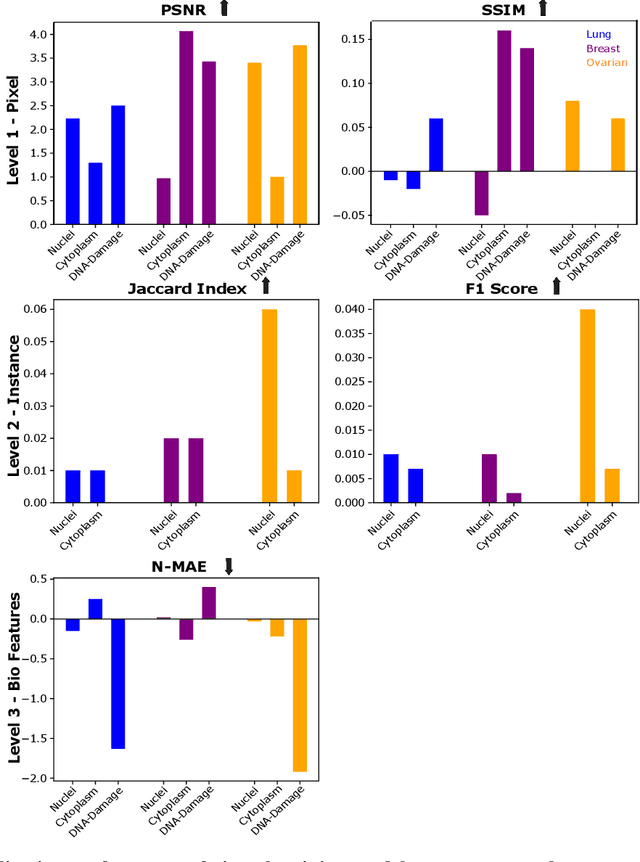
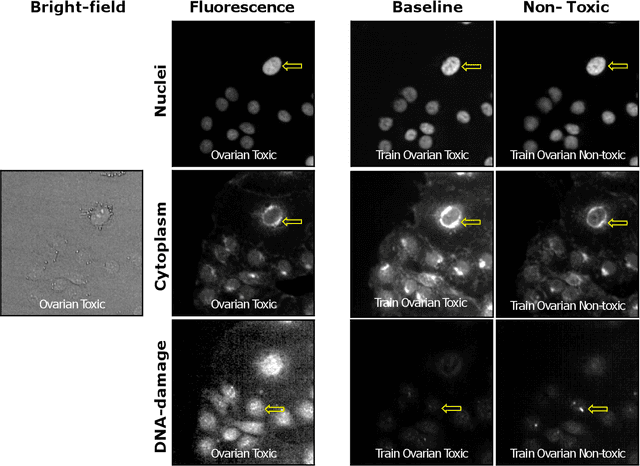
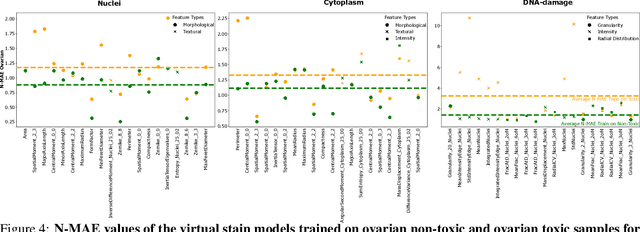
The large volume and variety of imaging data from high-throughput screening (HTS) in the pharmaceutical industry present an excellent resource for training virtual staining models. However, the potential of models trained under one set of experimental conditions to generalize to other conditions remains underexplored. This study systematically investigates whether data from three cell types (lung, ovarian, and breast) and two phenotypes (toxic and non-toxic conditions) commonly found in HTS can effectively train virtual staining models to generalize across three typical HTS distribution shifts: unseen phenotypes, unseen cell types, and the combination of both. Utilizing a dataset of 772,416 paired bright-field, cytoplasm, nuclei, and DNA-damage stain images, we evaluate the generalization capabilities of models across pixel-based, instance-wise, and biological-feature-based levels. Our findings indicate that training virtual nuclei and cytoplasm models on non-toxic condition samples not only generalizes to toxic condition samples but leads to improved performance across all evaluation levels compared to training on toxic condition samples. Generalization to unseen cell types shows variability depending on the cell type; models trained on ovarian or lung cell samples often perform well under other conditions, while those trained on breast cell samples consistently show poor generalization. Generalization to unseen cell types and phenotypes shows good generalization across all levels of evaluation compared to addressing unseen cell types alone. This study represents the first large-scale, data-centric analysis of the generalization capability of virtual staining models trained on diverse HTS datasets, providing valuable strategies for experimental training data generation.