 Add to Chrome
 Add to Firefox
 Add to Edge
Exploiting Local Flatness for Efficient Out-of-Distribution Detection
Jun 29, 2026
Detecting out-of-distribution (OOD) data is crucial for reliable machine learning deployment. Among detection strategies, post-hoc methods are particularly attractive due to their efficiency, as they operate directly on pre-trained networks without requiring retraining. Within this paradigm, one promising direction exploits loss-landscape curvature to estimate model uncertainty; however, such methods incur substantial computational cost and rely on implicit assumptions about how landscape flatness differs between in-distribution (ID) and OOD data. In this work, we provide the first systematic investigation of this curvature discrepancy and show that OOD inputs exhibit larger Hessian curvature than ID data, with the gap widening under stronger distributional shifts. Motivated by these observations, we propose Fold, a lightweight flatness-modulated OOD detector that leverages the feature Hessian and partial feature normalization to improve ID-OOD separability while avoiding costly parameter-space curvature approximations. To optimally adapt this normalization across diverse datasets, we further introduce AutoFold, a self-supervised tuning scheme that synthesizes pseudo-OOD samples via ID logit masking for automatic calibration without requiring external data. Experiments on OOD benchmarks show that Fold outperforms prior methods, improving the average AUROC by 1.63% and reducing FPR95 by 2.30%, while maintaining computational efficiency comparable to a standard forward pass. Supported by theoretical analysis and extensive ablations, Fold provides a principled and practical solution for robust real-world deployment.

Mitigating Staleness in Asynchronous Pipeline Parallelism via Basis Rotation
Feb 03, 2026Asynchronous pipeline parallelism maximizes hardware utilization by eliminating the pipeline bubbles inherent in synchronous execution, offering a path toward efficient large-scale distributed training. However, this efficiency gain can be compromised by gradient staleness, where the immediate model updates with delayed gradients introduce noise into the optimization process. Crucially, we identify a critical, yet often overlooked, pathology: this delay scales linearly with pipeline depth, fundamentally undermining the very scalability that the method originally intends to provide. In this work, we investigate this inconsistency and bridge the gap by rectifying delayed gradients through basis rotation, restoring scalable asynchronous training while maintaining performance. Specifically, we observe that the deleterious effects of delayed gradients are exacerbated when the Hessian eigenbasis is misaligned with the standard coordinate basis. We demonstrate that this misalignment prevents coordinate-wise adaptive schemes, such as Adam, from effectively leveraging curvature-aware adaptivity. This failure leads to significant oscillations in the optimization trajectory and, consequently, slower convergence. We substantiate these findings through both rigorous theoretical analysis and empirical evaluation. To address this challenge, we propose the use of basis rotation, demonstrating that it effectively mitigates the alignment issue and significantly accelerates convergence in asynchronous settings. For example, our training of a 1B-parameter LLM with basis rotation achieves the same training loss in 76.8% fewer iterations compared to the best-performing asynchronous pipeline parallel training baseline.
Convergence and Implicit Bias of Gradient Descent on Continual Linear Classification
Apr 17, 2025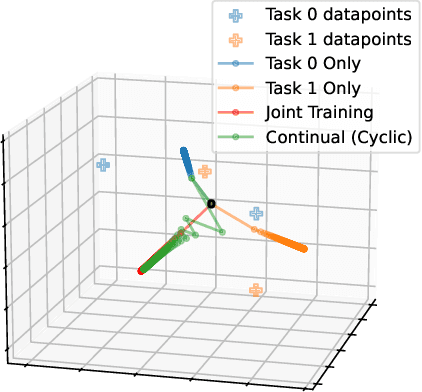
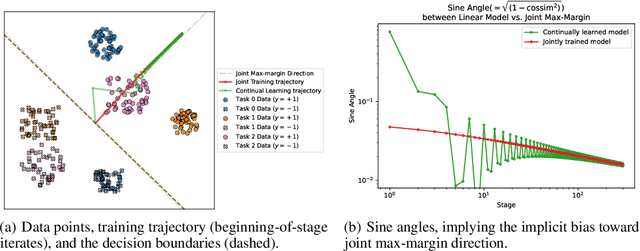
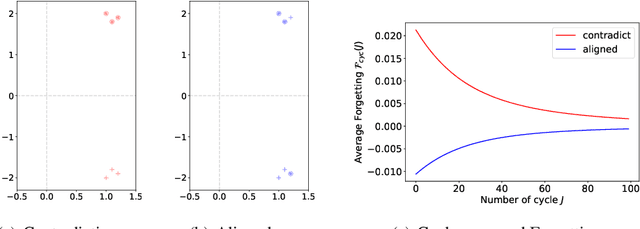
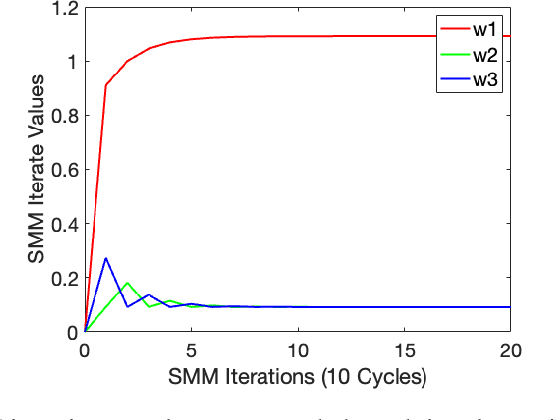
We study continual learning on multiple linear classification tasks by sequentially running gradient descent (GD) for a fixed budget of iterations per task. When all tasks are jointly linearly separable and are presented in a cyclic/random order, we show the directional convergence of the trained linear classifier to the joint (offline) max-margin solution. This is surprising because GD training on a single task is implicitly biased towards the individual max-margin solution for the task, and the direction of the joint max-margin solution can be largely different from these individual solutions. Additionally, when tasks are given in a cyclic order, we present a non-asymptotic analysis on cycle-averaged forgetting, revealing that (1) alignment between tasks is indeed closely tied to catastrophic forgetting and backward knowledge transfer and (2) the amount of forgetting vanishes to zero as the cycle repeats. Lastly, we analyze the case where the tasks are no longer jointly separable and show that the model trained in a cyclic order converges to the unique minimum of the joint loss function.