 Add to Chrome
 Add to Firefox
 Add to Edge
PersonaKit (PK): A Plug-and-Play Platform for User Testing Diverse Roles in Full-Duplex Dialogue
May 07, 2026
As spoken dialogue systems expand beyond traditional assistant roles to encompass diverse personas -- such as authoritative instructors, uncooperative merchants, or distracted workers -- they require distinct, human-like turn-taking behaviors to maintain psychological immersion. However, current full-duplex systems often default to a rigid, overly accommodating ``always-yield'' policy during overlapping speech, which severely undermines character consistency for non-submissive roles. Evaluating alternative, persona-specific turn-taking strategies through empirical user studies is challenging because building real-time full-duplex test environments requires substantial engineering overhead. To address this, we present PersonaKit (PK), an open-source, low-latency web platform for the rapid prototyping and evaluation of conversational agents. Using intuitive JSON configurations, researchers can define personas, specify probabilistic interruption-handling behaviors (e.g., yield, hold, bridge, or override), and automatically deploy comparative A/B surveys. Through an in-the-wild evaluation with 8 distinct personas, we demonstrate that PersonaKit provides an extensible, end-to-end framework for studying complex sociolinguistic behaviors in next-generation spoken agents.

Lla-VAP: LSTM Ensemble of Llama and VAP for Turn-Taking Prediction
Dec 24, 2024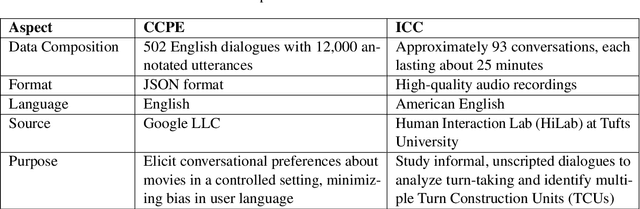
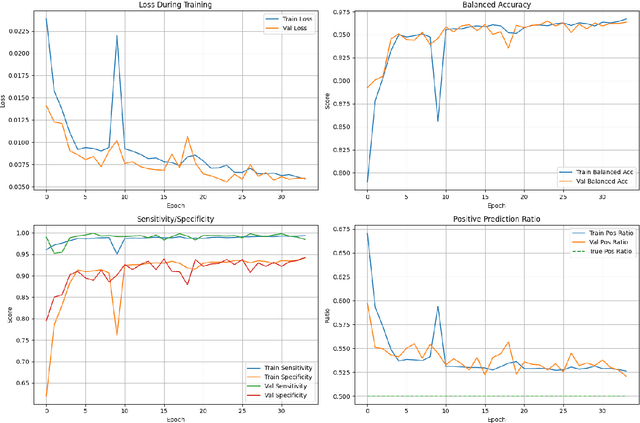

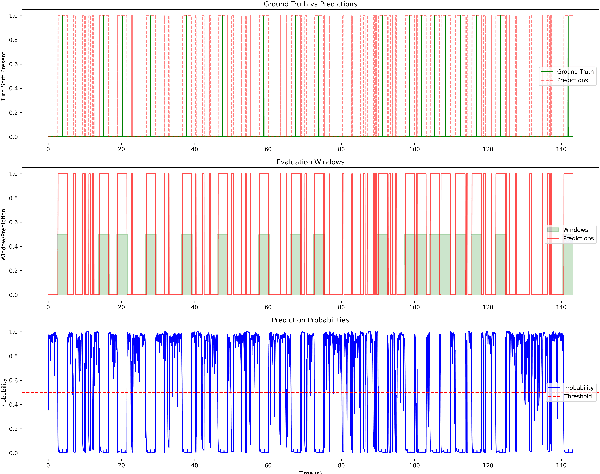
Turn-taking prediction is the task of anticipating when the speaker in a conversation will yield their turn to another speaker to begin speaking. This project expands on existing strategies for turn-taking prediction by employing a multi-modal ensemble approach that integrates large language models (LLMs) and voice activity projection (VAP) models. By combining the linguistic capabilities of LLMs with the temporal precision of VAP models, we aim to improve the accuracy and efficiency of identifying TRPs in both scripted and unscripted conversational scenarios. Our methods are evaluated on the In-Conversation Corpus (ICC) and Coached Conversational Preference Elicitation (CCPE) datasets, highlighting the strengths and limitations of current models while proposing a potentially more robust framework for enhanced prediction.
Modeling Student Performance in Game-Based Learning Environments
Sep 23, 2023This study investigates game-based learning in the context of the educational game "Jo Wilder and the Capitol Case," focusing on predicting student performance using various machine learning models, including K-Nearest Neighbors (KNN), Multi-Layer Perceptron (MLP), and Random Forest. The research aims to identify the features most predictive of student performance and correct question answering. By leveraging gameplay data, we establish complete benchmarks for these models and explore the importance of applying proper data aggregation methods. By compressing all numeric data to min/max/mean/sum and categorical data to first, last, count, and nunique, we reduced the size of the original training data from 4.6 GB to 48 MB of preprocessed training data, maintaining high F1 scores and accuracy. Our findings suggest that proper preprocessing techniques can be vital in enhancing the performance of non-deep-learning-based models. The MLP model outperformed the current state-of-the-art French Touch model, achieving an F-1 score of 0.83 and an accuracy of 0.74, suggesting its suitability for this dataset. Future research should explore using larger datasets, other preprocessing techniques, more advanced deep learning techniques, and real-world applications to provide personalized learning recommendations to students based on their predicted performance. This paper contributes to the understanding of game-based learning and provides insights into optimizing educational game experiences for improved student outcomes and skill development.