 Add to Chrome
 Add to Firefox
 Add to Edge
LLM-Assisted LDPC Decoding via Syndrome-Verified Semantic Priors
Aug 14, 2026
Semantic communication exploits the meaning of the payload, which bit-level processing discards. When channel decoding fails on a natural language payload, the errors appear as corrupted characters in the recovered text. A large language model (LLM) infers the intended characters from the semantic context, but it can also produce incorrect corrections. Applying them directly introduces new bit errors when the LLM modifies characters incorrectly. In this paper, we propose an LLM-assisted decoding framework for low-density parity-check (LDPC) codes. Rather than trusting LLM predictions, the decoder evaluates the modified characters jointly against the parity-check constraints and admits only the accepted corrections as verified semantic priors. These priors are injected as soft updates to the channel log-likelihood ratios, preserving the original channel evidence without modifying the decoder. A subsequent belief propagation pass distributes the injected evidence across the check nodes, recovering not only the injected bits but also the residual errors that the LLM fails to correct. Simulations demonstrate a 73% bit error rate reduction over a conventional decoder at 2.0 dB, whereas doubling its iterations to the same budget yields only 21%. The verification maintains an injection precision above 0.88 despite inaccurate LLM predictions, demonstrating that semantic knowledge can be reliably translated into physical-layer reliability gains.

SceneBaker: Radio-Ready Scene Generation for Sionna Ray-Tracing
Aug 05, 2026Wireless digital-twin (DT) research needs ray-tracing (RT) scenes that can be generated, versioned, and checked reproducibly. Current visual-authoring workflows can produce plausible city models, but they are poorly matched to repeated radio-simulation studies because geometry, terrain contact, and material semantics often require manual repair after export. This paper presents SceneBaker, a programmatic scene-generation pipeline that turns map and terrain data into Sionna RT-ready Mitsuba scenes without a GUI authoring step. Across four campus scenes, SceneBaker generates Sionna RT-ready scenes over the same geographic bounds as a Blender-generated baseline. The generated scenes avoid representative building-generation and terrain-contact faults while preserving comparable coverage-field and link-level channel-response behavior. The implementation and generated comparison assets are available at https://github.com/hslyu/sionna-scene-baker.
Temporal Channel Estimation for Generalized CSI Feedback
Aug 03, 2026Efficient Channel State Information (CSI) feedback is indispensable for frequency division duplex (FDD) massive multiple-input multiple-output (MIMO) systems. Existing compressed sensing (CS) algorithms exploit delay-domain sparsity but suffer from prohibitive iterative latency and discrete grid mismatch. Conversely, deep learning (DL) approaches achieve rapid inference but lack spatial scalability and domain adaptability, failing to generalize to unseen propagation environments, and demand computationally heavy encoders and decoder. In this paper, we propose TAP, a Tap-Assisted Parametric CSI Compression. TAP is a one-shot neural framework that unifies the speed of DL with the mathematical interpretability of CS. TAP replaces iterative pursuit with a lightweight 1D neural network that extracts dominant continuous propagation delays from temporal channel sequences via a differentiable sub-grid interpolation operator. TAP achieves true architecture independence, enabling zero-shot generalization across diverse array geometries and unseen propagation environments. Furthermore, TAP yields a completely decoder-free payload, allowing the BS to reconstruct the channel via a simple inverse fast Fourier transform (IFFT). Extensive evaluations across five 3GPP environments demonstrate that TAP achieves a 3.13 to 12.22 dB channel frequency response normalized mean square error (CFR-NMSE) improvement over CsiNet while shrinking the model footprint by 660 times to under 1 MB. Operating with sub-millisecond latencies, TAP accelerates inference by 2700 times over classical iterative OMP, providing a scalable and deployment-ready solution for next-generation networks.
End-to-End Secure Connection Probability in MultiLayer Networks with Heterogeneous Rician Fading
Feb 08, 2026Ensuring physical-layer security in non-terrestrial networks (NTNs) is challenging due to their global coverage and multi-hop relaying across heterogeneous network layers, where the locations and channels of potential eavesdroppers are typically unknown. In this work, we derive a tractable closedform expression of the end-to-end secure connection probability (SCP) of multi-hop relay routes under heterogeneous Rician fading. The resulting formula shares the same functional form as prior Rayleigh-based approximations but for the coefficients, thereby providing analytical support for the effectiveness of heuristic posterior coefficient calibration adopted in prior work. Numerical experiments under various conditions show that the proposed scheme estimates the SCP with an 1%p error in most cases; and doubles the accuracy compared with the conventional scheme even in the worst case. As a case study, we apply the proposed framework to real-world space-air-groundsea integrated network dataset, showing that the derived SCP accurately captures observed security trends in practical settings.
Accuracy-Delay Trade-Off in LLM Offloading via Token-Level Uncertainty
Feb 08, 2026Large language models (LLMs) offer significant potential for intelligent mobile services but are computationally intensive for resource-constrained devices. Mobile edge computing (MEC) allows such devices to offload inference tasks to edge servers (ESs), yet introduces latency due to communication and serverside queuing, especially in multi-user environments. In this work, we propose an uncertainty-aware offloading framework that dynamically decides whether to perform inference locally or offload it to the ES, based on token-level uncertainty and resource constraints. We define a margin-based token-level uncertainty metric and demonstrate its correlation with model accuracy. Leveraging this metric, we design a greedy offloading algorithm (GOA) that minimizes delay while maintaining accuracy by prioritizing offloading for highuncertainty queries. Our experiments show that GOA consistently achieves a favorable trade-off, outperforming baseline strategies in both accuracy and latency across varying user densities, and operates with practical computation time. These results establish GOA as a scalable and effective solution for LLM inference in MEC environments.
Faithful and Fast Influence Function via Advanced Sampling
Oct 30, 2025How can we explain the influence of training data on black-box models? Influence functions (IFs) offer a post-hoc solution by utilizing gradients and Hessians. However, computing the Hessian for an entire dataset is resource-intensive, necessitating a feasible alternative. A common approach involves randomly sampling a small subset of the training data, but this method often results in highly inconsistent IF estimates due to the high variance in sample configurations. To address this, we propose two advanced sampling techniques based on features and logits. These samplers select a small yet representative subset of the entire dataset by considering the stochastic distribution of features or logits, thereby enhancing the accuracy of IF estimations. We validate our approach through class removal experiments, a typical application of IFs, using the F1-score to measure how effectively the model forgets the removed class while maintaining inference consistency on the remaining classes. Our method reduces computation time by 30.1% and memory usage by 42.2%, or improves the F1-score by 2.5% compared to the baseline.
Multiple Active STAR-RIS-Assisted Secure Integrated Sensing and Communication via Cooperative Beamforming
Jul 24, 2025This paper explores an integrated sensing and communication (ISAC) network empowered by multiple active simultaneously transmitting and reflecting reconfigurable intelligent surfaces (STAR-RISs). A base station (BS) furnishes downlink communication to multiple users while concurrently interrogating a sensing target. We jointly optimize the BS transmit beamformer and the reflection/transmission coefficients of every active STAR-RIS in order to maximize the aggregate communication sum-rate, subject to (i) a stringent sensing signal-to-interference-plus-noise ratio (SINR) requirement, (ii) an upper bound on the leakage of confidential information, and (iii) individual hardware and total power constraints at both the BS and the STAR-RISs. The resulting highly non-convex program is tackled with an efficient alternating optimization (AO) framework. First, the original formulation is reformulated into an equivalent yet more tractable representation and partitioned into subproblems. The BS beamformer is updated in closed form via the Karush-Kuhn-Tucker (KKT) conditions, whereas the STAR-RIS reflection and transmission vectors are refined through successive convex approximation (SCA), yielding a semidefinite program that is then solved via semidefinite relaxation. Comprehensive simulations demonstrate that the proposed algorithm delivers substantial sum-rate gains over passive-RIS and single STAR-RIS baselines, all the while rigorously meeting the prescribed sensing and security constraints.
Joint Optimization of User Association and Resource Allocation for Load Balancing With Multi-Level Fairness
May 13, 2025User association, the problem of assigning each user device to a suitable base station, is increasingly crucial as wireless networks become denser and serve more users with diverse service demands. The joint optimization of user association and resource allocation (UARA) is a fundamental issue for future wireless networks, as it plays a pivotal role in enhancing overall network performance, user fairness, and resource efficiency. Given the latency-sensitive nature of emerging network applications, network management favors algorithms that are simple and computationally efficient rather than complex centralized approaches. Thus, distributed pricing-based strategies have gained prominence in the UARA literature, demonstrating practicality and effectiveness across various objective functions, e.g., sum-rate, proportional fairness, max-min fairness, and alpha-fairness. While the alpha-fairness frameworks allow for flexible adjustments between efficiency and fairness via a single parameter $\alpha$, existing works predominantly assume a homogeneous fairness context, assigning an identical $\alpha$ value to all users. Real-world networks, however, frequently require differentiated user prioritization due to varying application requirements and latency. To bridge this gap, we propose a novel heterogeneous alpha-fairness (HAF) objective function, assigning distinct {\alpha} values to different users, thereby providing enhanced control over the balance between throughput, fairness, and latency across the network. We present a distributed, pricing-based optimization approach utilizing an auxiliary variable framework and provide analytical proof of its convergence to an $\epsilon$-optimal solution, where the optimality gap $\epsilon$ decreases with the number of iterations.
Secure Multi-Hop Relaying in Large-Scale Space-Air-Ground-Sea Integrated Networks
May 01, 2025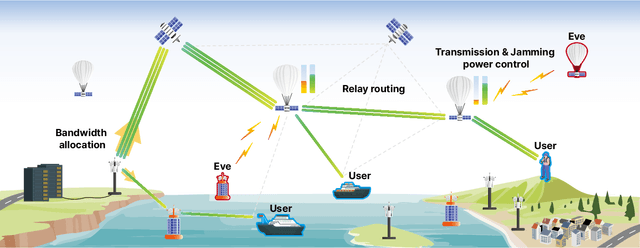
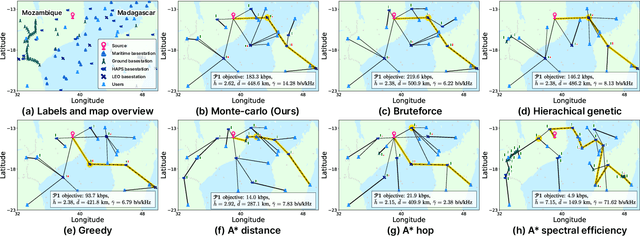

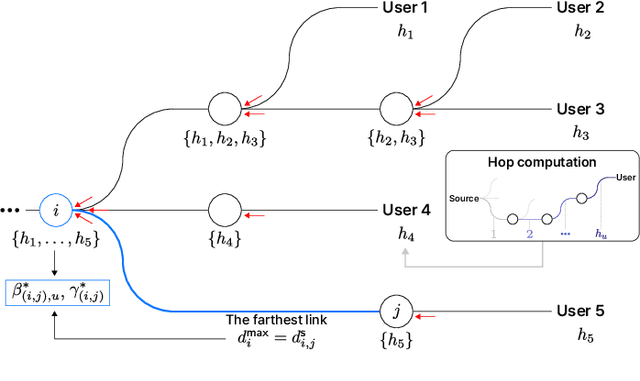
As a key enabler of borderless and ubiquitous connectivity, space-air-ground-sea integrated networks (SAGSINs) are expected to be a cornerstone of 6G wireless communications. However, the multi-tiered and global-scale nature of SAGSINs also amplifies the security vulnerabilities, particularly due to the hidden, passive eavesdroppers distributed throughout the network. In this paper, we introduce a joint optimization framework for multi-hop relaying in SAGSINs that maximizes the minimum user throughput while ensuring a minimum strictly positive secure connection (SPSC) probability. We first derive a closed-form expression for the SPSC probability and incorporate this into a cross-layer optimization framework that jointly optimizes radio resources and relay routes. Specifically, we propose an $\mathcal{O}(1)$ optimal frequency allocation and power splitting strategy-dividing power levels of data transmission and cooperative jamming. We then introduce a Monte-Carlo relay routing algorithm that closely approaches the performance of the numerical upper-bound method. We validate our framework on testbeds built with real-world dataset. All source code and data for reproducing the numerical experiments will be open-sourced.
Fed-ZOE: Communication-Efficient Over-the-Air Federated Learning via Zeroth-Order Estimation
Dec 21, 2024
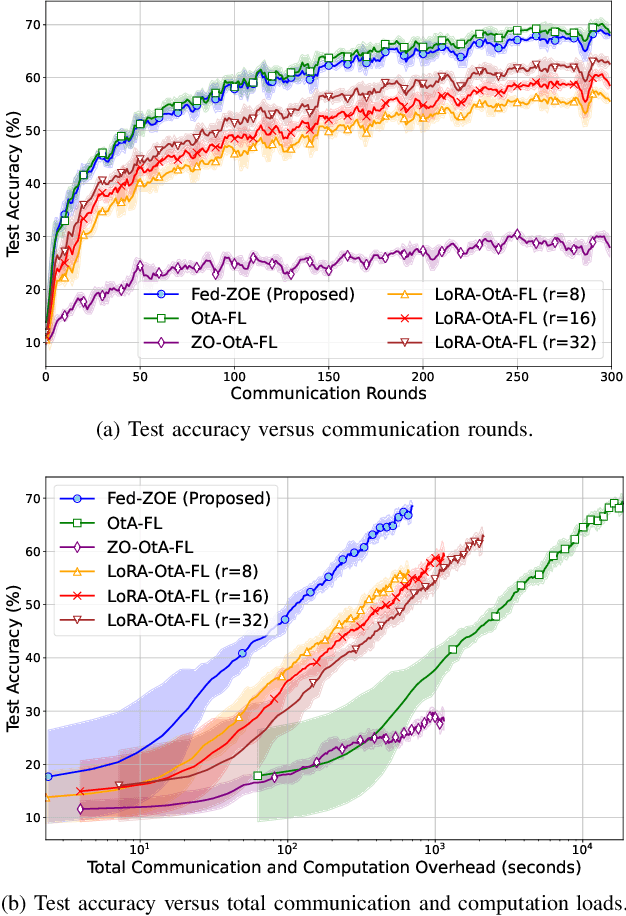
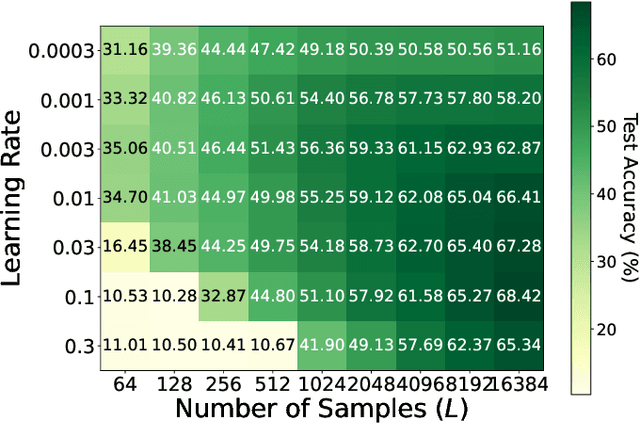
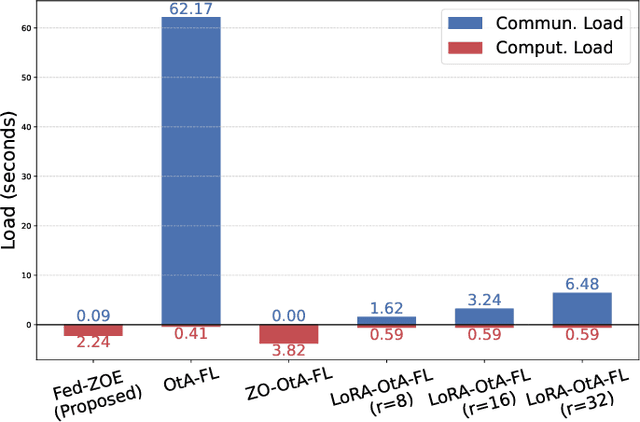
As 6G and beyond networks grow increasingly complex and interconnected, federated learning (FL) emerges as an indispensable paradigm for securely and efficiently leveraging decentralized edge data for AI. By virtue of the superposition property of communication signals, over-the-air FL (OtA-FL) achieves constant communication overhead irrespective of the number of edge devices (EDs). However, training neural networks over the air still incurs substantial communication costs, as the number of transmitted symbols equals the number of trainable parameters. To alleviate this issue, the most straightforward approach is to reduce the number of transmitted symbols by 1) gradient compression and 2) gradient sparsification. Unfortunately, these methods are incompatible with OtA-FL due to the loss of its superposition property. In this work, we introduce federated zeroth-order estimation (Fed-ZOE), an efficient framework inspired by the randomized gradient estimator (RGE) commonly used in zeroth-order optimization (ZOO). In FedZOE, EDs perform local weight updates as in standard FL, but instead of transmitting full gradient vectors, they send compressed local model update vectors in the form of several scalar-valued inner products between the local model update vectors and random vectors. These scalar values enable the parameter server (PS) to reconstruct the gradient using the RGE trick with highly reduced overhead, as well as preserving the superposition property. Unlike conventional ZOO leveraging RGE for step-wise gradient descent, Fed-ZOE compresses local model update vectors before transmission, thereby achieving higher accuracy and computational efficiency. Numerical evaluations using ResNet-18 on datasets such as CIFAR-10, TinyImageNet, SVHN, CIFAR-100, and Brain-CT demonstrate that Fed-ZOE achieves performance comparable to Fed-OtA while drastically reducing communication costs.