 Add to Chrome
 Add to Firefox
 Add to Edge
SNAP: Low-Latency Test-Time Adaptation with Sparse Updates
Nov 19, 2025
Test-Time Adaptation (TTA) adjusts models using unlabeled test data to handle dynamic distribution shifts. However, existing methods rely on frequent adaptation and high computational cost, making them unsuitable for resource-constrained edge environments. To address this, we propose SNAP, a sparse TTA framework that reduces adaptation frequency and data usage while preserving accuracy. SNAP maintains competitive accuracy even when adapting based on only 1% of the incoming data stream, demonstrating its robustness under infrequent updates. Our method introduces two key components: (i) Class and Domain Representative Memory (CnDRM), which identifies and stores a small set of samples that are representative of both class and domain characteristics to support efficient adaptation with limited data; and (ii) Inference-only Batch-aware Memory Normalization (IoBMN), which dynamically adjusts normalization statistics at inference time by leveraging these representative samples, enabling efficient alignment to shifting target domains. Integrated with five state-of-the-art TTA algorithms, SNAP reduces latency by up to 93.12%, while keeping the accuracy drop below 3.3%, even across adaptation rates ranging from 1% to 50%. This demonstrates its strong potential for practical use on edge devices serving latency-sensitive applications. The source code is available at https://github.com/chahh9808/SNAP.

IMG2IMU: Applying Knowledge from Large-Scale Images to IMU Applications via Contrastive Learning
Sep 02, 2022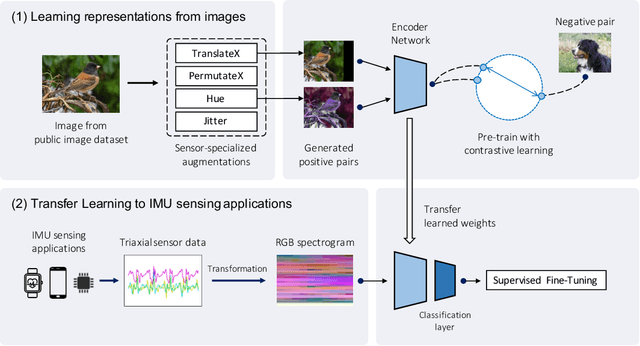
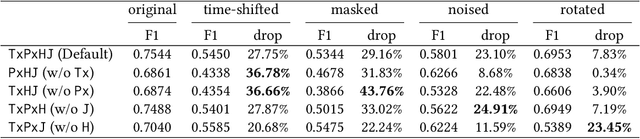
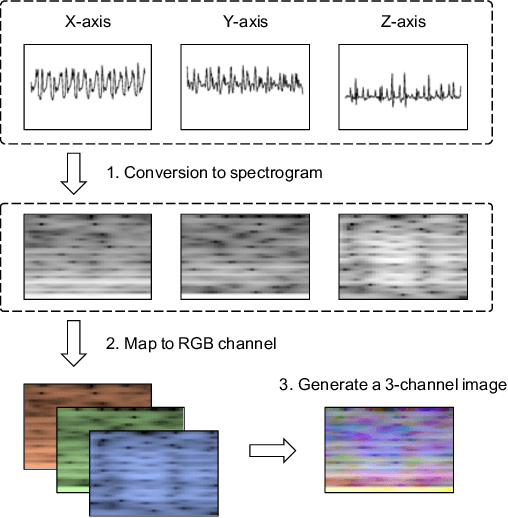

Recent advances in machine learning showed that pre-training representations acquired via self-supervised learning could achieve high accuracy on tasks with small training data. Unlike in vision and natural language processing domains, such pre-training for IMU-based applications is challenging, as there are only a few publicly available datasets with sufficient size and diversity to learn generalizable representations. To overcome this problem, we propose IMG2IMU, a novel approach that adapts pre-train representation from large-scale images to diverse few-shot IMU sensing tasks. We convert the sensor data into visually interpretable spectrograms for the model to utilize the knowledge gained from vision. Further, we apply contrastive learning on an augmentation set we designed to learn representations that are tailored to interpreting sensor data. Our extensive evaluations on five different IMU sensing tasks show that IMG2IMU consistently outperforms the baselines, illustrating that vision knowledge can be incorporated into a few-shot learning environment for IMU sensing tasks.