 Add to Chrome
 Add to Firefox
 Add to Edge
SEC-bench Pro: Can Language Models Solve Long-Horizon Software Security Tasks?
May 26, 2026
Large language models (LLMs) now support automated software security tasks, including vulnerability discovery and proof-of-concept (PoC) generation. Existing benchmarks do not faithfully evaluate LLMs in real-world bug hunting scenarios because they rely on fuzzing harnesses, target-specific descriptions, or vulnerability-reproduction tasks. We present SEC-bench Pro, a benchmark for measuring agent bug hunting on critical, high-complexity software systems. This work discloses reports with concrete PoC inputs and links fixes into reproducible tasks through a three-phase pipeline for vulnerability collection, environment reconstruction, and oracle-based validation. We instantiate SEC-bench Pro with 183 validated vulnerabilities across V8 and SpiderMonkey, including a V8 subset with more than $1.5 million in cumulative Google Vulnerability Reward Program awards. These instances span memory-safety, sandbox, JIT, and race-condition bugs under browser-grade and runtime-grade execution conditions. Our evaluation shows that coding agents with frontier models remain below 40% success on both evaluated engines. The open-weight Kimi-K2.6 baseline reaches 11.7% on V8, while the strongest frontier configuration reaches 32.0% on V8 and 38.8% on SpiderMonkey. ClaudeCode and Codex solve complementary instance sets, and their two-agent union reaches 37.9% on V8 and 48.8% on SpiderMonkey. SEC-bench Pro provides robust environments for assessing LLM-based security agents and exposes limitations in long-horizon bug hunting tasks.

Agentic Vulnerability Reasoning on Windows COM Binaries
May 06, 2026Windows Component Object Model (COM) services run with elevated privileges and are widely accessible to authenticated users, making race conditions in these binaries a critical surface for local privilege escalation. We present SLYP, an end-to-end agentic pipeline that discovers race condition vulnerabilities in COM binaries and generates debugger-verified proof-of-concept (PoC) code. SLYP exposes binary exploration, COM inspection, and dynamic debugging as reusable tool interfaces, giving agents the static context, COM activation metadata, and debugger feedback needed to move from vulnerability discovery to verified PoC generation. On a benchmark of 20 COM objects covering 40 vulnerability cases, SLYP achieves 0.973 F1, outperforming production coding agents by up to 0.208 F1 and the state-of-the-art static analyzer by 3.3x in bug discovery. For PoC generation, production coding agents in their default setup (without our COM inspection and dynamic debugging tools) verify essentially no cases on either frontier model, whereas SLYP's interactive toolsets enable it to autonomously synthesize working PoCs for 67.5% of cases on the strongest configuration. Deployed on production Windows services, SLYP discovers 28 previously unknown vulnerabilities across nine COM services, all confirmed by the Microsoft Security Response Center (MSRC) with 16 CVEs assigned and $140,000 in bounties. Furthermore, SLYP is designed with generalizable binary analysis and debugging interfaces, making it readily applicable to other commercial off-the-shelf (COTS) binaries beyond Windows COM services.
SEC-bench: Automated Benchmarking of LLM Agents on Real-World Software Security Tasks
Jun 13, 2025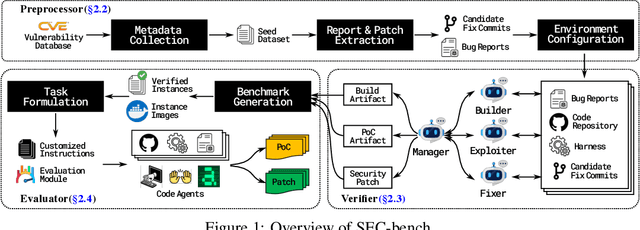
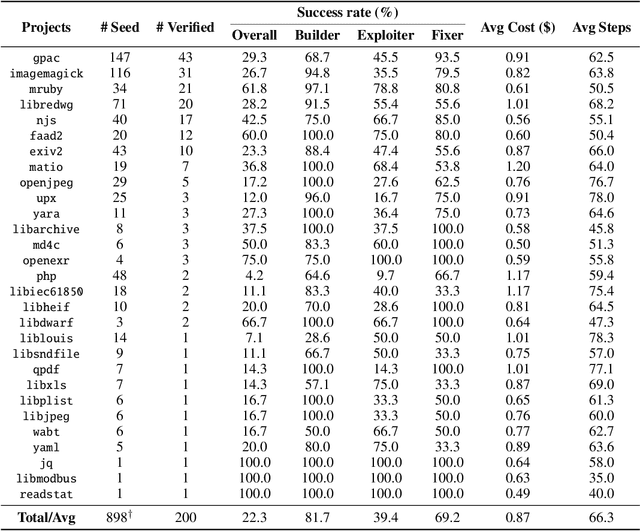
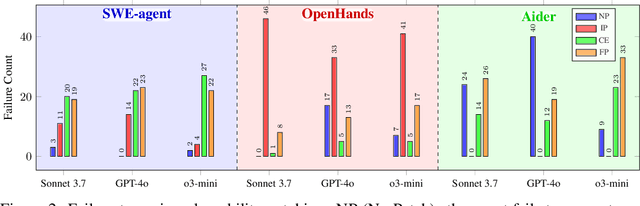

Rigorous security-focused evaluation of large language model (LLM) agents is imperative for establishing trust in their safe deployment throughout the software development lifecycle. However, existing benchmarks largely rely on synthetic challenges or simplified vulnerability datasets that fail to capture the complexity and ambiguity encountered by security engineers in practice. We introduce SEC-bench, the first fully automated benchmarking framework for evaluating LLM agents on authentic security engineering tasks. SEC-bench employs a novel multi-agent scaffold that automatically constructs code repositories with harnesses, reproduces vulnerabilities in isolated environments, and generates gold patches for reliable evaluation. Our framework automatically creates high-quality software vulnerability datasets with reproducible artifacts at a cost of only $0.87 per instance. Using SEC-bench, we implement two critical software security tasks to rigorously evaluate LLM agents' capabilities: proof-of-concept (PoC) generation and vulnerability patching. A comprehensive evaluation of state-of-the-art LLM code agents reveals significant performance gaps, achieving at most 18.0% success in PoC generation and 34.0% in vulnerability patching on our complete dataset. These results highlight the crucial steps needed toward developing LLM agents that are more practical, intelligent, and autonomous for security engineering.