 Add to Chrome
 Add to Firefox
 Add to Edge
Predictive Spectral Calibration for Source-Free Test-Time Regression
Mar 10, 2026
Test-time adaptation (TTA) for image regression has received far less attention than its classification counterpart. Methods designed for classification often depend on classification-specific objectives and decision boundaries, making them difficult to transfer directly to continuous regression targets. Recent progress revisits regression TTA through subspace alignment, showing that simple source-guided alignment can be both practical and effective. Building on this line of work, we propose Predictive Spectral Calibration (PSC), a source-free framework that extends subspace alignment to block spectral matching. Instead of relying on a fixed support subspace alone, PSC jointly aligns target features within the source predictive support and calibrates residual spectral slack in the orthogonal complement. PSC remains simple to implement, model-agnostic, and compatible with off-the-shelf pretrained regressors. Experiments on multiple image regression benchmarks show consistent improvements over strong baselines, with particularly clear gains under severe distribution shifts.

High Accurate and Explainable Multi-Pill Detection Framework with Graph Neural Network-Assisted Multimodal Data Fusion
Mar 17, 2023
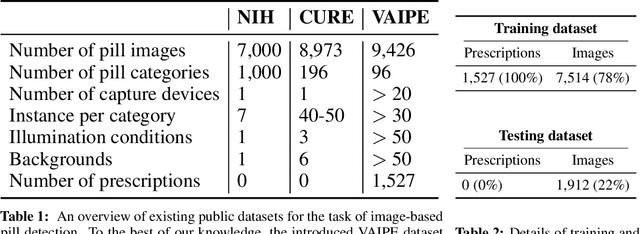
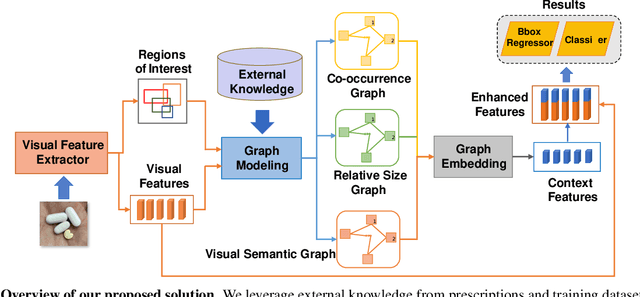
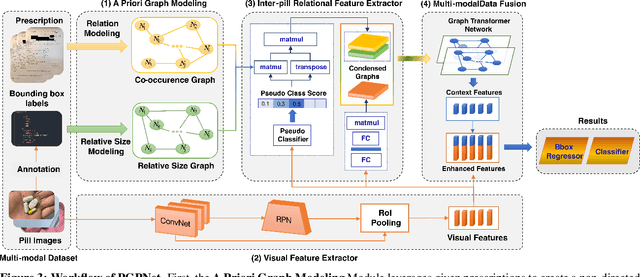
Due to the significant resemblance in visual appearance, pill misuse is prevalent and has become a critical issue, responsible for one-third of all deaths worldwide. Pill identification, thus, is a crucial concern needed to be investigated thoroughly. Recently, several attempts have been made to exploit deep learning to tackle the pill identification problem. However, most published works consider only single-pill identification and fail to distinguish hard samples with identical appearances. Also, most existing pill image datasets only feature single pill images captured in carefully controlled environments under ideal lighting conditions and clean backgrounds. In this work, we are the first to tackle the multi-pill detection problem in real-world settings, aiming at localizing and identifying pills captured by users in a pill intake. Moreover, we also introduce a multi-pill image dataset taken in unconstrained conditions. To handle hard samples, we propose a novel method for constructing heterogeneous a priori graphs incorporating three forms of inter-pill relationships, including co-occurrence likelihood, relative size, and visual semantic correlation. We then offer a framework for integrating a priori with pills' visual features to enhance detection accuracy. Our experimental results have proved the robustness, reliability, and explainability of the proposed framework. Experimentally, it outperforms all detection benchmarks in terms of all evaluation metrics. Specifically, our proposed framework improves COCO mAP metrics by 9.4% over Faster R-CNN and 12.0% compared to vanilla YOLOv5. Our study opens up new opportunities for protecting patients from medication errors using an AI-based pill identification solution.