 Add to Chrome
 Add to Firefox
 Add to Edge
FairFinGAN: Fairness-aware Synthetic Financial Data Generation
Mar 05, 2026
Financial datasets often suffer from bias that can lead to unfair decision-making in automated systems. In this work, we propose FairFinGAN, a WGAN-based framework designed to generate synthetic financial data while mitigating bias with respect to the protected attribute. Our approach incorporates fairness constraints directly into the training process through a classifier, ensuring that the synthetic data is both fair and preserves utility for downstream predictive tasks. We evaluate our proposed model on five real-world financial datasets and compare it with existing GAN-based data generation methods. Experimental results show that our approach achieves superior fairness metrics without significant loss in data utility, demonstrating its potential as a tool for bias-aware data generation in financial applications.

An experimental study on fairness-aware machine learning for credit scoring problem
Dec 28, 2024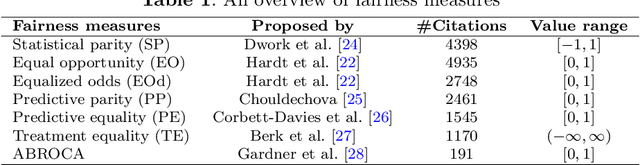



Digitalization of credit scoring is an essential requirement for financial organizations and commercial banks, especially in the context of digital transformation. Machine learning techniques are commonly used to evaluate customers' creditworthiness. However, the predicted outcomes of machine learning models can be biased toward protected attributes, such as race or gender. Numerous fairness-aware machine learning models and fairness measures have been proposed. Nevertheless, their performance in the context of credit scoring has not been thoroughly investigated. In this paper, we present a comprehensive experimental study of fairness-aware machine learning in credit scoring. The study explores key aspects of credit scoring, including financial datasets, predictive models, and fairness measures. We also provide a detailed evaluation of fairness-aware predictive models and fairness measures on widely used financial datasets.