 Add to Chrome
 Add to Firefox
 Add to Edge
T3R: Deeper Test-Time Adaptation for Graph Neural Networks via Gradient Rotation
Jun 29, 2026
Graph Neural Networks (GNNs) deployed in real-world systems typically have fixed weights, often leading to degraded performance under distribution shifts. This issue can be mitigated by conventional fine-tuning, but in many real-world cases, collecting labeled data is expensive or infeasible. A potential approach is Test-Time Training (TTT), which adapts models' weights using unlabeled test data, yet it is typically limited to shallow updates that affect only a subset of model parameters. We propose T3R, leveraging multiple Rotograd matrices to improve task affinity between the target and auxiliary tasks, essential for effective test-time training. T3R further introduces a rotation technique that reorients self-supervised signals using these matrices to create surrogate gradients for the target task, allowing deeper adaptation across nearly the entire architecture. Empirically, T3R reduces MAE by 0.172 points over standard inference in regression datasets and achieves at least 9.37% relative improvement on cross-domain OGB classification benchmarks compared to models without adaptation. These results highlight the potential to develop an adaptation pipeline for graph-based systems, particularly in settings where conventional fine-tuning or retraining is infeasible.

A Multivariate Statistical Framework for Detection, Classification and Pre-localization of Anomalies in Water Distribution Networks
Dec 17, 2025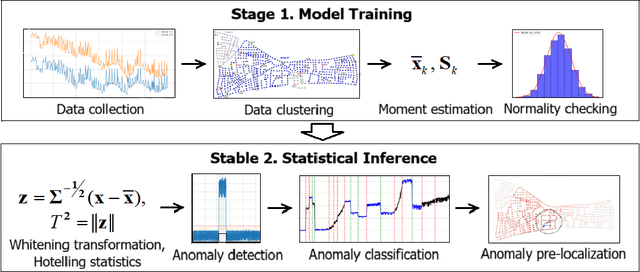
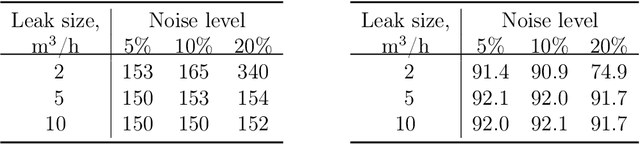
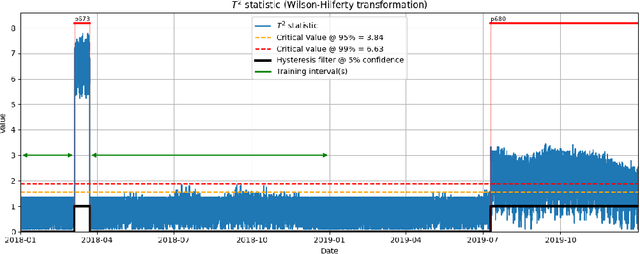
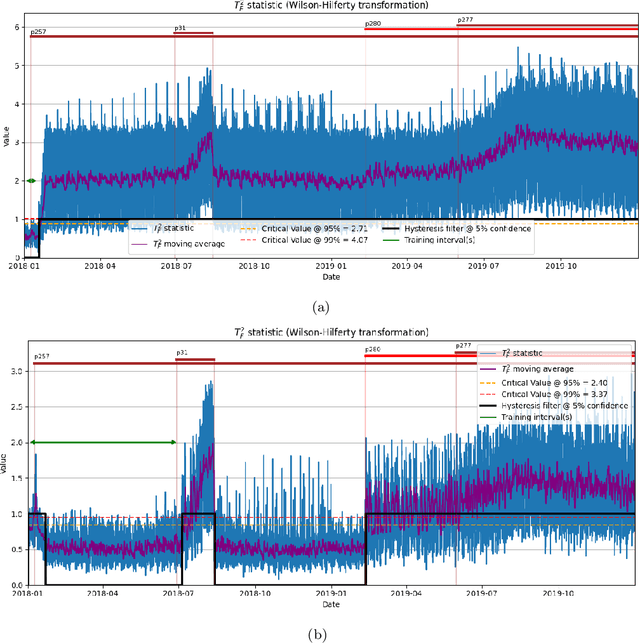
This paper presents a unified framework, for the detection, classification, and preliminary localization of anomalies in water distribution networks using multivariate statistical analysis. The approach, termed SICAMS (Statistical Identification and Classification of Anomalies in Mahalanobis Space), processes heterogeneous pressure and flow sensor data through a whitening transformation to eliminate spatial correlations among measurements. Based on the transformed data, the Hotelling's $T^2$ statistic is constructed, enabling the formulation of anomaly detection as a statistical hypothesis test of network conformity to normal operating conditions. It is shown that Hotelling's $T^2$ statistic can serve as an integral indicator of the overall "health" of the system, exhibiting correlation with total leakage volume, and thereby enabling approximate estimation of water losses via a regression model. A heuristic algorithm is developed to analyze the $T^2$ time series and classify detected anomalies into abrupt leaks, incipient leaks, and sensor malfunctions. Furthermore, a coarse leak localization method is proposed, which ranks sensors according to their statistical contribution and employs Laplacian interpolation to approximate the affected region within the network. Application of the proposed framework to the BattLeDIM L-Town benchmark dataset demonstrates high sensitivity and reliability in leak detection, maintaining robust performance even under multiple leaks. These capabilities make the method applicable to real-world operational environments without the need for a calibrated hydraulic model.
DiTEC-WDN: A Large-Scale Dataset of Water Distribution Network Scenarios under Diverse Hydraulic Conditions
Mar 21, 2025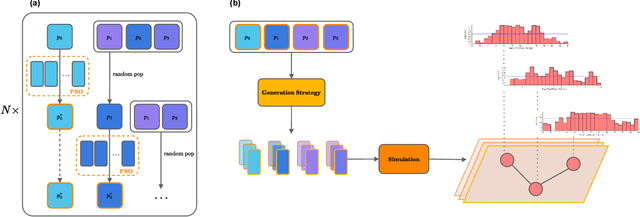
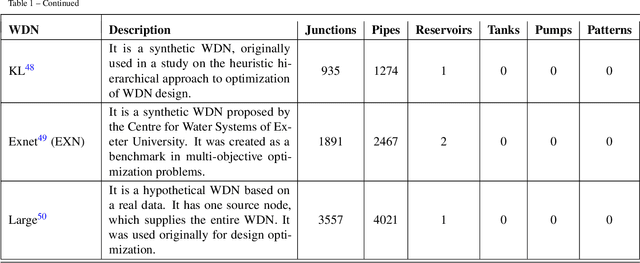
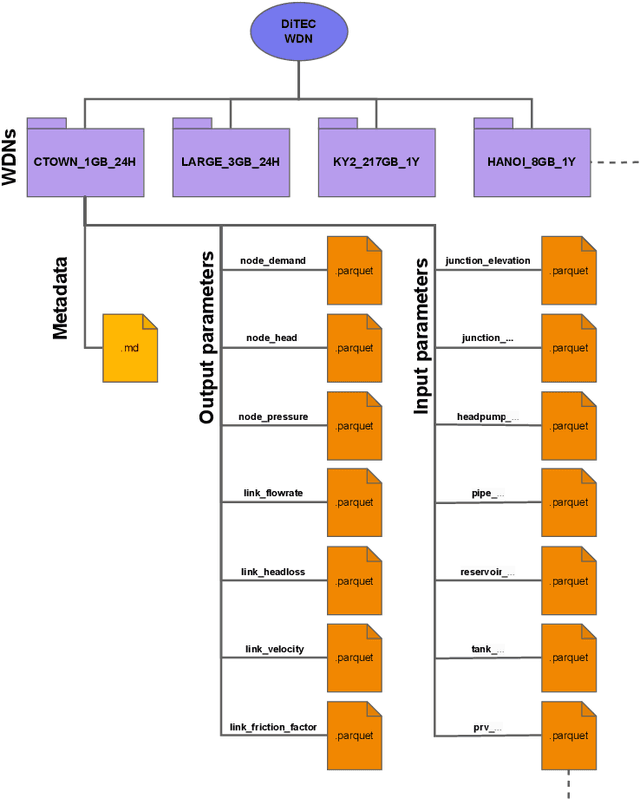
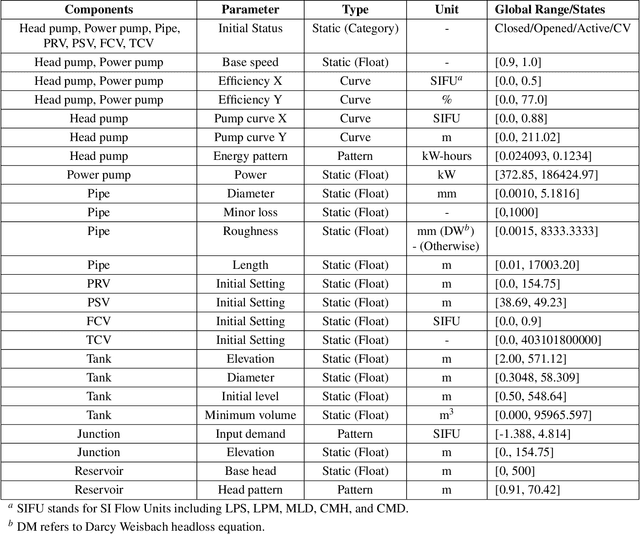
Privacy restrictions hinder the sharing of real-world Water Distribution Network (WDN) models, limiting the application of emerging data-driven machine learning, which typically requires extensive observations. To address this challenge, we propose the dataset DiTEC-WDN that comprises 36,000 unique scenarios simulated over either short-term (24 hours) or long-term (1 year) periods. We constructed this dataset using an automated pipeline that optimizes crucial parameters (e.g., pressure, flow rate, and demand patterns), facilitates large-scale simulations, and records discrete, synthetic but hydraulically realistic states under standard conditions via rule validation and post-hoc analysis. With a total of 228 million generated graph-based states, DiTEC-WDN can support a variety of machine-learning tasks, including graph-level, node-level, and link-level regression, as well as time-series forecasting. This contribution, released under a public license, encourages open scientific research in the critical water sector, eliminates the risk of exposing sensitive data, and fulfills the need for a large-scale water distribution network benchmark for study comparisons and scenario analysis.
Large-Scale Multipurpose Benchmark Datasets For Assessing Data-Driven Deep Learning Approaches For Water Distribution Networks
Apr 23, 2024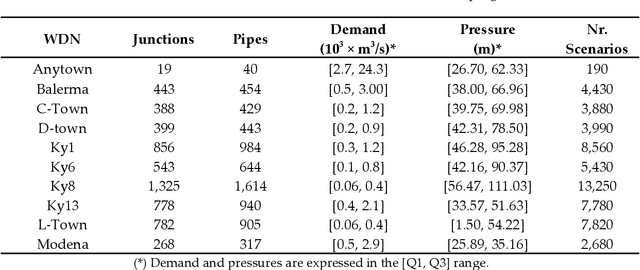
Currently, the number of common benchmark datasets that researchers can use straight away for assessing data-driven deep learning approaches is very limited. Most studies provide data as configuration files. It is still up to each practitioner to follow a particular data generation method and run computationally intensive simulations to obtain usable data for model training and evaluation. In this work, we provide a collection of datasets that includes several small and medium size publicly available Water Distribution Networks (WDNs), including Anytown, Modena, Balerma, C-Town, D-Town, L-Town, Ky1, Ky6, Ky8, and Ky13. In total 1,394,400 hours of WDNs data operating under normal conditions is made available to the community.
Graph Neural Networks for Pressure Estimation in Water Distribution Systems
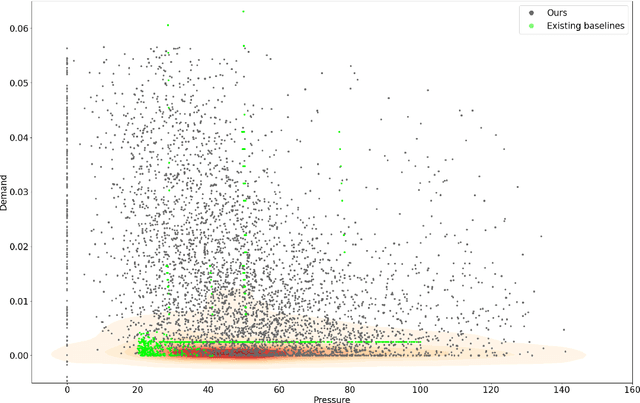
Nov 17, 2023Pressure and flow estimation in Water Distribution Networks (WDN) allows water management companies to optimize their control operations. For many years, mathematical simulation tools have been the most common approach to reconstructing an estimate of the WDN hydraulics. However, pure physics-based simulations involve several challenges, e.g. partially observable data, high uncertainty, and extensive manual configuration. Thus, data-driven approaches have gained traction to overcome such limitations. In this work, we combine physics-based modeling and Graph Neural Networks (GNN), a data-driven approach, to address the pressure estimation problem. First, we propose a new data generation method using a mathematical simulation but not considering temporal patterns and including some control parameters that remain untouched in previous works; this contributes to a more diverse training data. Second, our training strategy relies on random sensor placement making our GNN-based estimation model robust to unexpected sensor location changes. Third, a realistic evaluation protocol considers real temporal patterns and additionally injects the uncertainties intrinsic to real-world scenarios. Finally, a multi-graph pre-training strategy allows the model to be reused for pressure estimation in unseen target WDNs. Our GNN-based model estimates the pressure of a large-scale WDN in The Netherlands with a MAE of 1.94mH$_2$O and a MAPE of 7%, surpassing the performance of previous studies. Likewise, it outperformed previous approaches on other WDN benchmarks, showing a reduction of absolute error up to approximately 52% in the best cases.