 Add to Chrome
 Add to Firefox
 Add to Edge
Revisiting Chebyshev Polynomial and Anisotropic RBF Models for Tabular Regression
Feb 25, 2026
Smooth-basis models such as Chebyshev polynomial regressors and radial basis function (RBF) networks are well established in numerical analysis. Their continuously differentiable prediction surfaces suit surrogate optimisation, sensitivity analysis, and other settings where the response varies gradually with inputs. Despite these properties, smooth models seldom appear in tabular regression, where tree ensembles dominate. We ask whether they can compete, benchmarking models across 55 regression datasets organised by application domain. We develop an anisotropic RBF network with data-driven centre placement and gradient-based width optimisation, a ridge-regularised Chebyshev polynomial regressor, and a smooth-tree hybrid (Chebyshev model tree); all three are released as scikit-learn-compatible packages. We benchmark these against tree ensembles, a pre-trained transformer, and standard baselines, evaluating accuracy alongside generalisation behaviour. The transformer ranks first on accuracy across a majority of datasets, but its GPU dependence, inference latency, and dataset-size limits constrain deployment in the CPU-based settings common across applied science and industry. Among CPU-viable models, smooth models and tree ensembles are statistically tied on accuracy, but the former tend to exhibit tighter generalisation gaps. We recommend routinely including smooth-basis models in the candidate pool, particularly when downstream use benefits from tighter generalisation and gradually varying predictions.

A Generic Performance Model for Deep Learning in a Distributed Environment
May 19, 2023Performance modelling of a deep learning application is essential to improve and quantify the efficiency of the model framework. However, existing performance models are mostly case-specific, with limited capability for the new deep learning frameworks/applications. In this paper, we propose a generic performance model of an application in a distributed environment with a generic expression of the application execution time that considers the influence of both intrinsic factors/operations (e.g. algorithmic parameters/internal operations) and extrinsic scaling factors (e.g. the number of processors, data chunks and batch size). We formulate it as a global optimization problem and solve it using regularization on a cost function and differential evolution algorithm to find the best-fit values of the constants in the generic expression to match the experimentally determined computation time. We have evaluated the proposed model on three deep learning frameworks (i.e., TensorFlow, MXnet, and Pytorch). The experimental results show that the proposed model can provide accurate performance predictions and interpretability. In addition, the proposed work can be applied to any distributed deep neural network without instrumenting the code and provides insight into the factors affecting performance and scalability.
Layer-Wise Partitioning and Merging for Efficient and Scalable Deep Learning
Jul 22, 2022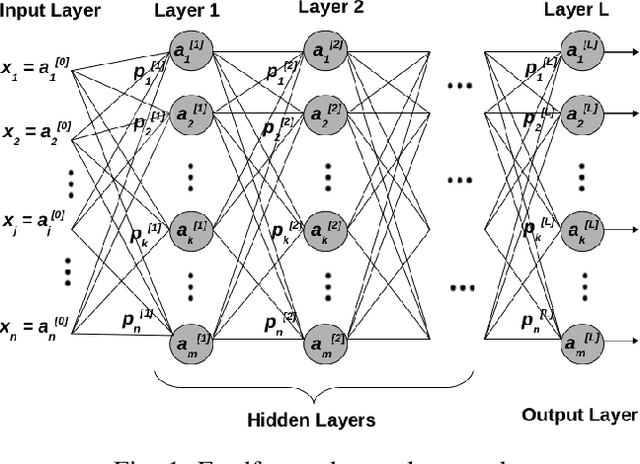
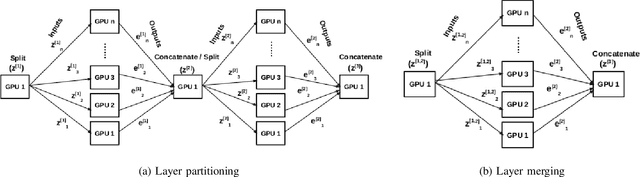

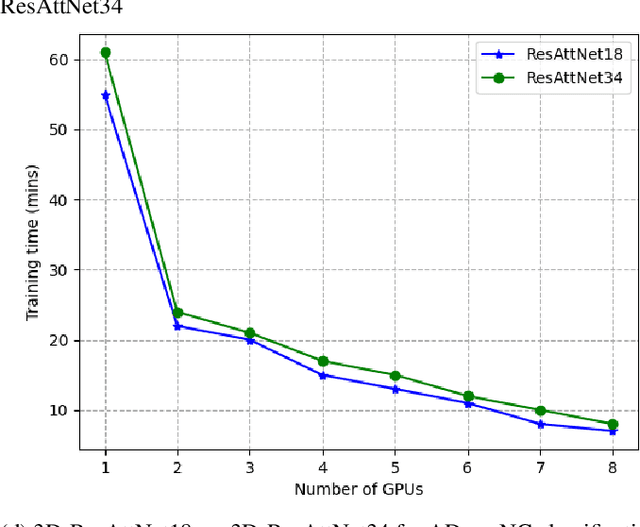
Deep Neural Network (DNN) models are usually trained sequentially from one layer to another, which causes forward, backward and update locking's problems, leading to poor performance in terms of training time. The existing parallel strategies to mitigate these problems provide suboptimal runtime performance. In this work, we have proposed a novel layer-wise partitioning and merging, forward and backward pass parallel framework to provide better training performance. The novelty of the proposed work consists of 1) a layer-wise partition and merging model which can minimise communication overhead between devices without the memory cost of existing strategies during the training process; 2) a forward pass and backward pass parallelisation and optimisation to address the update locking problem and minimise the total training cost. The experimental evaluation on real use cases shows that the proposed method outperforms the state-of-the-art approaches in terms of training speed; and achieves almost linear speedup without compromising the accuracy performance of the non-parallel approach.
Solving Sudoku with Ant Colony Optimisation
May 09, 2018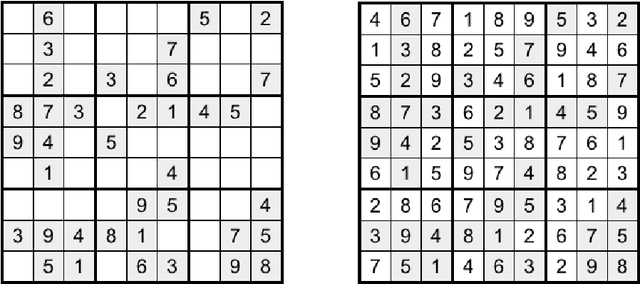
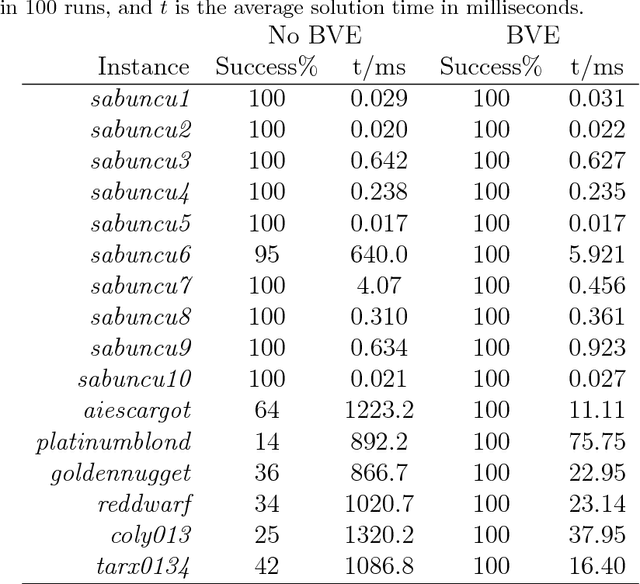
In this paper we present a new Ant Colony Optimisation-based algorithm for Sudoku, which out-performs existing methods on large instances. Our method includes a novel anti-stagnation operator, which we call Best Value Evaporation.