 Add to Chrome
 Add to Firefox
 Add to Edge
NOWJ@COLIEE 2026: Adaptive Pipelines for Legal Retrieval and Reasoning
Jul 18, 2026
This paper presents the methodologies and results of the NOWJ team's participation across all five tasks of the COLIEE 2026 competition. For Task 1 (Legal Case Retrieval), we propose a four-stage pipeline comprising candidate filtering, dense retrieval with complementary embedding models, cross-encoder reranking via fine-tuned generative rerankers and MLP-based pairwise classification, and adaptive per-query cutoff prediction. For Task 2 (Legal Case Entailment), we combine BM25 filtering, T5-based reranking, and LLM-based entailment verification with consensus ensemble. For Task 3 (Statute Law Retrieval and Entailment), we adopt a retrieval-augmented generation framework with dense retrieval, attention-based reranking, and few-shot-prompted LLM reasoning. For Task 4 (Legal Textual Entailment), we introduce a dynamic routing pipeline that classifies query difficulty and dispatches cases to either a balanced few-shot solver or a structured zero-shot chain-of-thought solver. For the Pilot Task (Legal Judgment Prediction), we combine hierarchical transformers with CRF layers, argument relation mining, and probabilistic argumentation graph reasoning.

L-MAD: A Systematic Evaluation of Multi-Agent Debate Structures in Legal Reasoning
Jul 10, 2026While multi-agent debate (MAD) frameworks have shown significant potential in general reasoning, their effectiveness in highly structured, knowledge-heavy legal domains remains under-explored. In this work, we introduce the Legal Multi-Agent Debate (L-MAD) framework to systematically evaluate different debate structures and aggregation methods within Legal Textual Entailment. By assigning distinct expert personas to multiple agents, L-MAD improves upon strong single-agent baselines by up to 8\%. Furthermore, analyzing how debate scales reveals a clear trade-off: increasing the agent population reduces inconsistency and improves accuracy, whereas extending discussion rounds induces a detrimental \textit{over-deliberation drift} where agents reinforce each other's mistakes. Ultimately, our findings outline the practical boundaries and safety margins of deploying collaborative multi-agent systems in high-stakes legal reasoning environments.
NeCo@ALQAC 2023: Legal Domain Knowledge Acquisition for Low-Resource Languages through Data Enrichment
Sep 11, 2023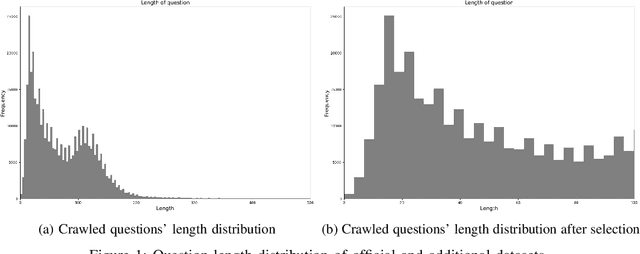
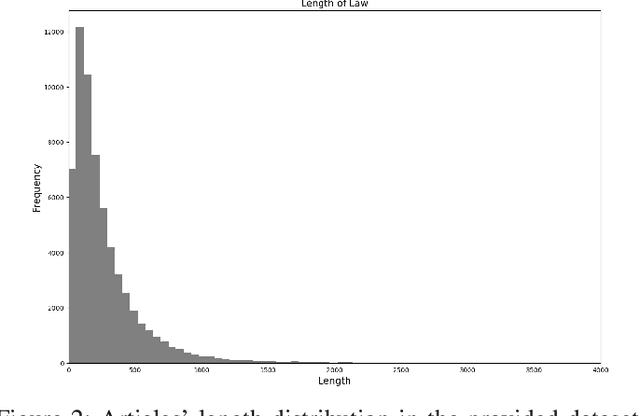
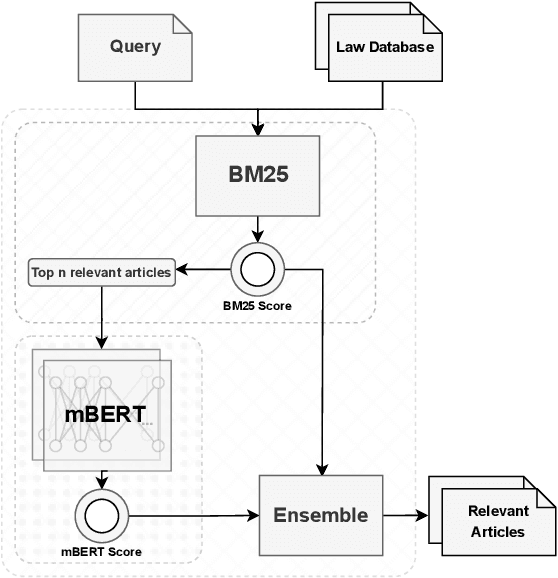
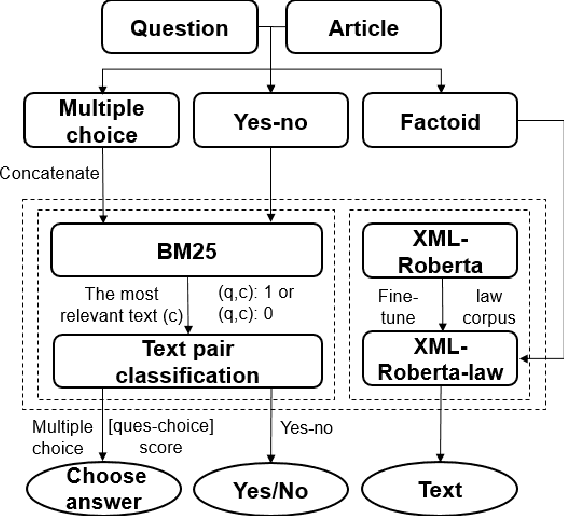
In recent years, natural language processing has gained significant popularity in various sectors, including the legal domain. This paper presents NeCo Team's solutions to the Vietnamese text processing tasks provided in the Automated Legal Question Answering Competition 2023 (ALQAC 2023), focusing on legal domain knowledge acquisition for low-resource languages through data enrichment. Our methods for the legal document retrieval task employ a combination of similarity ranking and deep learning models, while for the second task, which requires extracting an answer from a relevant legal article in response to a question, we propose a range of adaptive techniques to handle different question types. Our approaches achieve outstanding results on both tasks of the competition, demonstrating the potential benefits and effectiveness of question answering systems in the legal field, particularly for low-resource languages.