 Add to Chrome
 Add to Firefox
 Add to Edge
Integrated Graph Search and Model Predictive Control for Smooth and Efficient Path Planning in Autonomous Vehicles
Jul 05, 2026
Path planning is a fundamental component of autonomous vehicles, where achieving safe, comfortable, and dynamically feasible paths while ensuring computational efficiency remains a significant challenge. This paper presents a sequential path planning framework in which a rough path obtained from graph search is explicitly exploited to guide a Model Predictive Control (MPC)-based path refinement. A rough path is first obtained via Dijkstra search on a discretized grid and is then used to construct a spatially varying convex lateral safety corridor that explicitly captures obstacle avoidance constraints, transforming discrete obstacle avoidance decisions into continuous feasibility constraints for optimization. Within this corridor, an MPC problem is formulated to refine the path, enabling efficient optimization while maintaining path smoothness by penalizing the third-order spatial derivative of the lateral offset over a prediction horizon. The proposed algorithm is evaluated in multiple overtaking scenarios on both straight and curved roads, including cases with single and multiple target vehicles, using high-fidelity environment simulations (i.e., CarMaker). Compared with the previous study, which used polynomial fitting and a quadratic programming method, the proposed approach consistently achieves lower lateral acceleration, curvature, and jerk while reducing computational cost by 28.08% on straight roads and 29.52% on curved roads. These results demonstrate that exploiting graph-search structure within an MPC formulation provides an effective balance between path smoothness and computational efficiency for autonomous vehicles in structured driving environments.

Hierarchical Motion Planning and Offline Robust Model Predictive Control for Autonomous Vehicles
Feb 07, 2024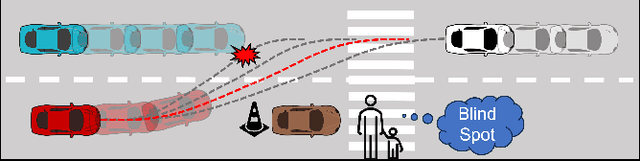
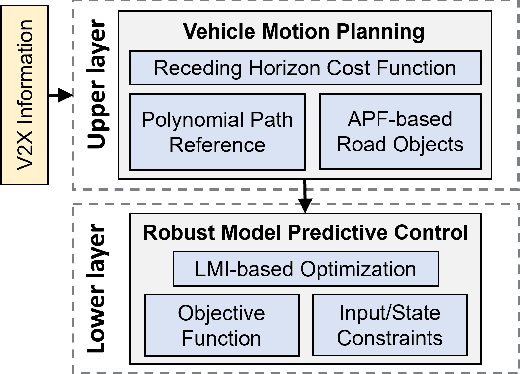

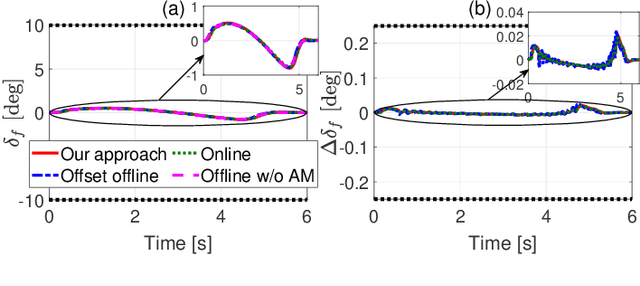
Driving vehicles in complex scenarios under harsh conditions is the biggest challenge for autonomous vehicles (AVs). To address this issue, we propose hierarchical motion planning and robust control strategy using the front-active steering system in complex scenarios with various slippery road adhesion coefficients while considering vehicle uncertain parameters. Behaviors of human vehicles (HVs) are considered and modeled in the form of a car-following model via the Intelligent Driver Model (IDM). Then, in the upper layer, the motion planner first generates an optimal trajectory by using the artificial potential field (APF) algorithm to formulate any surrounding objects, e.g., road marks, boundaries, and static/dynamic obstacles. To track the generated optimal trajectory, in the lower layer, an offline-constrained output feedback robust model predictive control (RMPC) is employed for the linear parameter varying (LPV) system by applying linear matrix inequality (LMI) optimization method that ensures the robustness against the model parameter uncertainties. Furthermore, by augmenting the system model, our proposed approach, called offline RMPC, achieves outstanding efficiency compared to three existing RMPC approaches, e.g., offset-offline RMPC, online RMPC, and offline RMPC without an augmented model (offline RMPC w/o AM), in both improving computing time and reducing input vibrations.