 Add to Chrome
 Add to Firefox
 Add to Edge
Dynamic Cooperative Strategies in Search Engine Advertising Market: With and Without Retail Competition
Dec 25, 2025
In search engine advertising (SEA) market, where competition among retailers is intense and multifaceted, channel coordination between retailers and manufacturers emerges as a critical factor, which significantly influences the effectiveness of advertising strategies. This research attempts to provide managerial guidelines for cooperative advertising in the SEA context by modeling two cooperative advertising decision scenarios. Scenario I defines a simple cooperative channel consisting of one manufacturer and one retailer. In Scenario II, we consider a more general setting where there is an independent retailer who competes with the Manufacturer-Retailer alliance in Scenario I. We propose a novel cooperative advertising optimization model, wherein a manufacturer can advertise product directly through SEA campaigns and indirectly by subsidizing its retailer. To highlight the distinctive features of SEA, our model incorporates dynamic quality scores and focuses on a finite time horizon. In each scenario, we provide a feasible equilibrium solution of optimal policies for all members. Subsequently, we conduct numerical experiments to perform sensitivity analysis for both the quality score and gross margin. Additionally, we explore the impact of the initial market share of the competing retailer in Scenario II. Finally, we investigate how retail competition affects the cooperative alliance's optimal strategy and channel performance. Our identified properties derived from the equilibrium and numerical analyses offer crucial insights for participants engaged in cooperative advertising within the SEA market.
* 60 pages, 17 figures,6 tables

Keyword Decisions in Sponsored Search Advertising: A Literature Review and Research Agenda
Feb 24, 2023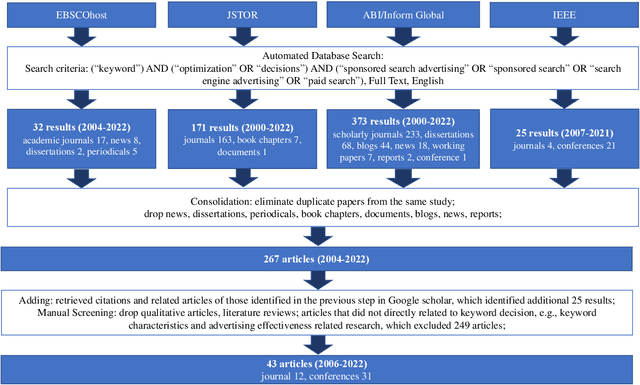
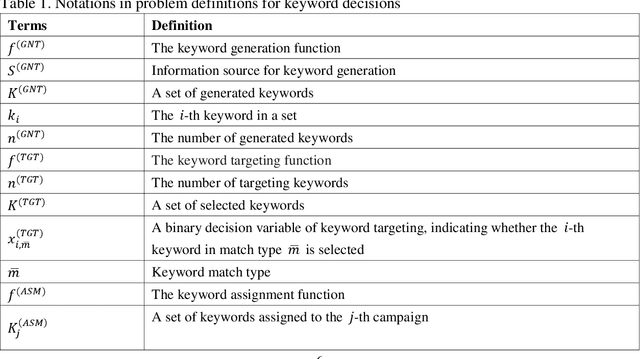
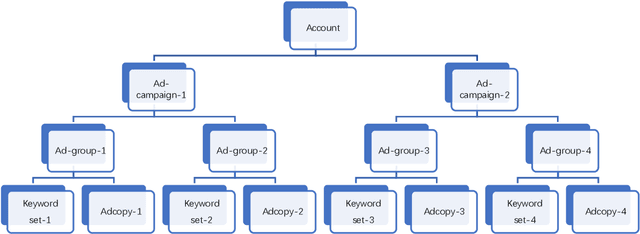
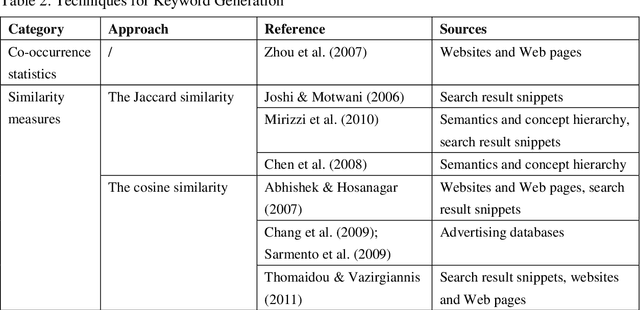
In sponsored search advertising (SSA), keywords serve as the basic unit of business model, linking three stakeholders: consumers, advertisers and search engines. This paper presents an overarching framework for keyword decisions that highlights the touchpoints in search advertising management, including four levels of keyword decisions, i.e., domain-specific keyword pool generation, keyword targeting, keyword assignment and grouping, and keyword adjustment. Using this framework, we review the state-of-the-art research literature on keyword decisions with respect to techniques, input features and evaluation metrics. Finally, we discuss evolving issues and identify potential gaps that exist in the literature and outline novel research perspectives for future exploration.
* 88 pages, 3 figures, 15 tables
Optimal Keywords Grouping in Sponsored Search Advertising under Uncertain Environments
Mar 04, 2022In sponsored search advertising, advertisers need to make a series of keyword decisions. Among them, how to group these keywords to form several adgroups within a campaign is a challenging task, due to the highly uncertain environment of search advertising. This paper proposes a stochastic programming model for keywords grouping, taking click-through rate and conversion rate as random variables, with consideration of budget constraints and advertisers' risk-tolerance. A branch-and-bound algorithm is developed to solve our model. Furthermore, we conduct computational experiments to evaluate the effectiveness of our model and solution, with two real-world datasets collected from reports and logs of search advertising campaigns. Experimental results illustrated that our keywords grouping approach outperforms five baselines, and it can approximately approach the optimum in a steady way. This research generates several interesting findings that illuminate critical managerial insights for advertisers in sponsored search advertising. First, keywords grouping does matter for advertisers, especially in the situation with a large number of keywords. Second, in keyword grouping decisions, the marginal profit does not necessarily show the marginal diminishing phenomenon as the budget increases. Such that, it's a worthy try for advertisers to increase their budget in keywords grouping decisions, in order to obtain additional profit. Third, the optimal keywords grouping solution is a result of multifaceted trade-off among various advertising factors. In particular, assigning more keywords into adgroups or having more budget won't certainly lead to higher profits. This suggests a warning for advertisers that it's not wise to take the number of keywords as the criterion for keywords grouping decisions.
* 36 pages, 6 figures, 5 tables