 Add to Chrome
 Add to Firefox
 Add to Edge
Dynamic Cooperative Strategies in Search Engine Advertising Market: With and Without Retail Competition
Dec 25, 2025
In search engine advertising (SEA) market, where competition among retailers is intense and multifaceted, channel coordination between retailers and manufacturers emerges as a critical factor, which significantly influences the effectiveness of advertising strategies. This research attempts to provide managerial guidelines for cooperative advertising in the SEA context by modeling two cooperative advertising decision scenarios. Scenario I defines a simple cooperative channel consisting of one manufacturer and one retailer. In Scenario II, we consider a more general setting where there is an independent retailer who competes with the Manufacturer-Retailer alliance in Scenario I. We propose a novel cooperative advertising optimization model, wherein a manufacturer can advertise product directly through SEA campaigns and indirectly by subsidizing its retailer. To highlight the distinctive features of SEA, our model incorporates dynamic quality scores and focuses on a finite time horizon. In each scenario, we provide a feasible equilibrium solution of optimal policies for all members. Subsequently, we conduct numerical experiments to perform sensitivity analysis for both the quality score and gross margin. Additionally, we explore the impact of the initial market share of the competing retailer in Scenario II. Finally, we investigate how retail competition affects the cooperative alliance's optimal strategy and channel performance. Our identified properties derived from the equilibrium and numerical analyses offer crucial insights for participants engaged in cooperative advertising within the SEA market.
* 60 pages, 17 figures,6 tables

Learning Parameters for a Generalized Vidale-Wolfe Response Model with Flexible Ad Elasticity and Word-of-Mouth
Feb 28, 2022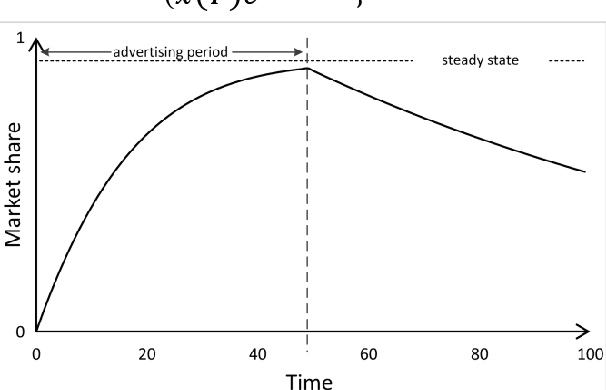
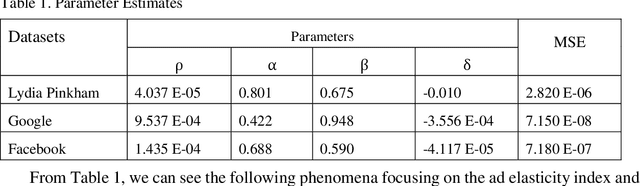
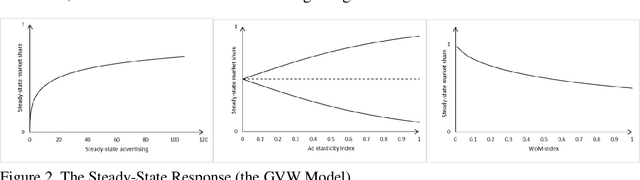
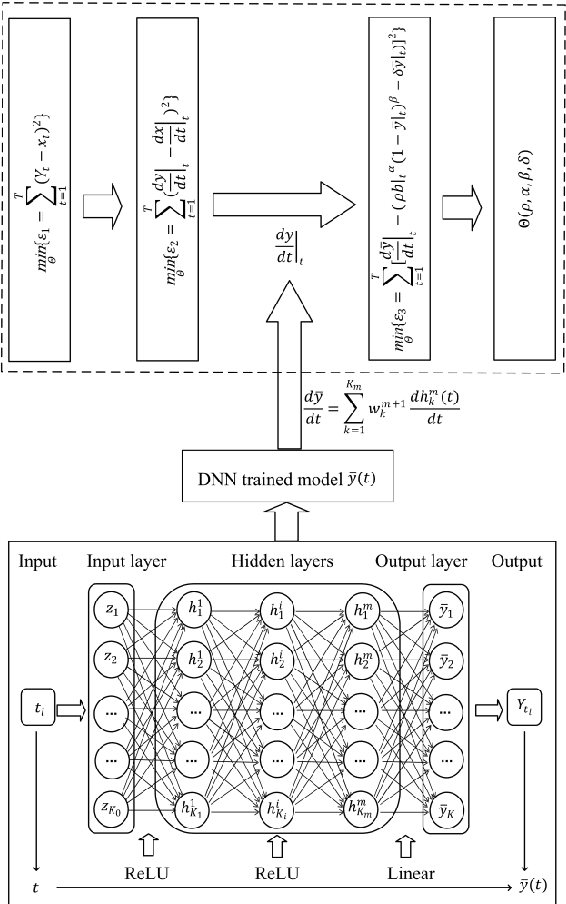
In this research, we investigate a generalized form of Vidale-Wolfe (GVW) model. One key element of our modeling work is that the GVW model contains two useful indexes representing advertiser's elasticity and the word-of-mouth (WoM) effect, respectively. Moreover, we discuss some desirable properties of the GVW model, and present a deep neural network (DNN)-based estimation method to learn its parameters. Furthermore, based on three realworld datasets, we conduct computational experiments to validate the GVW model and identified properties. In addition, we also discuss potential advantages of the GVW model over econometric models. The research outcome shows that both the ad elasticity index and the WoM index have significant influences on advertising responses, and the GVW model has potential advantages over econometric models of advertising, in terms of several interesting phenomena drawn from practical advertising situations. The GVW model and its deep learning-based estimation method provide a basis to support big data-driven advertising analytics and decision makings; in the meanwhile, identified properties and experimental findings of this research illuminate critical managerial insights for advertisers in various advertising forms.
* 20 pages, 8 figures, 1 table