 Add to Chrome
 Add to Firefox
 Add to Edge
Bridging Semantics and Physical Execution: A Neuro-Symbolic Framework for Multi-Pair Robotic Assembly
Jun 09, 2026
Multi-pair robotic assembly in unstructured environments faces spatial interference and contact uncertainties. Existing paradigms fail to bridge cognitive decision-making and physical execution, as they either encounter state-space explosion and knowledge bottlenecks or suffer from logical hallucinations and topological conflicts. We propose an end-to-end neuro-symbolic framework that solves the challenge hierarchically: generating optimal subgraphs for each pair, decoupling generality from edge cases, and then resolving cross-pair interferences. Given an eye-on-hand RGB-D assembly scene, the framework extracts semantic instance identity and state while quantifying the scene for divergence calculation. For each pair, optimal subgraph is generated via LLM using barely basic actions to mitigate hallucinations. Supportive actions for edge cases are reasoned and inserted with a lightweight discriminator. Driven by the divergence between the quantified baseline and current scene, it is easily extensible at low cost. Augmented subgraphs are topologically coordinated into global sequences while preserving internal behavioral coherence. Dynamic behavior trees embedding atomic skills close the force-aware execution loop. Offline evaluation on 100 real-world scenes achieves 97.00% global executability, outperforming classical and state-of-the-art planners. Real-robot deployment on a UR3 arm attains 90% success rate with 0.5 mm tolerance under strong interference, demonstrating a unified and verifiable solution for complex autonomous assembly.

Reactive Motion Generation With Particle-Based Perception in Dynamic Environments
Feb 18, 2026Reactive motion generation in dynamic and unstructured scenarios is typically subject to essentially static perception and system dynamics. Reliably modeling dynamic obstacles and optimizing collision-free trajectories under perceptive and control uncertainty are challenging. This article focuses on revealing tight connection between reactive planning and dynamic mapping for manipulators from a model-based perspective. To enable efficient particle-based perception with expressively dynamic property, we present a tensorized particle weight update scheme that explicitly maintains obstacle velocities and covariance meanwhile. Building upon this dynamic representation, we propose an obstacle-aware MPPI-based planning formulation that jointly propagates robot-obstacle dynamics, allowing future system motion to be predicted and evaluated under uncertainty. The model predictive method is shown to significantly improve safety and reactivity with dynamic surroundings. By applying our complete framework in simulated and noisy real-world environments, we demonstrate that explicit modeling of robot-obstacle dynamics consistently enhances performance over state-of-the-art MPPI-based perception-planning baselines avoiding multiple static and dynamic obstacles.
DSO-VSA: a Variable Stiffness Actuator with Decoupled Stiffness and Output Characteristics for Rehabilitation Robotics
Dec 21, 2025Stroke-induced motor impairment often results in substantial loss of upper-limb function, creating a strong demand for rehabilitation robots that enable safe and transparent physical human-robot interaction (pHRI). Variable stiffness actuators are well suited for such applications. However, in most existing designs, stiffness is coupled with the deflection angle, complicating both modeling and control. To address this limitation, this paper presents a variable stiffness actuator featuring decoupled stiffness and output behavior for rehabilitation robotics. The system integrates a variable stiffness mechanism that combines a variable-length lever with a hypocycloidal straight-line mechanism to achieve a linear torque-deflection relationship and continuous stiffness modulation from near zero to theoretically infinite. It also incorporates a differential transmission mechanism based on a planetary gear system that enables dual-motor load sharing. A cascade PI controller is further developed on the basis of the differential configuration, in which the position-loop term jointly regulates stiffness and deflection angle, effectively suppressing stiffness fluctuations and output disturbances. The performance of prototype was experimentally validated through stiffness calibration, stiffness regulation, torque control, decoupled characteristics, and dual-motor load sharing, indicating the potential for rehabilitation exoskeletons and other pHRI systems.
Learning Multimodal Confidence for Intention Recognition in Human-Robot Interaction
May 23, 2024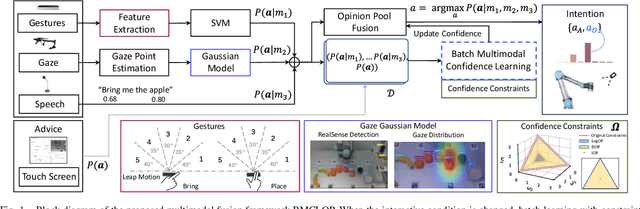
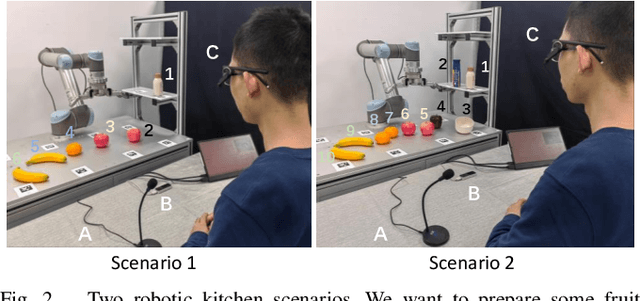
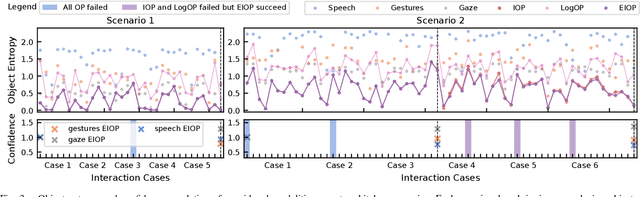

The rapid development of collaborative robotics has provided a new possibility of helping the elderly who has difficulties in daily life, allowing robots to operate according to specific intentions. However, efficient human-robot cooperation requires natural, accurate and reliable intention recognition in shared environments. The current paramount challenge for this is reducing the uncertainty of multimodal fused intention to be recognized and reasoning adaptively a more reliable result despite current interactive condition. In this work we propose a novel learning-based multimodal fusion framework Batch Multimodal Confidence Learning for Opinion Pool (BMCLOP). Our approach combines Bayesian multimodal fusion method and batch confidence learning algorithm to improve accuracy, uncertainty reduction and success rate given the interactive condition. In particular, the generic and practical multimodal intention recognition framework can be easily extended further. Our desired assistive scenarios consider three modalities gestures, speech and gaze, all of which produce categorical distributions over all the finite intentions. The proposed method is validated with a six-DoF robot through extensive experiments and exhibits high performance compared to baselines.