 Add to Chrome
 Add to Firefox
 Add to Edge
SERUM: Simple, Efficient, Robust, and Unifying Marking for Diffusion-based Image Generation
Mar 11, 2026
We propose SERUM: an intriguingly simple yet highly effective method for marking images generated by diffusion models (DMs). We only add a unique watermark noise to the initial diffusion generation noise and train a lightweight detector to identify watermarked images, simplifying and unifying the strengths of prior approaches. SERUM provides robustness against any image augmentations or watermark removal attacks and is extremely efficient, all while maintaining negligible impact on image quality. In contrast to prior approaches, which are often only resilient to limited perturbations and incur significant training, injection, and detection costs, our SERUM achieves remarkable performance, with the highest true positive rate (TPR) at a 1% false positive rate (FPR) in most scenarios, along with fast injection and detection and low detector training overhead. Its decoupled architecture also seamlessly supports multiple users by embedding individualized watermarks with little interference between the marks. Overall, our method provides a practical solution to mark outputs from DMs and to reliably distinguish generated from natural images.

FeNeC: Enhancing Continual Learning via Feature Clustering with Neighbor- or Logit-Based Classification
Mar 18, 2025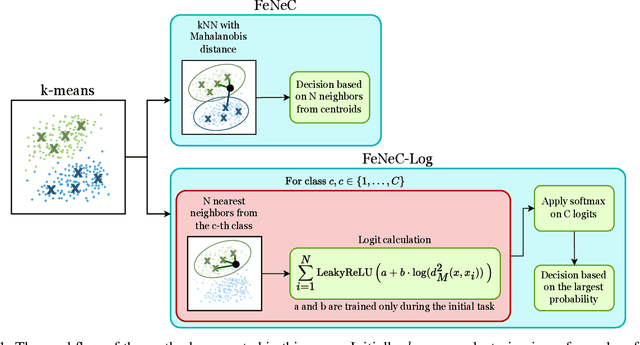

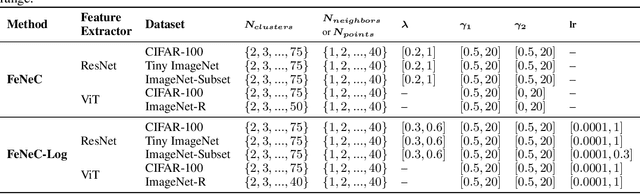
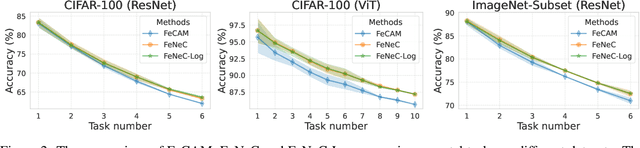
The ability of deep learning models to learn continuously is essential for adapting to new data categories and evolving data distributions. In recent years, approaches leveraging frozen feature extractors after an initial learning phase have been extensively studied. Many of these methods estimate per-class covariance matrices and prototypes based on backbone-derived feature representations. Within this paradigm, we introduce FeNeC (Feature Neighborhood Classifier) and FeNeC-Log, its variant based on the log-likelihood function. Our approach generalizes the existing concept by incorporating data clustering to capture greater intra-class variability. Utilizing the Mahalanobis distance, our models classify samples either through a nearest neighbor approach or trainable logit values assigned to consecutive classes. Our proposition may be reduced to the existing approaches in a special case while extending them with the ability of more flexible adaptation to data. We demonstrate that two FeNeC variants achieve competitive performance in scenarios where task identities are unknown and establish state-of-the-art results on several benchmarks.