 Add to Chrome
 Add to Firefox
 Add to Edge
2D Stability Selection: Design Jittering for Doubly Stable Feature Selection
May 04, 2026
We study feature selection in high-dimensional regression under two distinct sources of instability: sampling variability and measurement error in the design matrix. Stability Selection addresses the former through sub-sampling and aggregation, but does not explicitly stress-test robustness to noisy predictors. We introduce doubly stable feature selection, a perturb-and-aggregate framework that targets features whose inclusion is stable both across randomization and across increasing levels of design noise. The method injects controlled additive noise into the design matrix, fits a fixed base selector such as the Lasso on the perturbed data, and aggregates selection frequencies. Sweeping over a grid of noise levels yields a stability path that summarizes robustness to measurement error while using the full sample size and isolating the effect of design perturbations. On the theory side, we show that classical model-selection conditions are preserved under sufficiently small perturbations, with a high-probability extension for Gaussian noise. Empirically, experiments on synthetic and real datasets show improved robustness compared with Stability Selection and standard base selectors.

Adaptive Importance Sampling and Quasi-Monte Carlo Methods for 6G URLLC Systems
Mar 07, 2023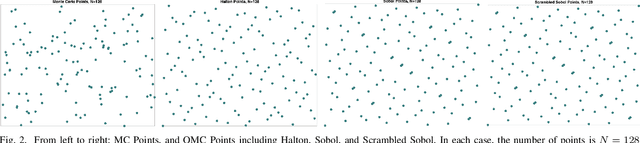
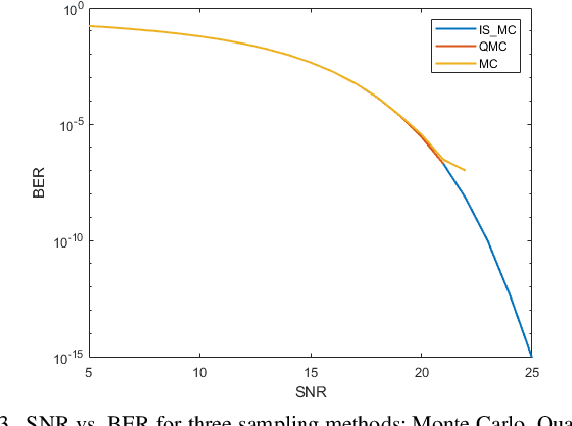
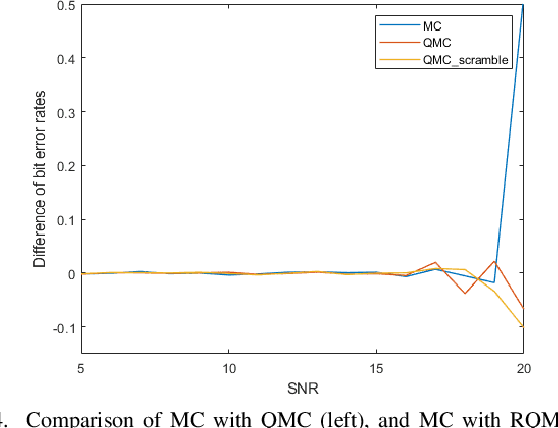
In this paper, we propose an efficient simulation method based on adaptive importance sampling, which can automatically find the optimal proposal within the Gaussian family based on previous samples, to evaluate the probability of bit error rate (BER) or word error rate (WER). These two measures, which involve high-dimensional black-box integration and rare-event sampling, can characterize the performance of coded modulation. We further integrate the quasi-Monte Carlo method within our framework to improve the convergence speed. The proposed importance sampling algorithm is demonstrated to have much higher efficiency than the standard Monte Carlo method in the AWGN scenario.