 Add to Chrome
 Add to Firefox
 Add to Edge
KGCaRe: Explainable Complex Conditional Question Answering using Automatic Knowledge Graph Construction and Context Retrieval with LLMs
Aug 10, 2026
Answering complex conditional questions using Large Language Models (LLMs) and Retrieval-Augmented Generation (RAG) remains a challenge, particularly in domain-specific contexts where general-purpose LLMs and RAG tend to underperform. We hypothesize that augmenting RAG with unstructured and structured knowledge, extracted from both documents and knowledge graphs (KGs), can improve reasoning and answer accuracy for such tasks. To test this, we propose KGCaRe, a hybrid approach that combines neural retrieval with symbolic reasoning over LLM-generated KGs. KGCaRe constructs a KG from documents using a multi-prompt extraction strategy and stores it in a graph database. Simultaneously, the documents are embedded into a vector store to enable neural retrieval. KGCaRe performs innovative iterative graph traversal guided by the LLM to extract relevant triples, prune irrelevant information, and uses additional clue entities to traverse the graph again if the initial traversal does not provide satisfactory context to generate the answer. The relevant triples extracted from the KG in path form, along with semantically retrieved text passages, are then fed into custom KGCaRe prompts to generate answers to the complex conditional questions with explanations. We evaluate KGCaRe on two complex conditional QA datasets. Our results on these datasets show that KGCaRe consistently outperforms existing baselines, including Vanilla LLM, Code Prompt, Text Prompt, Think-on-Graph, Vanilla RAG, and HybridContextQA, across multiple LLMs such as Mistral, Mixtral, GPT-3.5, and GPT-4o. We publicly release the software pipeline that we developed to implement the proposed KGCaRe approach.

Multi-output Headed Ensembles for Product Item Classification
Jul 29, 2023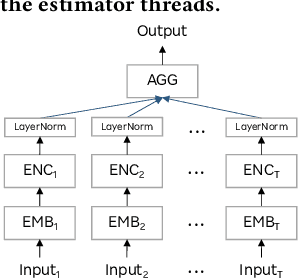
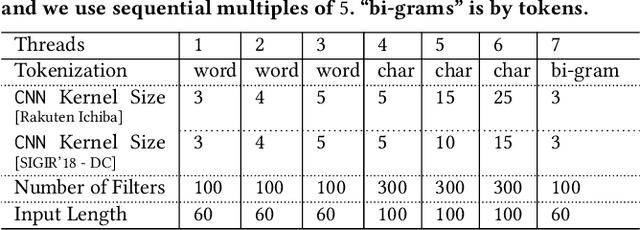
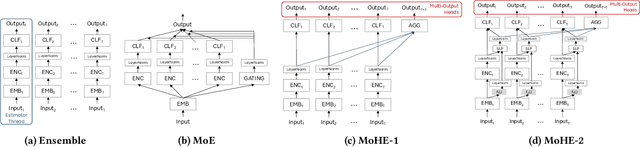
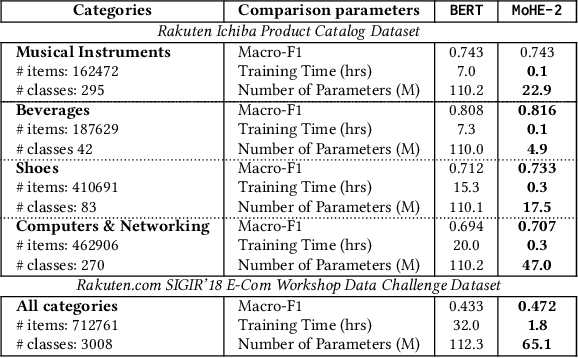
In this paper, we revisit the problem of product item classification for large-scale e-commerce catalogs. The taxonomy of e-commerce catalogs consists of thousands of genres to which are assigned items that are uploaded by merchants on a continuous basis. The genre assignments by merchants are often wrong but treated as ground truth labels in automatically generated training sets, thus creating a feedback loop that leads to poorer model quality over time. This problem of taxonomy classification becomes highly pronounced due to the unavailability of sizable curated training sets. Under such a scenario it is common to combine multiple classifiers to combat poor generalization performance from a single classifier. We propose an extensible deep learning based classification model framework that benefits from the simplicity and robustness of averaging ensembles and fusion based classifiers. We are also able to use metadata features and low-level feature engineering to boost classification performance. We show these improvements against robust industry standard baseline models that employ hyperparameter optimization. Additionally, due to continuous insertion, deletion and updates to real-world high-volume e-commerce catalogs, assessing model performance for deployment using A/B testing and/or manual annotation becomes a bottleneck. To this end, we also propose a novel way to evaluate model performance using user sessions that provides better insights in addition to traditional measures of precision and recall.