 Add to Chrome
 Add to Firefox
 Add to Edge
Wrench-Aware Admittance Control for Unknown-Payload Manipulation
Apr 21, 2026
Unknown payloads can strongly affect compliant robotic manipulation, especially when the payload center of mass is not aligned with the tool center point. In this case, the payload generates an offset wrench at the robot wrist. During motion, this wrench is not only related to payload weight, but also to payload inertia. If it is not modeled, the compliant controller can interpret it as an external interaction wrench, which causes unintended compliant motion, larger tracking error, and reduced transport accuracy. This paper presents a wrench-aware admittance control framework for unknown-payload pick-and-place using a UR5e robot. The method uses force-torque measurements in two different roles. First, a three-axis translational excitation term is used to reduce payload-induced force effects during transport without making the robot excessively stiff. Second, after grasping, the controller first estimates payload mass for transport compensation and then estimates the payload CoM offset relative to the TCP using wrist force-torque measurements collected during the subsequent translational motion. This helps improve object placement and stacking behavior. Experimental results show improved transport and placement performance compared with uncorrected placement while preserving compliant motion.

Reachability-Aware Time Scaling for Path Tracking
Apr 01, 2026This paper studies tracking of collision-free waypoint paths produced by an offline planner for a planar double-integrator system with bounded speed and acceleration. Because sampling-based planners must route around obstacles, the resulting waypoint paths can contain sharp turns and high-curvature regions, so one-step reachability under acceleration limits becomes critical even when the path geometry is collision-free. We build on a pure-pursuit-style, reachability-guided quadratic-program (QP) tracker with a one-step acceleration margin. Offline, we evaluate this margin along a spline fitted to the waypoint path and update a scalar speed-scaling profile so that the required one-step acceleration remains below the available bound. Online, the same look-ahead tracking structure is used to track the scaled reference.
Mass-Adaptive Admittance Control for Robotic Manipulators
Apr 22, 2025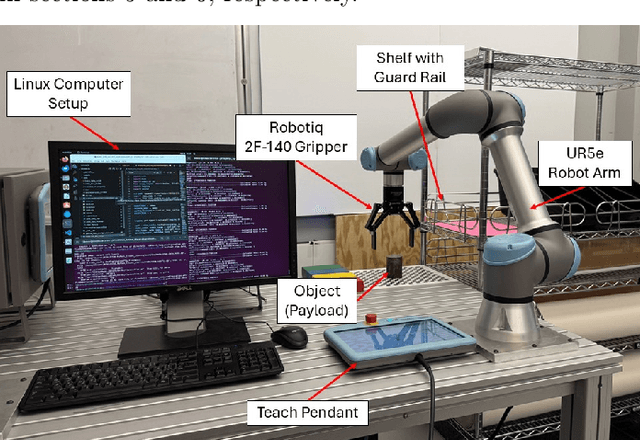
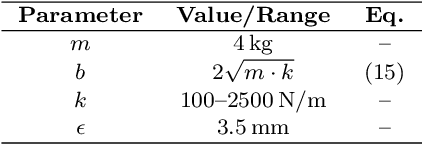
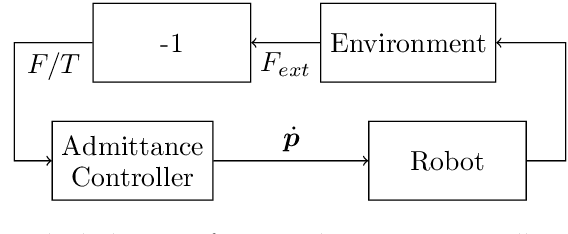
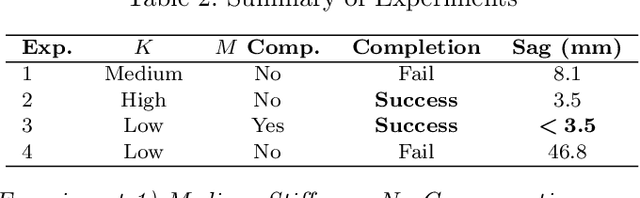
Handling objects with unknown or changing masses is a common challenge in robotics, often leading to errors or instability if the control system cannot adapt in real-time. In this paper, we present a novel approach that enables a six-degrees-of-freedom robotic manipulator to reliably follow waypoints while automatically estimating and compensating for unknown payload weight. Our method integrates an admittance control framework with a mass estimator, allowing the robot to dynamically update an excitation force to compensate for the payload mass. This strategy mitigates end-effector sagging and preserves stability when handling objects of unknown weights. We experimentally validated our approach in a challenging pick-and-place task on a shelf with a crossbar, improved accuracy in reaching waypoints and compliant motion compared to a baseline admittance-control scheme. By safely accommodating unknown payloads, our work enhances flexibility in robotic automation and represents a significant step forward in adaptive control for uncertain environments.