 Add to Chrome
 Add to Firefox
 Add to Edge
SoccerLens: Grounded Soccer Video Understanding Beyond Accuracy
May 10, 2026
Vision-language models (VLMs) have recently shown strong potential in soccer video understanding. However, given the high complexity of soccer videos due to large viewpoint variations, rapid shot transitions, and cluttered scenes, it remains unclear on whether VLMs rely on meaningful visual evidence or exploit spurious correlations and shortcut learning. Existing evaluation protocols focus primarily on classification accuracy and do not assess visual grounding. To address this limitation, we introduce SoccerLens, a benchmark for grounded soccer video understanding. The benchmark contains annotated video segments spanning $13$ common soccer events, with structured visual cues organized into three levels of semantic relevance. We further extend the attribution method of Chefer [arXiv:2103.15679] to jointly model spatial and temporal attention, and introduce evaluation metrics that measure whether model attention aligns with annotated cues or drifts toward spurious regions. Our evaluation of state-of-the-art soccer VLMs shows that, despite strong classification accuracy, current models fail to exceed $50\%$ grounding performance even under the loosest cue definitions and consistently underutilize temporal information. These results reveal a substantial gap between predictive performance and true visual grounding, highlighting the need for grounded evaluation in complex spatio-temporal domains such as soccer.

FLoBC: A Decentralized Blockchain-Based Federated Learning Framework
Dec 22, 2021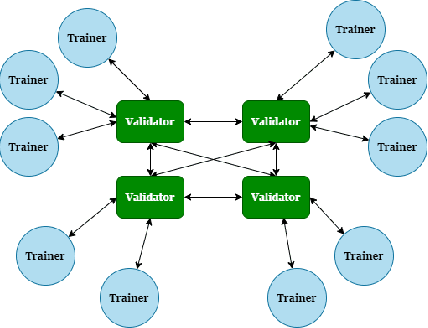
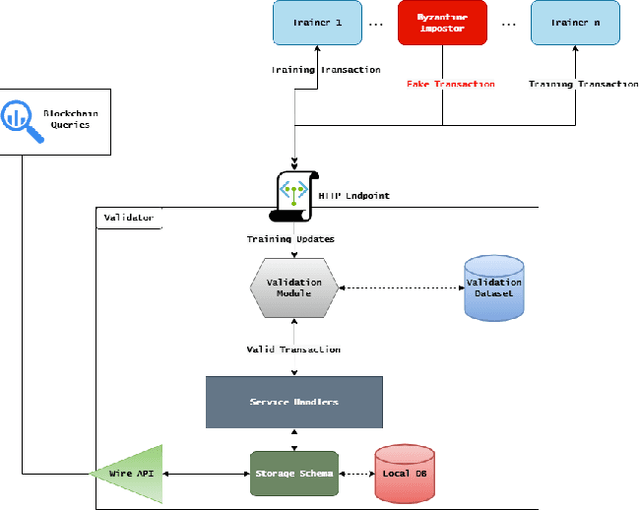
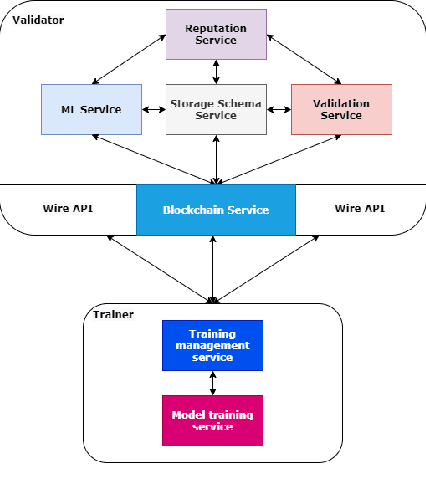
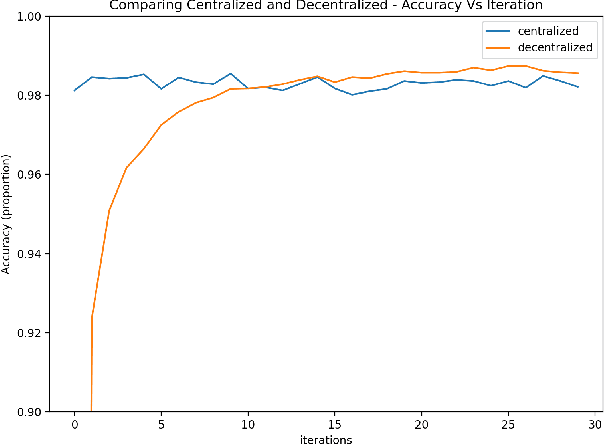
The rapid expansion of data worldwide invites the need for more distributed solutions in order to apply machine learning on a much wider scale. The resultant distributed learning systems can have various degrees of centralization. In this work, we demonstrate our solution FLoBC for building a generic decentralized federated learning system using blockchain technology, accommodating any machine learning model that is compatible with gradient descent optimization. We present our system design comprising the two decentralized actors: trainer and validator, alongside our methodology for ensuring reliable and efficient operation of said system. Finally, we utilize FLoBC as an experimental sandbox to compare and contrast the effects of trainer-to-validator ratio, reward-penalty policy, and model synchronization schemes on the overall system performance, ultimately showing by example that a decentralized federated learning system is indeed a feasible alternative to more centralized architectures.