 Add to Chrome
 Add to Firefox
 Add to Edge
Zero Hallucination, by Construction: Hallucination-Aware Layered Oversight for Trustworthy Enterprise AI
Jul 20, 2026
Enterprises will not deploy AI agents they cannot trust, and the most-cited reason for distrust is hallucination: confident, fluent output that is simply not true. The common response is to wait for a model that does not hallucinate. We argue that this is the wrong target. Large language models are, by construction, capable of generating unsupported text, and no amount of scale removes the possibility; a faithfulness judge bolted onto a raw model catches some errors but still ships others, and even well-curated retrieval pipelines have been shown to fabricate citations. We reframe the goal: "zero hallucination" is not a property a model possesses but a property a system enforces. We present HALO (Hallucination-Aware Layered Oversight), an assurance architecture which treats hallucination as a containable failure mode rather than an eliminable one. HALO composes six layers of defense: grounded generation over retrieved, approved content; constrained, deterministic execution that bounds where the model can err; multi-signal verification that scores every output for groundedness and hallucination using both an LLM judge and evidence-based checks against the source text; calibrated abstention, so the system declines rather than guesses when grounding is insufficient; total traceability of every retrieval, tool call, and generation; and continuous oversight that detects drift, alerts on threshold breaches, and closes the loop by regenerating and statistically validating improved agents. We detail each layer, give particular attention to evidence-based confidence (which verifies extractions against the source document rather than trusting the model's self-reported certainty), and illustrate the architecture on a regulated claims-extraction workload

A Classifier That Teaches Itself: Self-Improving, Frozen-gate Training (SIFT) for Dynamic Document Classification
Jul 20, 2026Document classification is a solved problem in the laboratory and an unsolved one in the enterprise. The blocker is rarely model architecture; it is the labeling project that must precede a model and the institutional fear of letting a model retrain itself once one exists. We present SIFT (Self-Improving, Frozen-gate Training), a dynamic classifier service, which attacks both. SIFT serves classification from a deliberately cheap, CPU-bound pipeline, a SPLADE sparse encoder feeding a LightGBM head, and escalates only the low-confidence minority of pages to an LLM judge. The judge's verdicts are written back into a labeled corpus, so the expensive model continuously teaches the cheap one: the escalation rate falls, the corpus grows from production traffic rather than from an up-front annotation effort, and accuracy compounds with use. Onboarding a new document family requires only a declarative bundle, label space, anchor phrases, and a judge glossary, not a labeling project. The harder problem is safety: an autonomously retraining classifier can silently regress. SIFT resolves this with a two-part promote gate, a critical-label F1 regression check plus a frozen golden regression set the model is never trained on, either of which vetoes promotion. This turns "retrain monthly without a human" from reckless into routine. We describe the architecture, the self-feeding corpus loop, the frozen-gate promotion mechanism, and an illustrative multi-domain deployment, and we discuss the economics of a classifier whose marginal labeling cost trends toward zero.
"Vorbeşti Româneşte?" A Recipe to Train Powerful Romanian LLMs with English Instructions
Jun 26, 2024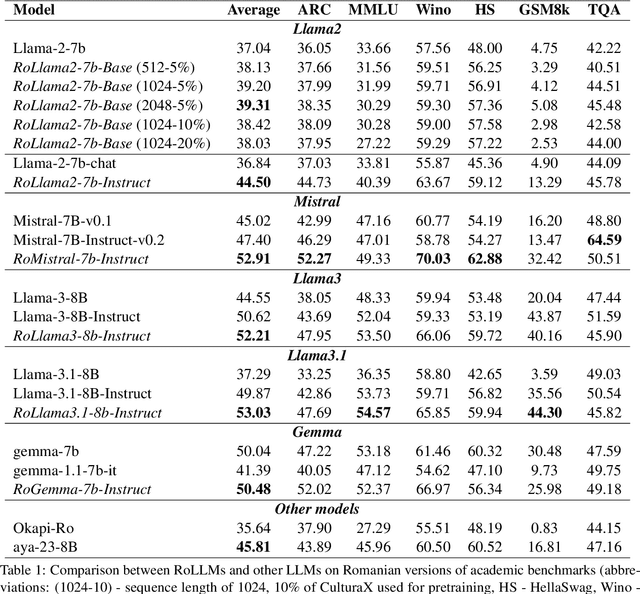
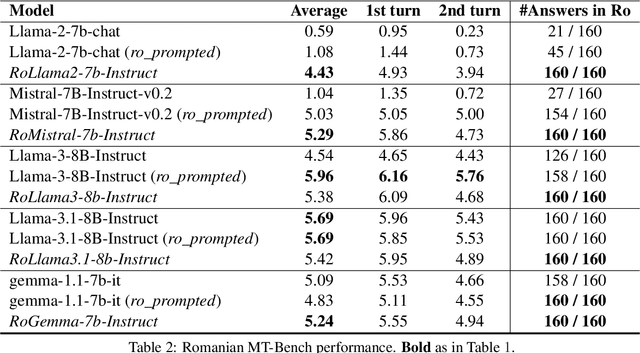
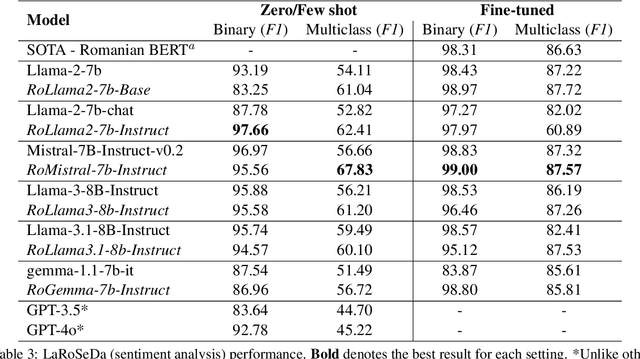
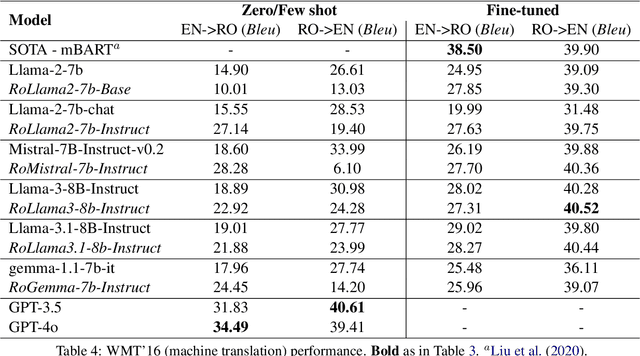
In recent years, Large Language Models (LLMs) have achieved almost human-like performance on various tasks. While some LLMs have been trained on multilingual data, most of the training data is in English; hence, their performance in English greatly exceeds other languages. To our knowledge, we are the first to collect and translate a large collection of texts, instructions, and benchmarks and train, evaluate, and release open-source LLMs tailored for Romanian. We evaluate our methods on four different categories, including academic benchmarks, MT-Bench (manually translated), and a professionally built historical, cultural, and social benchmark adapted to Romanian. We argue for the usefulness and high performance of RoLLMs by obtaining state-of-the-art results across the board. We publicly release all resources (i.e., data, training and evaluation code, models) to support and encourage research on Romanian LLMs while concurrently creating a generalizable recipe, adequate for other low or less-resourced languages.
OpenLLM-Ro -- Technical Report on Open-source Romanian LLMs
May 17, 2024

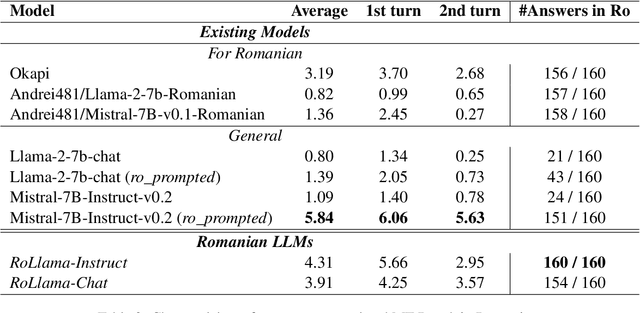
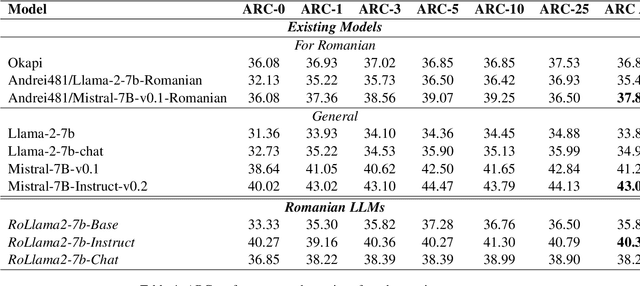
In recent years, Large Language Models (LLMs) have achieved almost human-like performance on various tasks. While some LLMs have been trained on multilingual data, most of the training data is in English. Hence, their performance in English greatly exceeds their performance in other languages. This document presents our approach to training and evaluating the first foundational and chat LLM specialized for Romanian.
Improving Legal Judgement Prediction in Romanian with Long Text Encoders
Mar 04, 2024
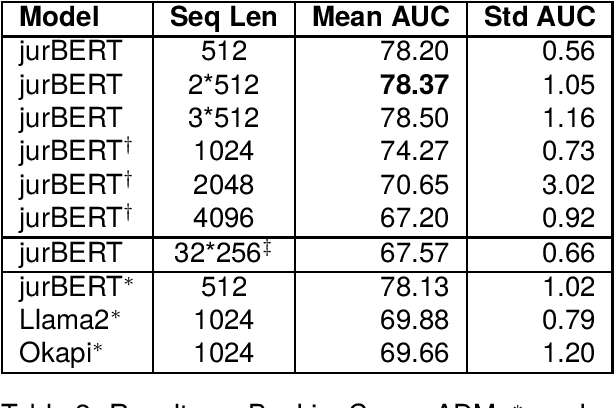


In recent years,the entire field of Natural Language Processing (NLP) has enjoyed amazing novel results achieving almost human-like performance on a variety of tasks. Legal NLP domain has also been part of this process, as it has seen an impressive growth. However, general-purpose models are not readily applicable for legal domain. Due to the nature of the domain (e.g. specialized vocabulary, long documents) specific models and methods are often needed for Legal NLP. In this work we investigate both specialized and general models for predicting the final ruling of a legal case, task known as Legal Judgment Prediction (LJP). We particularly focus on methods to extend to sequence length of Transformer-based models to better understand the long documents present in legal corpora. Extensive experiments on 4 LJP datasets in Romanian, originating from 2 sources with significantly different sizes and document lengths, show that specialized models and handling long texts are critical for a good performance.