 Add to Chrome
 Add to Firefox
 Add to Edge
The Power of Light: Improving Synthetic-to-Real Domain Adaptation through Physically-Based Indirect Illumination
Jun 21, 2026
While synthetic data generation resolves the manual labeling bottleneck in computer vision, minimizing the syn-to-real domain gap requires optimizing rendering variables. This paper presents a systematic study analyzing the impact of lighting configurations and background complexity on object detection performance. We introduce SmartSDG, an automated, reproducible pipeline built on NVIDIA Isaac Sim using Physically-Based Shading (PBS), alongside ILLUM\_INTRUCK, a new multi-object industrial benchmark dataset. Through 18 controlled experiments utilizing a state-of-the-art YOLOv12 framework, we demonstrate that complex, indirect lighting configurations paired with domain-relevant background variability significantly increase visual cue richness. Our quantitative findings show that avoiding direct specular peaks preserves crucial surface textures, mitigates the domain gap, reduces false positives, and accelerates model convergence compared to using conventional direct-light synthetic data. Ultimately, we provide actionable virtual scene design guidelines to maximize object detection robustness in industrial automation.

Worker Activity Recognition in Manufacturing Line Using Near-body Electric Field
Aug 07, 2023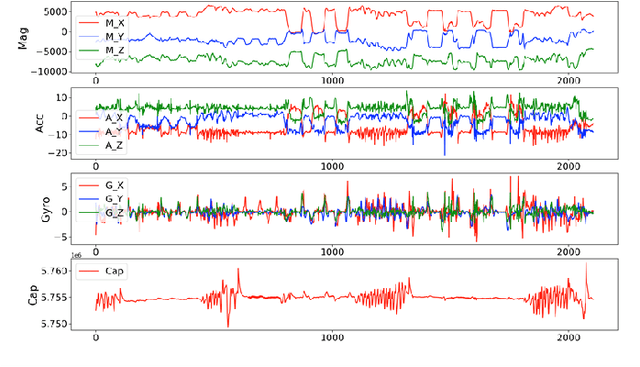
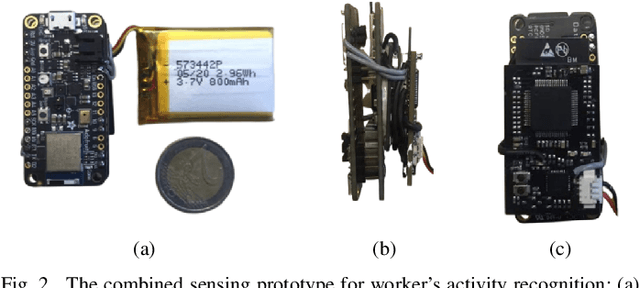

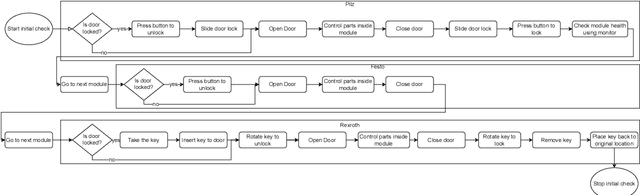
Manufacturing industries strive to improve production efficiency and product quality by deploying advanced sensing and control systems. Wearable sensors are emerging as a promising solution for achieving this goal, as they can provide continuous and unobtrusive monitoring of workers' activities in the manufacturing line. This paper presents a novel wearable sensing prototype that combines IMU and body capacitance sensing modules to recognize worker activities in the manufacturing line. To handle these multimodal sensor data, we propose and compare early, and late sensor data fusion approaches for multi-channel time-series convolutional neural networks and deep convolutional LSTM. We evaluate the proposed hardware and neural network model by collecting and annotating sensor data using the proposed sensing prototype and Apple Watches in the testbed of the manufacturing line. Experimental results demonstrate that our proposed methods achieve superior performance compared to the baseline methods, indicating the potential of the proposed approach for real-world applications in manufacturing industries. Furthermore, the proposed sensing prototype with a body capacitive sensor and feature fusion method improves by 6.35%, yielding a 9.38% higher macro F1 score than the proposed sensing prototype without a body capacitive sensor and Apple Watch data, respectively.