 Add to Chrome
 Add to Firefox
 Add to Edge
RadarEye: Robust Liquid Level Tracking Using mmWave Radar in Robotic Pouring
Feb 11, 2026
Transparent liquid manipulation in robotic pouring remains challenging for perception systems: specular/refraction effects and lighting variability degrade visual cues, undermining reliable level estimation. To address this challenge, we introduce RadarEye, a real-time mmWave radar signal processing pipeline for robust liquid level estimation and tracking during the whole pouring process. RadarEye integrates (i) a high-resolution range-angle beamforming module for liquid level sensing and (ii) a physics-informed mid-pour tracker that suppresses multipath to maintain lock on the liquid surface despite stream-induced clutter and source container reflections. The pipeline delivers sub-millisecond latency. In real-robot water-pouring experiments, RadarEye achieves a 0.35 cm median absolute height error at 0.62 ms per update, substantially outperforming vision and ultrasound baselines.

FuseGrasp: Radar-Camera Fusion for Robotic Grasping of Transparent Objects
Feb 28, 2025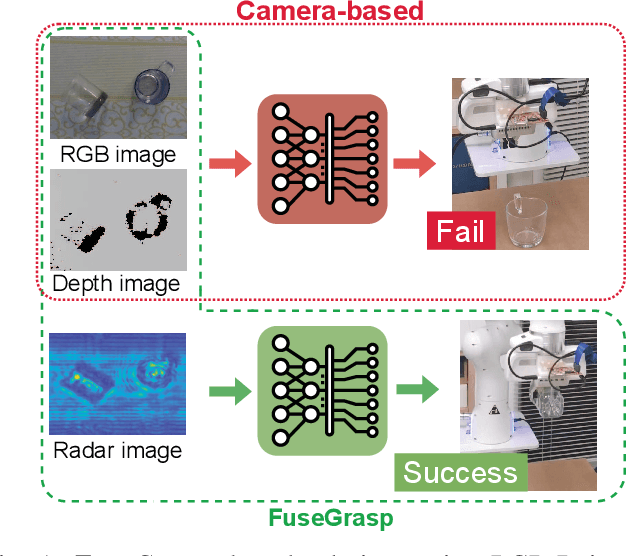
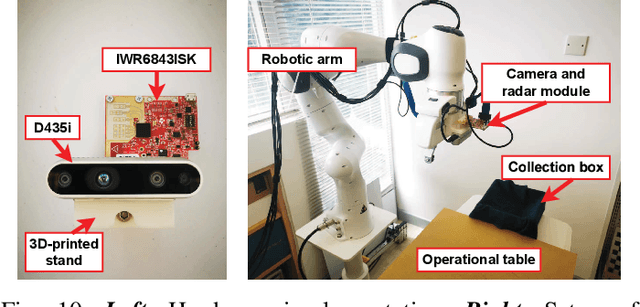
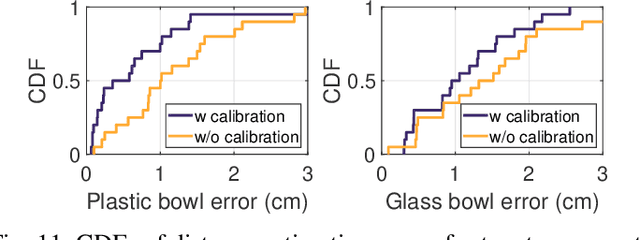
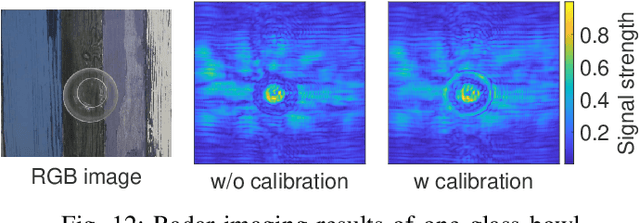
Transparent objects are prevalent in everyday environments, but their distinct physical properties pose significant challenges for camera-guided robotic arms. Current research is mainly dependent on camera-only approaches, which often falter in suboptimal conditions, such as low-light environments. In response to this challenge, we present FuseGrasp, the first radar-camera fusion system tailored to enhance the transparent objects manipulation. FuseGrasp exploits the weak penetrating property of millimeter-wave (mmWave) signals, which causes transparent materials to appear opaque, and combines it with the precise motion control of a robotic arm to acquire high-quality mmWave radar images of transparent objects. The system employs a carefully designed deep neural network to fuse radar and camera imagery, thereby improving depth completion and elevating the success rate of object grasping. Nevertheless, training FuseGrasp effectively is non-trivial, due to limited radar image datasets for transparent objects. We address this issue utilizing large RGB-D dataset, and propose an effective two-stage training approach: we first pre-train FuseGrasp on a large public RGB-D dataset of transparent objects, then fine-tune it on a self-built small RGB-D-Radar dataset. Furthermore, as a byproduct, FuseGrasp can determine the composition of transparent objects, such as glass or plastic, leveraging the material identification capability of mmWave radar. This identification result facilitates the robotic arm in modulating its grip force appropriately. Extensive testing reveals that FuseGrasp significantly improves the accuracy of depth reconstruction and material identification for transparent objects. Moreover, real-world robotic trials have confirmed that FuseGrasp markedly enhances the handling of transparent items. A video demonstration of FuseGrasp is available at https://youtu.be/MWDqv0sRSok.