 Add to Chrome
 Add to Firefox
 Add to Edge
Cross-view Multimodal Vision-Based Assessment Framework for Traditional Chinese Medicine Rehabilitation Training
Jun 26, 2026
Vision-based assessment can provide convenient and cost-effective evaluation in Traditional Chinese Medicine (TCM) rehabilitation training, where action quality assessment (AQA) from computer vision offers a promising solution. Existing automatic AQA frameworks for physical therapy typically rely on skeletal data captured from a single viewpoint, which is inefficient for TCM techniques such as acupuncture or Tuina that involve dense hand self-occlusion and complex hand-object interactions. To address these challenges, we propose CME-AQA, a cross-view, multimodal vision-based assessment framework that integrates visual-pose fusion to enhance understanding of environmental context and leverages both first-person and third-person videos during training to improve inference robustness. We collected two dual-view datasets, TCM-AQA61-A (Acupuncture) and TCM-AQA61-T (Tuina), each containing synchronized first-person and third-person recordings of 61 subjects with expert annotations. Experimental results show that our approach achieves superior or comparable mean performance against competitive baselines, achieving over 10% relative improvement in weighted F1 over the best competing method on key rating tasks such as Needle Depth and Quick Needle Insertion, while also reducing mean absolute error in quantitative measures such as insertion time and manipulation frequency. Testing on a CPR dataset further demonstrates comparable performance on several posture-based criteria, suggesting applicability to related structured simulated clinical skill assessments where participant motion is central to evaluation. Overall, CME-AQA enhances assessment accuracy for structured TCM rehabilitation training and facilitates more convenient and effective training-oriented skill evaluation.
* Published in IEEE Transactions on Neural Systems and Rehabilitation Engineering, 2026

Correlation-Distance Graph Learning for Treatment Response Prediction from rs-fMRI
Nov 17, 2023
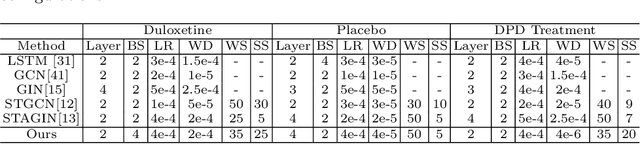
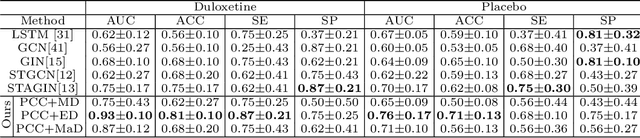

Resting-state fMRI (rs-fMRI) functional connectivity (FC) analysis provides valuable insights into the relationships between different brain regions and their potential implications for neurological or psychiatric disorders. However, specific design efforts to predict treatment response from rs-fMRI remain limited due to difficulties in understanding the current brain state and the underlying mechanisms driving the observed patterns, which limited the clinical application of rs-fMRI. To overcome that, we propose a graph learning framework that captures comprehensive features by integrating both correlation and distance-based similarity measures under a contrastive loss. This approach results in a more expressive framework that captures brain dynamic features at different scales and enables more accurate prediction of treatment response. Our experiments on the chronic pain and depersonalization disorder datasets demonstrate that our proposed method outperforms current methods in different scenarios. To the best of our knowledge, we are the first to explore the integration of distance-based and correlation-based neural similarity into graph learning for treatment response prediction.