 Add to Chrome
 Add to Firefox
 Add to Edge
Discourse Diversity in Multi-Turn Empathic Dialogue
Apr 13, 2026
Large language models (LLMs) produce responses rated as highly empathic in single-turn settings (Ayers et al., 2023; Lee et al., 2024), yet they are also known to be formulaic generators that reuse the same lexical patterns, syntactic templates, and discourse structures across tasks (Jiang et al., 2025; Shaib et al., 2024; Namuduri et al., 2025). Less attention has been paid to whether this formulaicity extends to the level of discourse moves, i.e., what a response does for the person it is addressing. This question is especially consequential for empathic dialogue, where effective support demands not just a kind response at one moment but varied strategies as a conversation unfolds (Stiles et al., 1998). Indeed, prior work shows that LLMs reuse the same tactic sequences more than human supporters in single-turn settings (Gueorguieva et al., 2026). We extend this analysis to multi-turn conversations and find that the rigidity compounds: once a tactic appears in a supporter turn, LLMs reuse it in the next at nearly double the rate of humans (0.50-0.56 vs. 0.27). This pattern holds across LLMs serving as supporters in real emotional support conversations, and is invisible to standard similarity metrics. To address this gap, we introduce MINT (Multi-turn Inter-tactic Novelty Training), the first reinforcement learning framework to optimize discourse move diversity across multi-turn empathic dialogue. The best MINT variant combines an empathy quality reward with a cross-turn tactic novelty signal, improving aggregate empathy by 25.3% over vanilla across 1.7B and 4B models while reducing cross-turn discourse move repetition by 26.3% on the 4B model, surpassing all baselines including quality-only and token-level diversity methods on both measures. These results suggest that what current models lack is not empathy itself, but the ability to vary their discourse moves across a conversation.

AI generates well-liked but templatic empathic responses
Apr 09, 2026Recent research shows that greater numbers of people are turning to Large Language Models (LLMs) for emotional support, and that people rate LLM responses as more empathic than human-written responses. We suggest a reason for this success: LLMs have learned and consistently deploy a well-liked template for expressing empathy. We develop a taxonomy of 10 empathic language "tactics" that include validating someone's feelings and paraphrasing, and apply this taxonomy to characterize the language that people and LLMs produce when writing empathic responses. Across a set of 2 studies comparing a total of n = 3,265 AI-generated (by six models) and n = 1,290 human-written responses, we find that LLM responses are highly formulaic at a discourse functional level. We discovered a template -- a structured sequence of tactics -- that matches between 83--90% of LLM responses (and 60--83\% in a held out sample), and when those are matched, covers 81--92% of the response. By contrast, human-written responses are more diverse. We end with a discussion of implications for the future of AI-generated empathy.
SPRI: Aligning Large Language Models with Context-Situated Principles
Feb 05, 2025


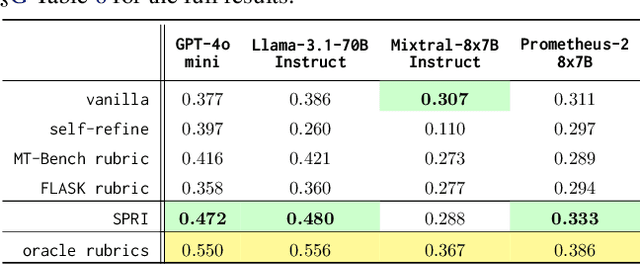
Aligning Large Language Models to integrate and reflect human values, especially for tasks that demand intricate human oversight, is arduous since it is resource-intensive and time-consuming to depend on human expertise for context-specific guidance. Prior work has utilized predefined sets of rules or principles to steer the behavior of models (Bai et al., 2022; Sun et al., 2023). However, these principles tend to be generic, making it challenging to adapt them to each individual input query or context. In this work, we present Situated-PRInciples (SPRI), a framework requiring minimal or no human effort that is designed to automatically generate guiding principles in real-time for each input query and utilize them to align each response. We evaluate SPRI on three tasks, and show that 1) SPRI can derive principles in a complex domain-specific task that leads to on-par performance as expert-crafted ones; 2) SPRI-generated principles lead to instance-specific rubrics that outperform prior LLM-as-a-judge frameworks; 3) using SPRI to generate synthetic SFT data leads to substantial improvement on truthfulness. We release our code and model generations at https://github.com/honglizhan/SPRI-public.
Large Language Models are Capable of Offering Cognitive Reappraisal, if Guided
Apr 01, 2024


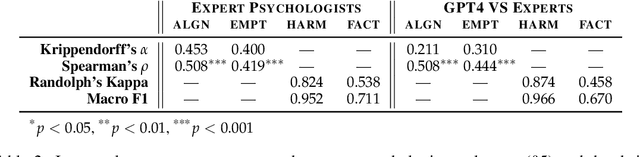
Large language models (LLMs) have offered new opportunities for emotional support, and recent work has shown that they can produce empathic responses to people in distress. However, long-term mental well-being requires emotional self-regulation, where a one-time empathic response falls short. This work takes a first step by engaging with cognitive reappraisals, a strategy from psychology practitioners that uses language to targetedly change negative appraisals that an individual makes of the situation; such appraisals is known to sit at the root of human emotional experience. We hypothesize that psychologically grounded principles could enable such advanced psychology capabilities in LLMs, and design RESORT which consists of a series of reappraisal constitutions across multiple dimensions that can be used as LLM instructions. We conduct a first-of-its-kind expert evaluation (by clinical psychologists with M.S. or Ph.D. degrees) of an LLM's zero-shot ability to generate cognitive reappraisal responses to medium-length social media messages asking for support. This fine-grained evaluation showed that even LLMs at the 7B scale guided by RESORT are capable of generating empathic responses that can help users reappraise their situations.
Large Language Models Produce Responses Perceived to be Empathic
Mar 26, 2024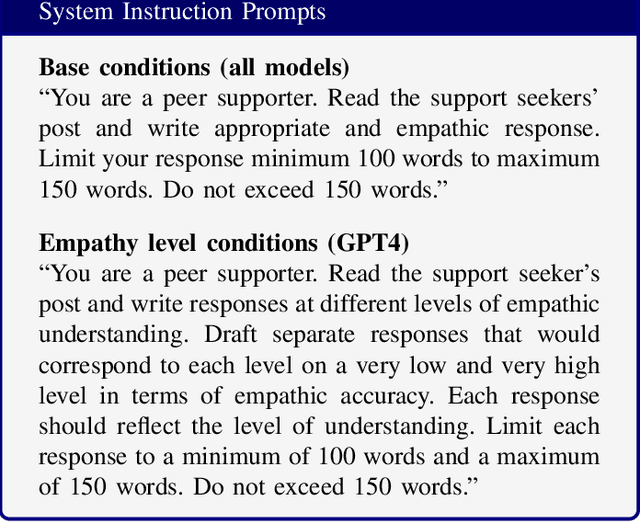
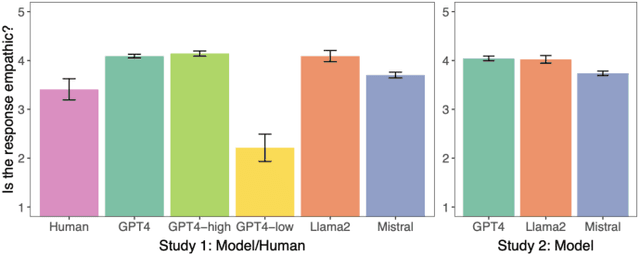
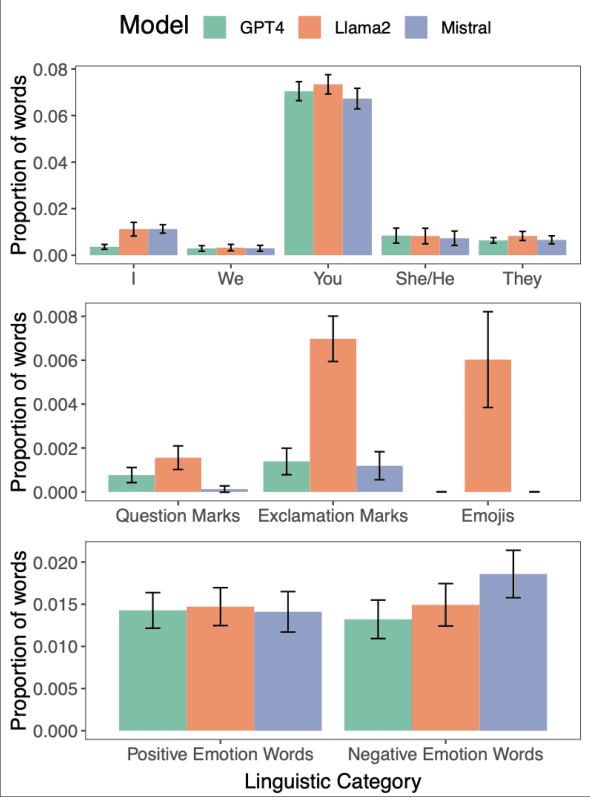
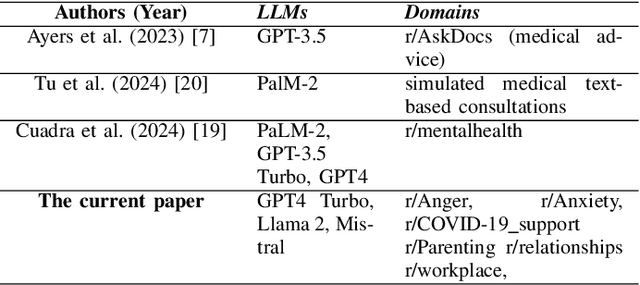
Large Language Models (LLMs) have demonstrated surprising performance on many tasks, including writing supportive messages that display empathy. Here, we had these models generate empathic messages in response to posts describing common life experiences, such as workplace situations, parenting, relationships, and other anxiety- and anger-eliciting situations. Across two studies (N=192, 202), we showed human raters a variety of responses written by several models (GPT4 Turbo, Llama2, and Mistral), and had people rate these responses on how empathic they seemed to be. We found that LLM-generated responses were consistently rated as more empathic than human-written responses. Linguistic analyses also show that these models write in distinct, predictable ``styles", in terms of their use of punctuation, emojis, and certain words. These results highlight the potential of using LLMs to enhance human peer support in contexts where empathy is important.
Evaluating Subjective Cognitive Appraisals of Emotions from Large Language Models
Oct 22, 2023The emotions we experience involve complex processes; besides physiological aspects, research in psychology has studied cognitive appraisals where people assess their situations subjectively, according to their own values (Scherer, 2005). Thus, the same situation can often result in different emotional experiences. While the detection of emotion is a well-established task, there is very limited work so far on the automatic prediction of cognitive appraisals. This work fills the gap by presenting CovidET-Appraisals, the most comprehensive dataset to-date that assesses 24 appraisal dimensions, each with a natural language rationale, across 241 Reddit posts. CovidET-Appraisals presents an ideal testbed to evaluate the ability of large language models -- excelling at a wide range of NLP tasks -- to automatically assess and explain cognitive appraisals. We found that while the best models are performant, open-sourced LLMs fall short at this task, presenting a new challenge in the future development of emotionally intelligent models. We release our dataset at https://github.com/honglizhan/CovidET-Appraisals-Public.
Unsupervised Extractive Summarization of Emotion Triggers
Jun 02, 2023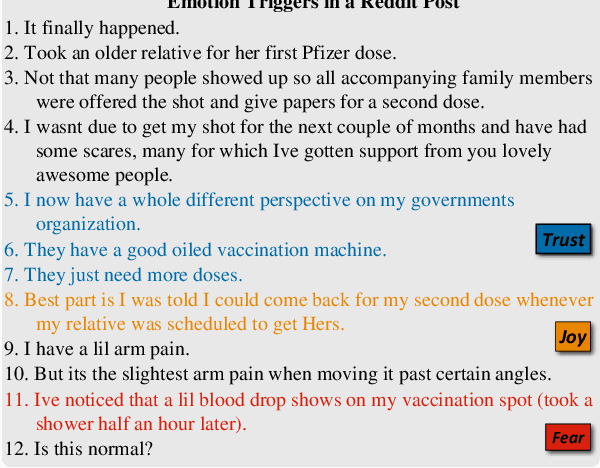
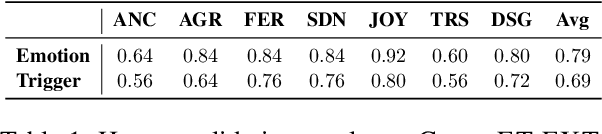
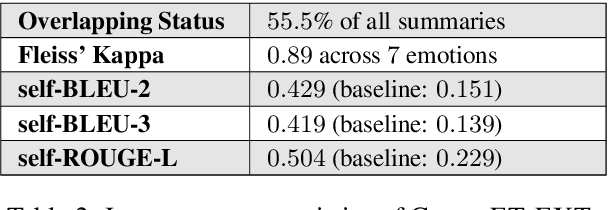
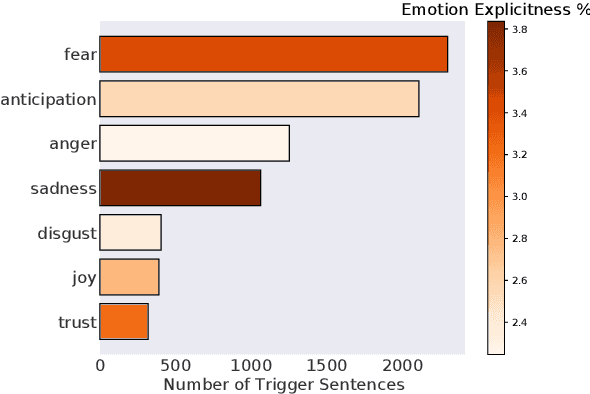
Understanding what leads to emotions during large-scale crises is important as it can provide groundings for expressed emotions and subsequently improve the understanding of ongoing disasters. Recent approaches trained supervised models to both detect emotions and explain emotion triggers (events and appraisals) via abstractive summarization. However, obtaining timely and qualitative abstractive summaries is expensive and extremely time-consuming, requiring highly-trained expert annotators. In time-sensitive, high-stake contexts, this can block necessary responses. We instead pursue unsupervised systems that extract triggers from text. First, we introduce CovidET-EXT, augmenting (Zhan et al. 2022)'s abstractive dataset (in the context of the COVID-19 crisis) with extractive triggers. Second, we develop new unsupervised learning models that can jointly detect emotions and summarize their triggers. Our best approach, entitled Emotion-Aware Pagerank, incorporates emotion information from external sources combined with a language understanding module, and outperforms strong baselines. We release our data and code at https://github.com/tsosea2/CovidET-EXT.
Why Do You Feel This Way? Summarizing Triggers of Emotions in Social Media Posts
Oct 22, 2022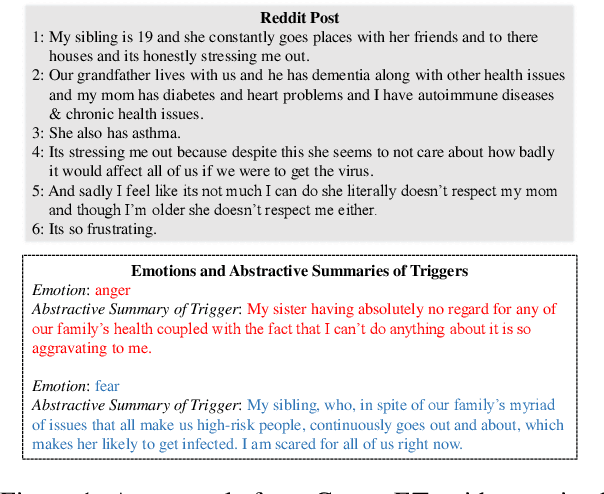
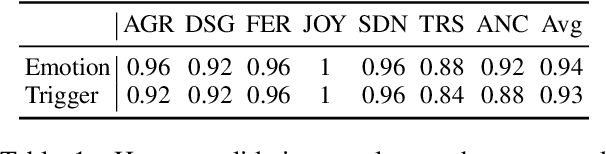
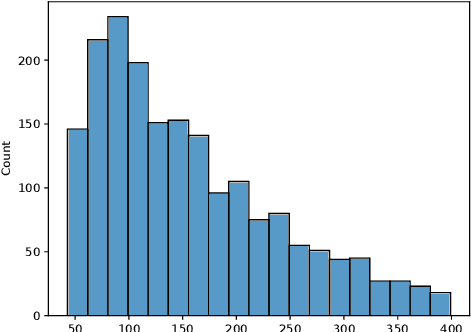
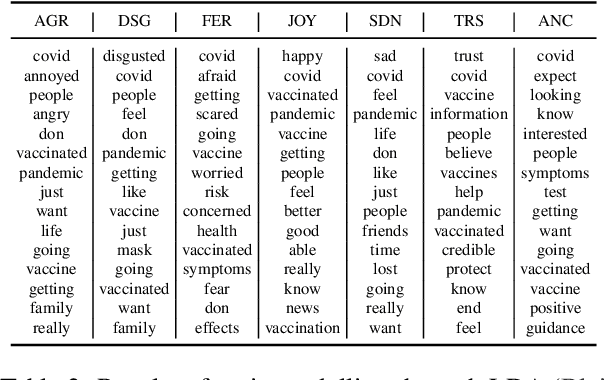
Crises such as the COVID-19 pandemic continuously threaten our world and emotionally affect billions of people worldwide in distinct ways. Understanding the triggers leading to people's emotions is of crucial importance. Social media posts can be a good source of such analysis, yet these texts tend to be charged with multiple emotions, with triggers scattering across multiple sentences. This paper takes a novel angle, namely, emotion detection and trigger summarization, aiming to both detect perceived emotions in text, and summarize events and their appraisals that trigger each emotion. To support this goal, we introduce CovidET (Emotions and their Triggers during Covid-19), a dataset of ~1,900 English Reddit posts related to COVID-19, which contains manual annotations of perceived emotions and abstractive summaries of their triggers described in the post. We develop strong baselines to jointly detect emotions and summarize emotion triggers. Our analyses show that CovidET presents new challenges in emotion-specific summarization, as well as multi-emotion detection in long social media posts.