 Add to Chrome
 Add to Firefox
 Add to Edge
Toward Autonomous O-RAN: A Multi-Scale Agentic AI Framework for Real-Time Network Control and Management
Feb 15, 2026
Open Radio Access Networks (O-RAN) promise flexible 6G network access through disaggregated, software-driven components and open interfaces, but this programmability also increases operational complexity. Multiple control loops coexist across the service management layer and RAN Intelligent Controller (RIC), while independently developed control applications can interact in unintended ways. In parallel, recent advances in generative Artificial Intelligence (AI) are enabling a shift from isolated AI models toward agentic AI systems that can interpret goals, coordinate multiple models and control functions, and adapt their behavior over time. This article proposes a multi-scale agentic AI framework for O-RAN that organizes RAN intelligence as a coordinated hierarchy across the Non-Real-Time (Non-RT), Near-Real-Time (Near-RT), and Real-Time (RT) control loops: (i) A Large Language Model (LLM) agent in the Non-RT RIC translates operator intent into policies and governs model lifecycles. (ii) Small Language Model (SLM) agents in the Near-RT RIC execute low-latency optimization and can activate, tune, or disable existing control applications; and (iii) Wireless Physical-layer Foundation Model (WPFM) agents near the distributed unit provide fast inference close to the air interface. We describe how these agents cooperate through standardized O-RAN interfaces and telemetry. Using a proof-of-concept implementation built on open-source models, software, and datasets, we demonstrate the proposed agentic approach in two representative scenarios: robust operation under non-stationary conditions and intent-driven slice resource control.

Generative Adversarial Networks (GANs) in Networking: A Comprehensive Survey & Evaluation
May 10, 2021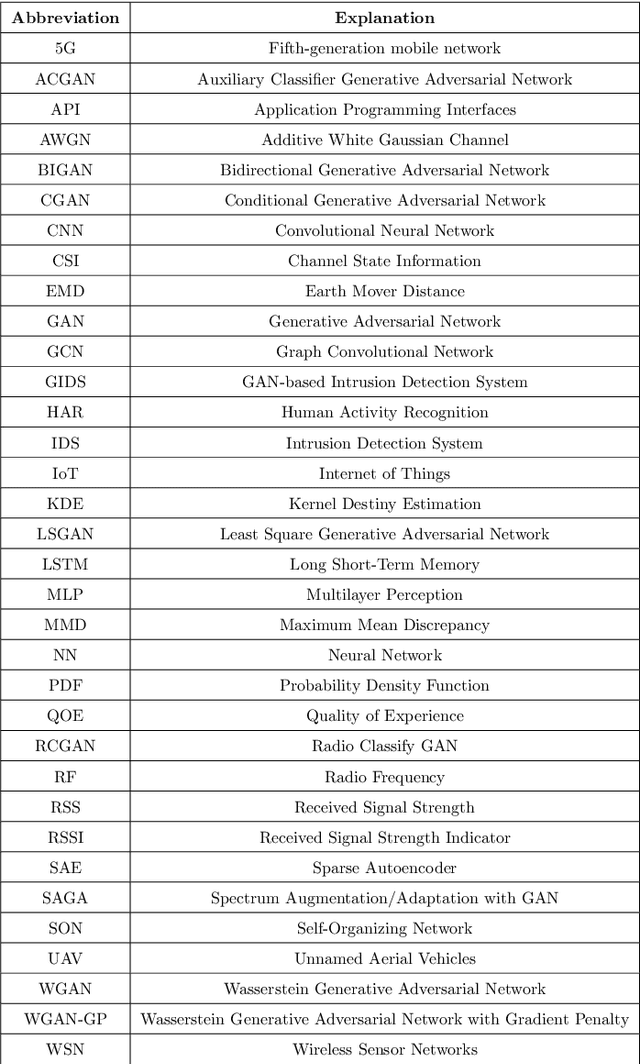
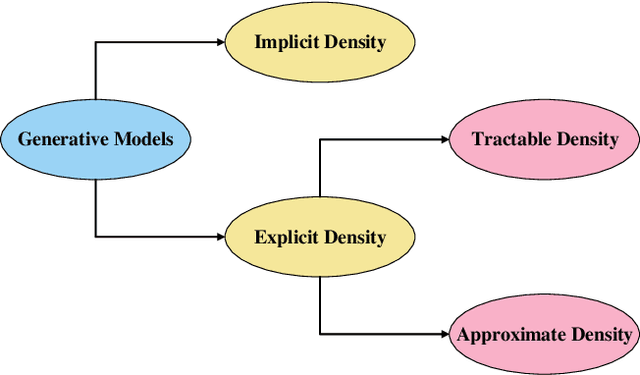
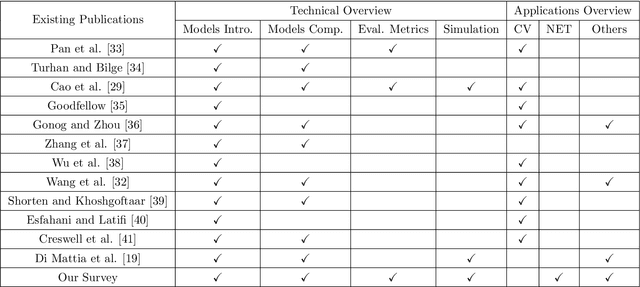
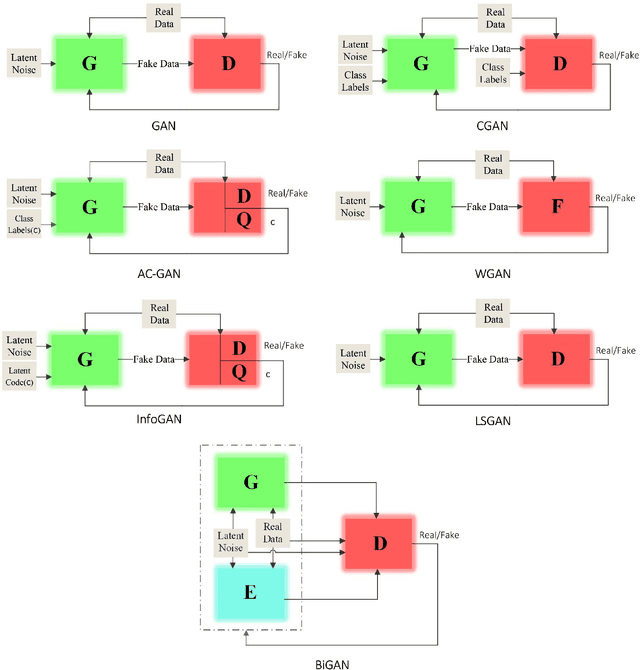
Despite the recency of their conception, Generative Adversarial Networks (GANs) constitute an extensively researched machine learning sub-field for the creation of synthetic data through deep generative modeling. GANs have consequently been applied in a number of domains, most notably computer vision, in which they are typically used to generate or transform synthetic images. Given their relative ease of use, it is therefore natural that researchers in the field of networking (which has seen extensive application of deep learning methods) should take an interest in GAN-based approaches. The need for a comprehensive survey of such activity is therefore urgent. In this paper, we demonstrate how this branch of machine learning can benefit multiple aspects of computer and communication networks, including mobile networks, network analysis, internet of things, physical layer, and cybersecurity. In doing so, we shall provide a novel evaluation framework for comparing the performance of different models in non-image applications, applying this to a number of reference network datasets.
Using Synthetic Data to Enhance the Accuracy of Fingerprint-Based Localization: A Deep Learning Approach
May 06, 2021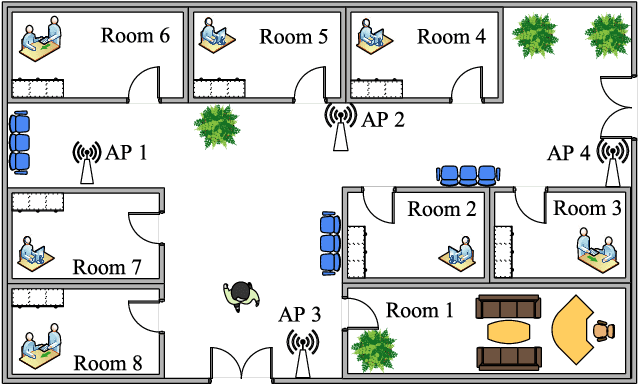
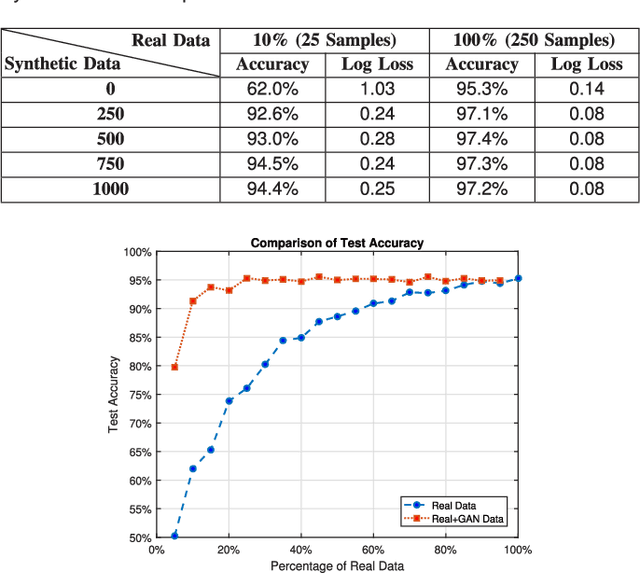
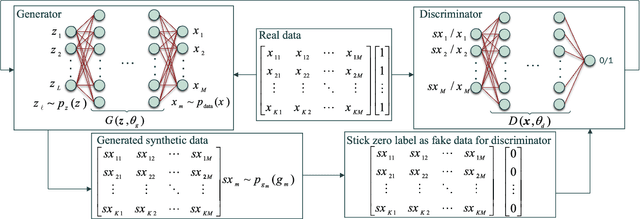
Human-centered data collection is typically costly and implicates issues of privacy. Various solutions have been proposed in the literature to reduce this cost, such as crowdsourced data collection, or the use of semi-supervised algorithms. However, semi-supervised algorithms require a source of unlabeled data, and crowd-sourcing methods require numbers of active participants. An alternative passive data collection modality is fingerprint-based localization. Such methods use received signal strength (RSS) or channel state information (CSI) in wireless sensor networks to localize users in indoor/outdoor environments. In this paper, we introduce a novel approach to reduce training data collection costs in fingerprint-based localization by using synthetic data. Generative adversarial networks (GANs) are used to learn the distribution of a limited sample of collected data and, following this, to produce synthetic data that can be used to augment the real collected data in order to increase overall positioning accuracy. Experimental results on a benchmark dataset show that by applying the proposed method and using a combination of 10% collected data and 90% synthetic data, we can obtain essentially similar positioning accuracy to that which would be obtained by using the full set of collected data. This means that by employing GAN-generated synthetic data, we can use 90% less real data, thereby reduce data-collection costs while achieving acceptable accuracy.
Using GAN to Enhance the Accuracy of Indoor Human Activity Recognition
Apr 23, 2020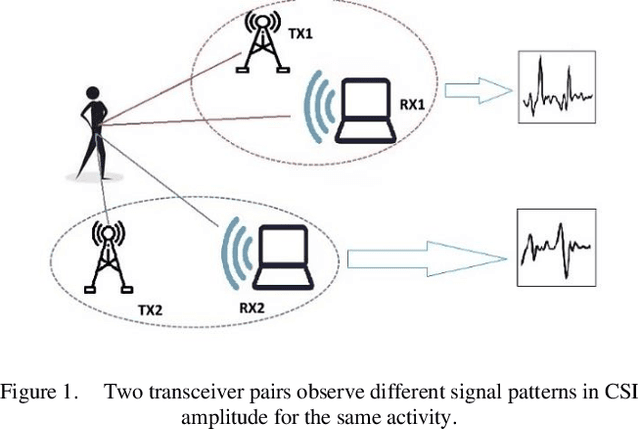
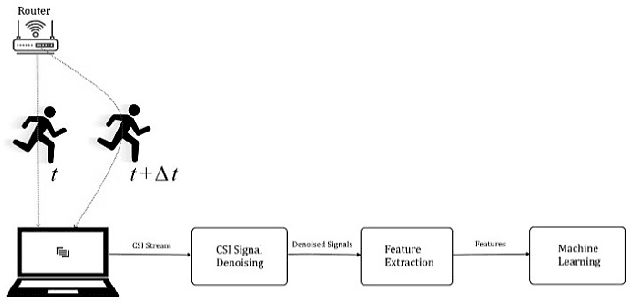
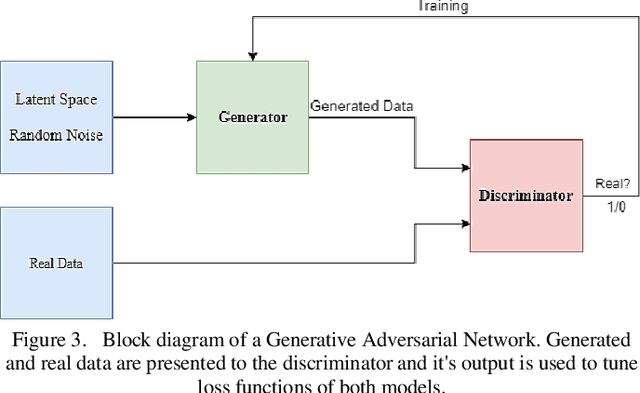
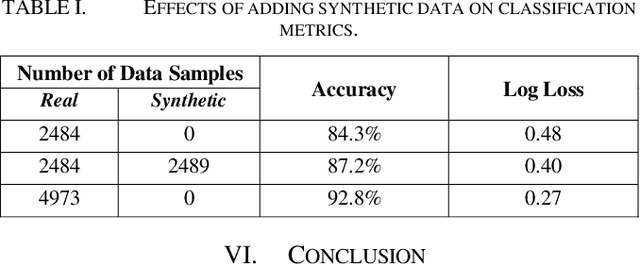
Indoor human activity recognition (HAR) explores the correlation between human body movements and the reflected WiFi signals to classify different activities. By analyzing WiFi signal patterns, especially the dynamics of channel state information (CSI), different activities can be distinguished. Gathering CSI data is expensive both from the timing and equipment perspective. In this paper, we use synthetic data to reduce the need for real measured CSI. We present a semi-supervised learning method for CSI-based activity recognition systems in which long short-term memory (LSTM) is employed to learn features and recognize seven different actions. We apply principal component analysis (PCA) on CSI amplitude data, while short-time Fourier transform (STFT) extracts the features in the frequency domain. At first, we train the LSTM network with entirely raw CSI data, which takes much more processing time. To this end, we aim to generate data by using 50% of raw data in conjunction with a generative adversarial network (GAN). Our experimental results confirm that this model can increase classification accuracy by 3.4% and reduce the Log loss by almost 16% in the considered scenario.