 Add to Chrome
 Add to Firefox
 Add to Edge
GyRot: Leveraging Hidden Synergy between Rotation and Fine-grained Group Quantization for Low-bit LLM Inference
Jul 30, 2026
Low-bit quantization is essential for efficient LLM inference, and both rotation and fine-grained group quantization have shown individual promise. However, their combination often leads to accuracy degradation or hardware overhead due to a mismatch between the global nature of rotation and the localized behavior of group scaling. We propose GyRot, a quantization framework and hardware accelerator that bridges this gap through algorithm-hardware co-design. GyRot introduces Coarse Rotation, Fine Grouping (CoRFiG) and Harmonic-Aligned Permutation (HAP) to enable cooperative integration of rotation and group quantization, enhancing quantizability while relaxing scaling factor precision. To further reduce hardware cost, we reformulate asymmetric quantization and introduce a zero-point rounding strategy that enables fully integer dequantization. Implemented on an INT4-based tensor PE architecture, GyRot achieves state-of-the-art 4-bit accuracy across LLaMA-family models, while delivering up to 3.4x speedup and 3.6x energy efficiency over baseline LLM accelerators. These results validate GyRot's practical effectiveness for scalable and energy-efficient LLM deployment.
* 15 pages, 12 figures. Published in 2026 IEEE International Symposium on High-Performance Computer Architecture (HPCA), Sydney, Australia, pp. 1-15, DOI: 10.1109/HPCA68181.2026.11408453

Extension of Direct Feedback Alignment to Convolutional and Recurrent Neural Network for Bio-plausible Deep Learning
Jun 23, 2020


Throughout this paper, we focus on the improvement of the direct feedback alignment (DFA) algorithm and extend the usage of the DFA to convolutional and recurrent neural networks (CNNs and RNNs). Even though the DFA algorithm is biologically plausible and has a potential of high-speed training, it has not been considered as the substitute for back-propagation (BP) due to the low accuracy in the CNN and RNN training. In this work, we propose a new DFA algorithm for BP-level accurate CNN and RNN training. Firstly, we divide the network into several modules and apply the DFA algorithm within the module. Second, the DFA with the sparse backward weight is applied. It comes with a form of dilated convolution in the CNN case, and in a form of sparse matrix multiplication in the RNN case. Additionally, the error propagation method of CNN becomes simpler through the group convolution. Finally, hybrid DFA increases the accuracy of the CNN and RNN training to the BP-level while taking advantage of the parallelism and hardware efficiency of the DFA algorithm.
Efficient Convolutional Neural Network Training with Direct Feedback Alignment
Jan 06, 2019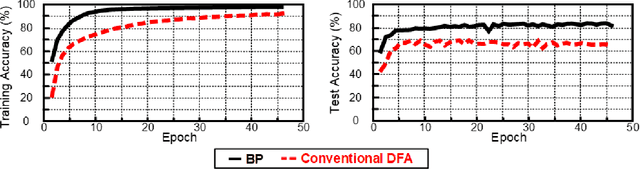

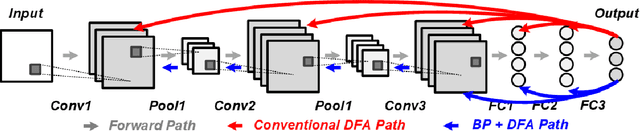

There were many algorithms to substitute the back-propagation (BP) in the deep neural network (DNN) training. However, they could not become popular because their training accuracy and the computational efficiency were worse than BP. One of them was direct feedback alignment (DFA), but it showed low training performance especially for the convolutional neural network (CNN). In this paper, we overcome the limitation of the DFA algorithm by combining with the conventional BP during the CNN training. To improve the training stability, we also suggest the feedback weight initialization method by analyzing the patterns of the fixed random matrices in the DFA. Finally, we propose the new training algorithm, binary direct feedback alignment (BDFA) to minimize the computational cost while maintaining the training accuracy compared with the DFA. In our experiments, we use the CIFAR-10 and CIFAR-100 dataset to simulate the CNN learning from the scratch and apply the BDFA to the online learning based object tracking application to examine the training in the small dataset environment. Our proposed algorithms show better performance than conventional BP in both two different training tasks especially when the dataset is small.