 Add to Chrome
 Add to Firefox
 Add to Edge
MuST-VAD: Mutual Structured Learning for Video Anomaly Detection
Aug 07, 2026
In this paper, we propose MuST-VAD, a mutual structured learning framework for weakly supervised video anomaly detection (VAD) in which an anomaly detector and a large vision-language model (LVLM) exchange their acquired knowledge. Detectors in weakly supervised VAD learn anomaly scores from features extracted by a fixed, task-agnostic backbone. These fixed features bound the achievable detection accuracy. Recent methods therefore transfer LVLM semantics into the detector as richer features. However, this transfer is one-way: what the detector learns about the target videos never returns to the LVLM. MuST-VAD extends the one-way transfer into a bidirectional learning loop. In this loop, the latest detector predictions supervise the LVLM adaptation, and the adapted LVLM returns updated representations that retrain the detector; the two models alternate these updates over small video groups. Both models train on detector-selected key clips, while confidence weighting and annotation-anchored question answering keep the exchanged supervision reliable. On UCF-Crime, our mutual learning improves the one-pass transfer baseline from 88.15% to 88.63% AUROC and from 37.25% to 42.46% average precision (AP), outperforming the state-of-the-art method in AP by 4.13 points.

Edge-based Denoising Image Compression
Sep 17, 2024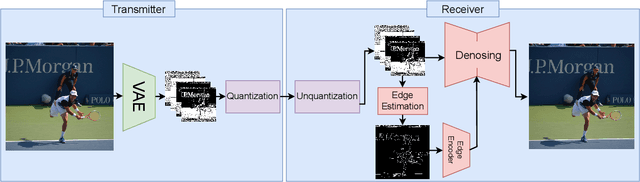
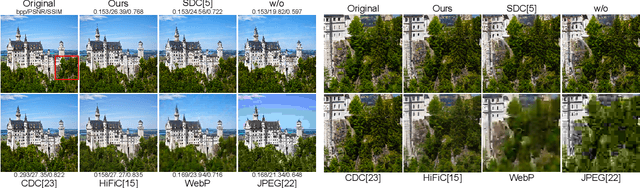
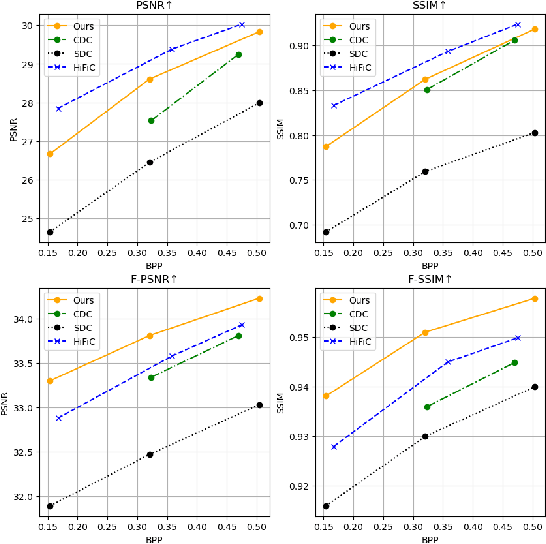
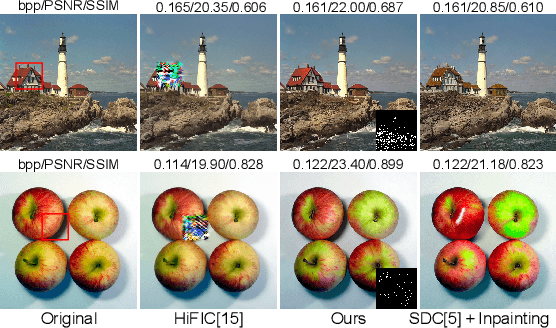
In recent years, deep learning-based image compression, particularly through generative models, has emerged as a pivotal area of research. Despite significant advancements, challenges such as diminished sharpness and quality in reconstructed images, learning inefficiencies due to mode collapse, and data loss during transmission persist. To address these issues, we propose a novel compression model that incorporates a denoising step with diffusion models, significantly enhancing image reconstruction fidelity by sub-information(e.g., edge and depth) from leveraging latent space. Empirical experiments demonstrate that our model achieves superior or comparable results in terms of image quality and compression efficiency when measured against the existing models. Notably, our model excels in scenarios of partial image loss or excessive noise by introducing an edge estimation network to preserve the integrity of reconstructed images, offering a robust solution to the current limitations of image compression.
SDOF-Tracker: Fast and Accurate Multiple Human Tracking by Skipped-Detection and Optical-Flow
Jun 29, 2021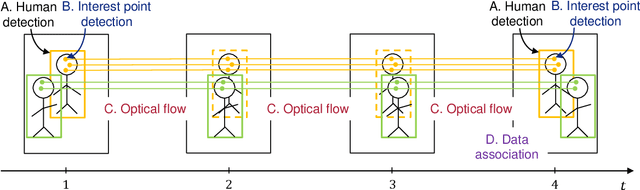
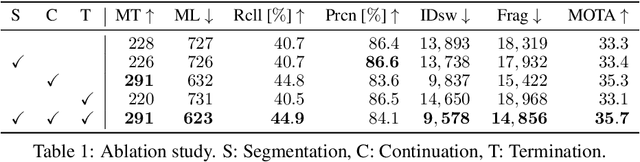
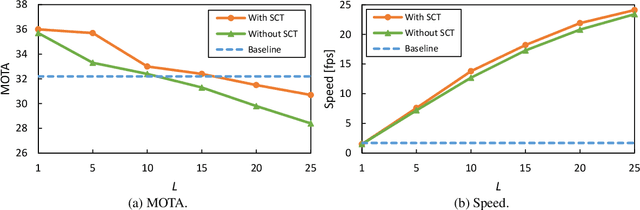
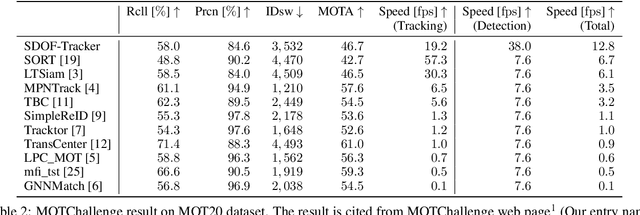
Multiple human tracking is a fundamental problem for scene understanding. Although both accuracy and speed are required in real-world applications, recent tracking methods based on deep learning have focused on accuracy and require substantial running time. This study aims to improve running speed by performing human detection at a certain frame interval because it accounts for most of the running time. The question is how to maintain accuracy while skipping human detection. In this paper, we propose a method that complements the detection results with optical flow, based on the fact that someone's appearance does not change much between adjacent frames. To maintain the tracking accuracy, we introduce robust interest point selection within human regions and a tracking termination metric calculated by the distribution of the interest points. On the MOT20 dataset in the MOTChallenge, the proposed SDOF-Tracker achieved the best performance in terms of the total running speed while maintaining the MOTA metric. Our code is available at https://anonymous.4open.science/r/sdof-tracker-75AE.
Multiple Human Tracking using Multi-Cues including Primitive Action Features
Sep 18, 2019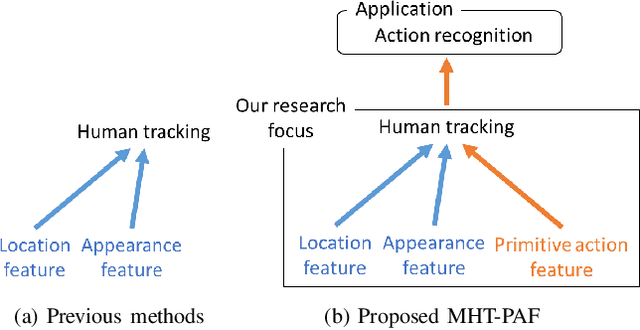
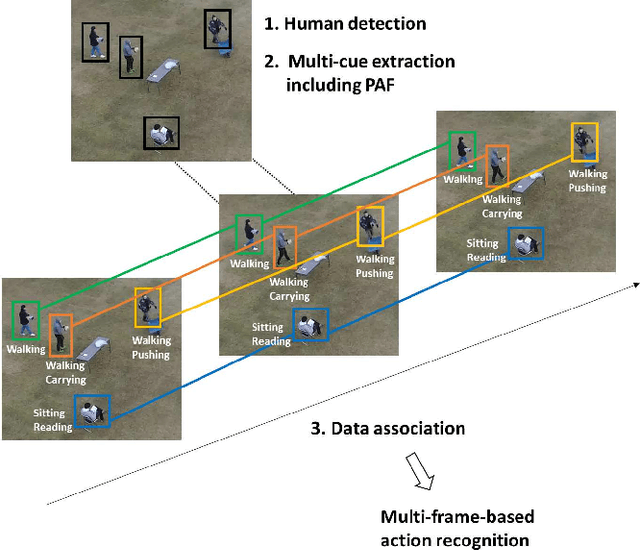
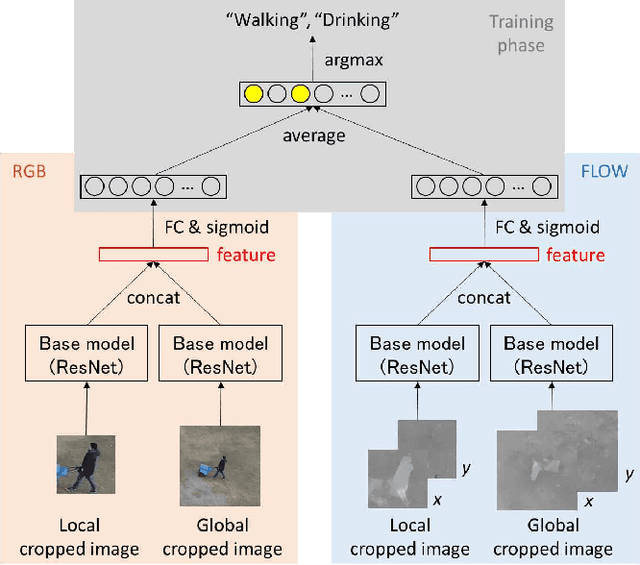
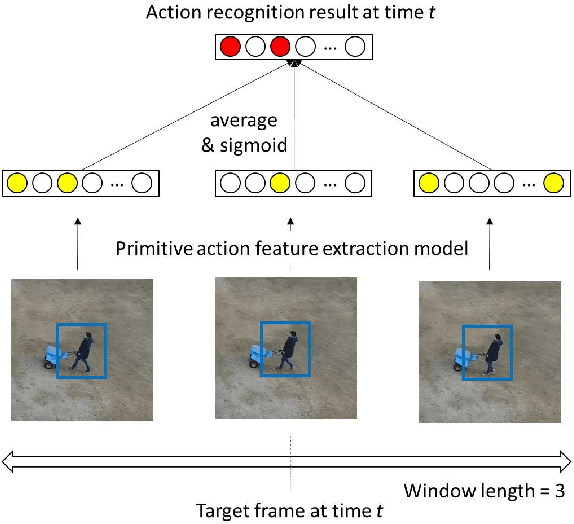
In this paper, we propose a Multiple Human Tracking method using multi-cues including Primitive Action Features (MHT-PAF). MHT-PAF can perform the accurate human tracking in dynamic aerial videos captured by a drone. PAF employs a global context, rich information by multi-label actions, and a middle level feature. The accurate human tracking result using PAF helps multi-frame-based action recognition. In the experiments, we verified the effectiveness of the proposed method using the Okutama-Action dataset. Our code is available online.