 Add to Chrome
 Add to Firefox
 Add to Edge
Structure-Guided Entity Resolution: Fine-Tuning LLMs for Robust Name Matching in Complex Linguistic Contexts
May 22, 2026
Matching person names across heterogeneous records is a core challenge in entity resolution, especially within linguistically and culturally complex environments. Variations in naming conventions, inconsistent transliteration across scripts, and frequent data entry errors make it difficult to unify user identities, an essential requirement for Know Your Customer (KYC) compliance. While Large Language Models have shown promise in understanding natural language, they often struggle with the structured ambiguity present in such domain-specific settings. This paper introduces Structure-Guided Entity Resolution (SGER), a novel framework that fine-tunes an LLM through a two-phase curriculum. The model is first trained to parse the grammatical and semantic structure of personal names, then optimized for the downstream task of binary entity matching. We evaluate SGER in the challenging context of Indian identity data, one of the most linguistically diverse and noisy environments globally. SGER achieves 99.02% accuracy and an F1 of 0.994 on a held-out set of 50,000 real-world pairs, outperforming GPT-4o few-shot prompting and single-stage fine-tuning baselines. The system is fully deployed in production at Dream11, the world's largest fantasy sports platform, serving 250M+ users. Our results demonstrate that curriculum-guided training enables robust, high-precision entity resolution in real-world multilingual systems at scale.

Schema on the Inside: A Two-Phase Fine-Tuning Method for High-Efficiency Text-to-SQL at Scale
Mar 25, 2026Applying large, proprietary API-based language models to text-to-SQL tasks poses a significant industry challenge: reliance on massive, schema-heavy prompts results in prohibitive per-token API costs and high latency, hindering scalable production deployment. We present a specialized, self-hosted 8B-parameter model designed for a conversational bot in CriQ, a sister app to Dream11, India's largest fantasy sports platform with over 250 million users, that answers user queries about cricket statistics. Our novel two-phase supervised fine-tuning approach enables the model to internalize the entire database schema, eliminating the need for long-context prompts. This reduces input tokens by over 99%, from a 17k-token baseline to fewer than 100, and replaces costly external API calls with efficient local inference. The resulting system achieves 98.4% execution success and 92.5% semantic accuracy, substantially outperforming a prompt-engineered baseline using Google's Gemini Flash 2.0 (95.6% execution, 89.4% semantic accuracy). These results demonstrate a practical path toward high-precision, low-latency text-to-SQL applications using domain-specialized, self-hosted language models in large-scale production environments.
* 8 pages, 6 figures. Published in the Proceedings of the Fortieth AAAI Conference on Artificial Intelligence (AAAI-26), 2026
Optimizing Fantasy Sports Team Selection with Deep Reinforcement Learning
Dec 26, 2024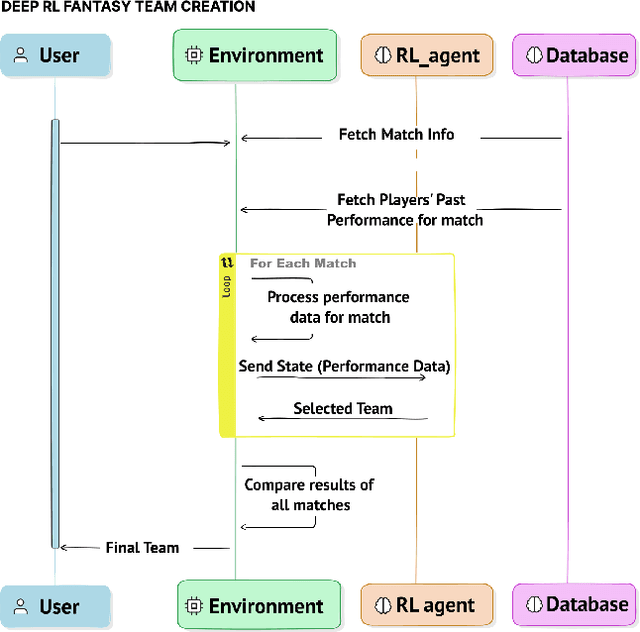
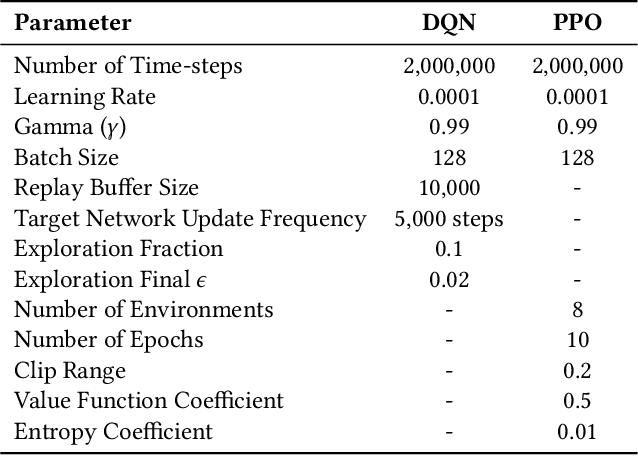
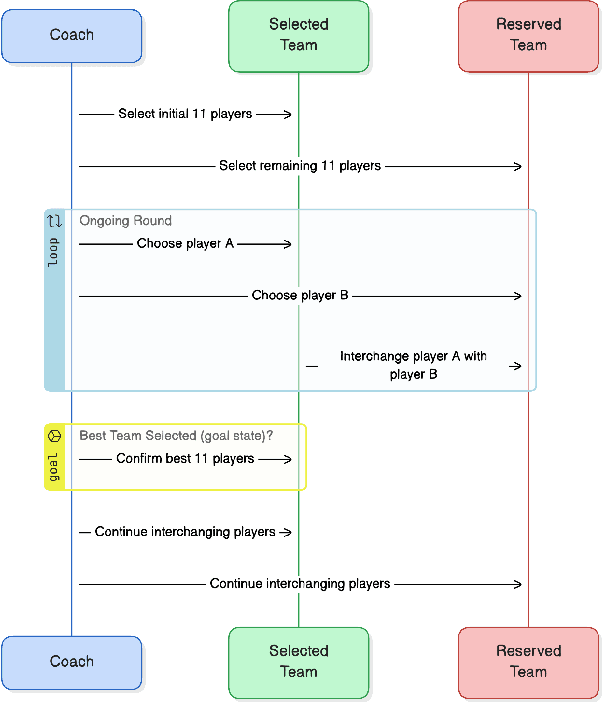
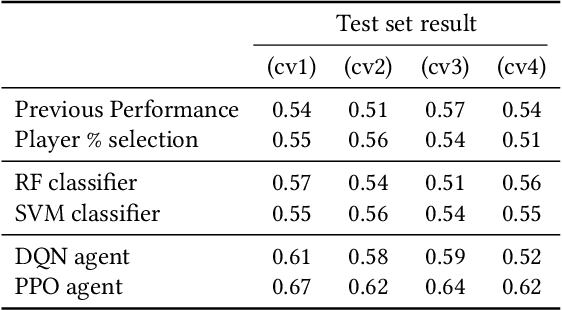
Fantasy sports, particularly fantasy cricket, have garnered immense popularity in India in recent years, offering enthusiasts the opportunity to engage in strategic team-building and compete based on the real-world performance of professional athletes. In this paper, we address the challenge of optimizing fantasy cricket team selection using reinforcement learning (RL) techniques. By framing the team creation process as a sequential decision-making problem, we aim to develop a model that can adaptively select players to maximize the team's potential performance. Our approach leverages historical player data to train RL algorithms, which then predict future performance and optimize team composition. This not only represents a huge business opportunity by enabling more accurate predictions of high-performing teams but also enhances the overall user experience. Through empirical evaluation and comparison with traditional fantasy team drafting methods, we demonstrate the effectiveness of RL in constructing competitive fantasy teams. Our results show that RL-based strategies provide valuable insights into player selection in fantasy sports.