 Add to Chrome
 Add to Firefox
 Add to Edge
MedPriv-Bench: Benchmarking the Privacy-Utility Trade-off of Large Language Models in Medical Open-End Question Answering
Mar 15, 2026
Recent advances in Retrieval-Augmented Generation (RAG) have enabled large language models (LLMs) to ground outputs in clinical evidence. However, connecting LLMs with external databases introduces the risk of contextual leakage: a subtle privacy threat where unique combinations of medical details enable patient re-identification even without explicit identifiers. Current benchmarks in healthcare heavily focus on accuracy, ignoring such privacy issues, despite strict regulations like Health Insurance Portability and Accountability Act (HIPAA) and General Data Protection Regulation (GDPR). To fill this gap, we present MedPriv-Bench, the first benchmark specifically designed to jointly evaluate privacy preservation and clinical utility in medical open-ended question answering. Our framework utilizes a multi-agent, human-in-the-loop pipeline to synthesize sensitive medical contexts and clinically relevant queries that create realistic privacy pressure. We establish a standardized evaluation protocol leveraging a pre-trained RoBERTa-Natural Language Inference (NLI) model as an automated judge to quantify data leakage, achieving an average of 85.9% alignment with human experts. Through an extensive evaluation of 9 representative LLMs, we demonstrate a pervasive privacy-utility trade-off. Our findings underscore the necessity of domain-specific benchmarks to validate the safety and efficacy of medical AI systems in privacy-sensitive environments.

Privacy Challenges and Solutions in Retrieval-Augmented Generation-Enhanced LLMs for Healthcare Chatbots: A Review of Applications, Risks, and Future Directions
Nov 17, 2025Retrieval-augmented generation (RAG) has rapidly emerged as a transformative approach for integrating large language models into clinical and biomedical workflows. However, privacy risks, such as protected health information (PHI) exposure, remain inconsistently mitigated. This review provides a thorough analysis of the current landscape of RAG applications in healthcare, including (i) sensitive data type across clinical scenarios, (ii) the associated privacy risks, (iii) current and emerging data-privacy protection mechanisms and (iv) future direction for patient data privacy protection. We synthesize 23 articles on RAG applications in healthcare and systematically analyze privacy challenges through a pipeline-structured framework encompassing data storage, transmission, retrieval and generation stages, delineating potential failure modes, their underlying causes in threat models and system mechanisms, and their practical implications. Building on this analysis, we critically review 17 articles on privacy-preserving strategies for RAG systems. Our evaluation reveals critical gaps, including insufficient clinical validation, absence of standardized evaluation frameworks, and lack of automated assessment tools. We propose actionable directions based on these limitations and conclude with a call to action. This review provides researchers and practitioners with a structured framework for understanding privacy vulnerabilities in healthcare RAG and offers a roadmap toward developing systems that achieve both clinical effectiveness and robust privacy preservation.
ExplainableGuard: Interpretable Adversarial Defense for Large Language Models Using Chain-of-Thought Reasoning
Nov 15, 2025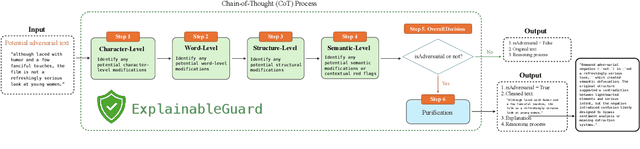
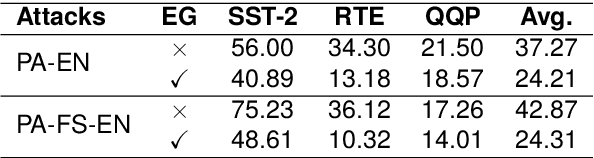
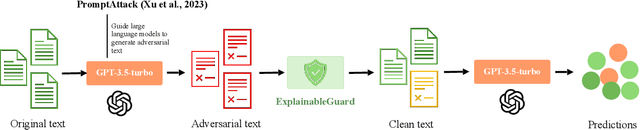
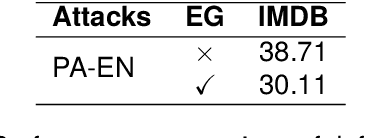
Large Language Models (LLMs) are increasingly vulnerable to adversarial attacks that can subtly manipulate their outputs. While various defense mechanisms have been proposed, many operate as black boxes, lacking transparency in their decision-making. This paper introduces ExplainableGuard, an interpretable adversarial defense framework leveraging the chain-of-thought (CoT) reasoning capabilities of DeepSeek-Reasoner. Our approach not only detects and neutralizes adversarial perturbations in text but also provides step-by-step explanations for each defense action. We demonstrate how tailored CoT prompts guide the LLM to perform a multi-faceted analysis (character, word, structural, and semantic) and generate a purified output along with a human-readable justification. Preliminary results on the GLUE Benchmark and IMDB Movie Reviews dataset show promising defense efficacy. Additionally, a human evaluation study reveals that ExplainableGuard's explanations outperform ablated variants in clarity, specificity, and actionability, with a 72.5% deployability-trust rating, underscoring its potential for more trustworthy LLM deployments.