 Add to Chrome
 Add to Firefox
 Add to Edge
Decodable but not structured: linear probing enables Underwater Acoustic Target Recognition with pretrained audio embeddings
Jan 13, 2026
Increasing levels of anthropogenic noise from ships contribute significantly to underwater sound pollution, posing risks to marine ecosystems. This makes monitoring crucial to understand and quantify the impact of the ship radiated noise. Passive Acoustic Monitoring (PAM) systems are widely deployed for this purpose, generating years of underwater recordings across diverse soundscapes. Manual analysis of such large-scale data is impractical, motivating the need for automated approaches based on machine learning. Recent advances in automatic Underwater Acoustic Target Recognition (UATR) have largely relied on supervised learning, which is constrained by the scarcity of labeled data. Transfer Learning (TL) offers a promising alternative to mitigate this limitation. In this work, we conduct the first empirical comparative study of transfer learning for UATR, evaluating multiple pretrained audio models originating from diverse audio domains. The pretrained model weights are frozen, and the resulting embeddings are analyzed through classification, clustering, and similarity-based evaluations. The analysis shows that the geometrical structure of the embedding space is largely dominated by recording-specific characteristics. However, a simple linear probe can effectively suppress this recording-specific information and isolate ship-type features from these embeddings. As a result, linear probing enables effective automatic UATR using pretrained audio models at low computational cost, significantly reducing the need for a large amounts of high-quality labeled ship recordings.

The Computation of Generalized Embeddings for Underwater Acoustic Target Recognition using Contrastive Learning
May 19, 2025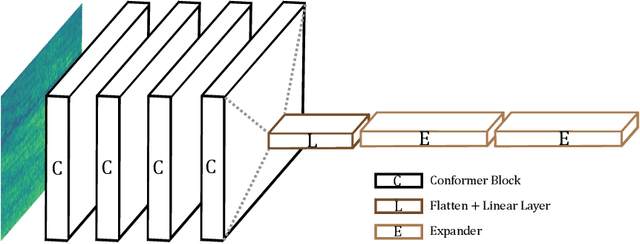
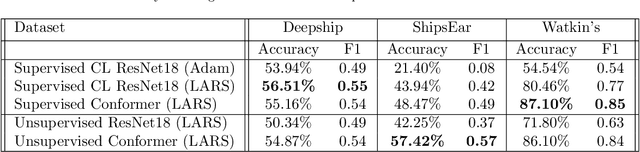
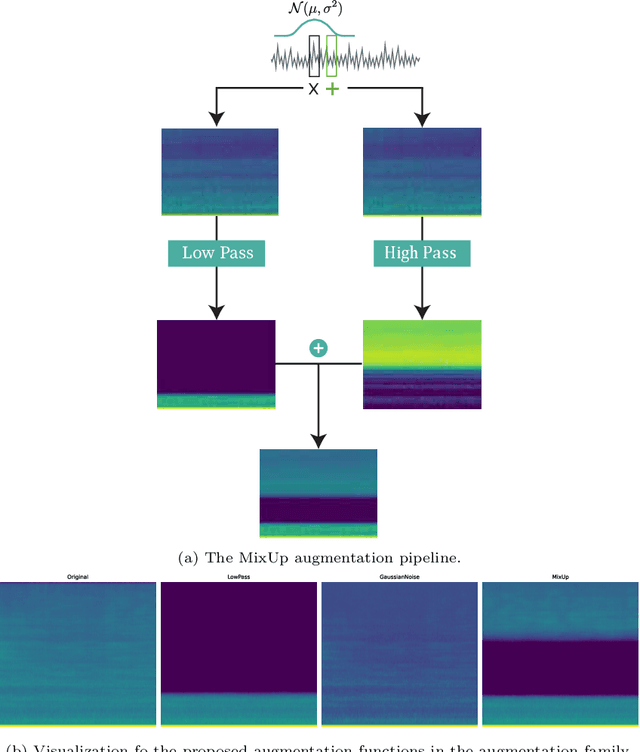
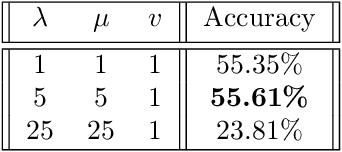
The increasing level of sound pollution in marine environments poses an increased threat to ocean health, making it crucial to monitor underwater noise. By monitoring this noise, the sources responsible for this pollution can be mapped. Monitoring is performed by passively listening to these sounds. This generates a large amount of data records, capturing a mix of sound sources such as ship activities and marine mammal vocalizations. Although machine learning offers a promising solution for automatic sound classification, current state-of-the-art methods implement supervised learning. This requires a large amount of high-quality labeled data that is not publicly available. In contrast, a massive amount of lower-quality unlabeled data is publicly available, offering the opportunity to explore unsupervised learning techniques. This research explores this possibility by implementing an unsupervised Contrastive Learning approach. Here, a Conformer-based encoder is optimized by the so-called Variance-Invariance-Covariance Regularization loss function on these lower-quality unlabeled data and the translation to the labeled data is made. Through classification tasks involving recognizing ship types and marine mammal vocalizations, our method demonstrates to produce robust and generalized embeddings. This shows to potential of unsupervised methods for various automatic underwater acoustic analysis tasks.