 Add to Chrome
 Add to Firefox
 Add to Edge
Can Visual Mamba Improve AI-Generated Image Detection? An In-Depth Investigation
May 14, 2026
In recent years, computer vision has witnessed remarkable progress, fueled by the development of innovative architectures such as Convolutional Neural Networks (CNNs), Generative Adversarial Networks (GANs), diffusion-based architectures, Vision Transformers (ViTs), and, more recently, Vision-Language Models (VLMs). This progress has undeniably contributed to creating increasingly realistic and diverse visual content. However, such advancements in image generation also raise concerns about potential misuse in areas such as misinformation, identity theft, and threats to privacy and security. In parallel, Mamba-based architectures have emerged as versatile tools for a range of image analysis tasks, including classification, segmentation, medical imaging, object detection, and image restoration, in this rapidly evolving field. However, their potential for identifying AI-generated images remains relatively unexplored compared to established techniques. This study provides a systematic evaluation and comparative analysis of Vision Mamba models for AI-generated image detection. We benchmark multiple Vision Mamba variants against representative CNNs, ViTs, and VLM-based detectors across diverse datasets and synthetic image sources, focusing on key metrics such as accuracy, efficiency, and generalizability across diverse image types and generative models. Through this comprehensive analysis, we aim to elucidate Vision Mamba's strengths and limitations relative to established methodologies in terms of applicability, accuracy, and efficiency in detecting AI-generated images. Overall, our findings highlight both the promise and current limitations of Vision Mamba as a component in systems designed to distinguish authentic from AI-generated visual content. This research is crucial for enhancing detection in an age where distinguishing between real and AI-generated content is a major challenge.

SPARK-IL: Spectral Retrieval-Augmented RAG for Knowledge-driven Deepfake Detection via Incremental Learning
Apr 04, 2026Detecting AI-generated images remains a significant challenge because detectors trained on specific generators often fail to generalize to unseen models; however, while pixel-level artifacts vary across models, frequency-domain signatures exhibit greater consistency, providing a promising foundation for cross-generator detection. To address this, we propose SPARK-IL, a retrieval-augmented framework that combines dual-path spectral analysis with incremental learning by utilizing a partially frozen ViT-L/14 encoder for semantic representations alongside a parallel path for raw RGB pixel embeddings. Both paths undergo multi-band Fourier decomposition into four frequency bands, which are individually processed by Kolmogorov-Arnold Networks (KAN) with mixture-of-experts for band-specific transformations before the resulting spectral embeddings are fused via cross-attention with residual connections. During inference, this fused embedding retrieves the $k$ nearest labeled signatures from a Milvus database using cosine similarity to facilitate predictions via majority voting, while an incremental learning strategy expands the database and employs elastic weight consolidation to preserve previously learned transformations. Evaluated on the UniversalFakeDetect benchmark across 19 generative models -- including GANs, face-swapping, and diffusion methods -- SPARK-IL achieves a 94.6\% mean accuracy, with the code to be publicly released at https://github.com/HessenUPHF/SPARK-IL.
RAVID: Retrieval-Augmented Visual Detection: A Knowledge-Driven Approach for AI-Generated Image Identification
Aug 05, 2025In this paper, we introduce RAVID, the first framework for AI-generated image detection that leverages visual retrieval-augmented generation (RAG). While RAG methods have shown promise in mitigating factual inaccuracies in foundation models, they have primarily focused on text, leaving visual knowledge underexplored. Meanwhile, existing detection methods, which struggle with generalization and robustness, often rely on low-level artifacts and model-specific features, limiting their adaptability. To address this, RAVID dynamically retrieves relevant images to enhance detection. Our approach utilizes a fine-tuned CLIP image encoder, RAVID CLIP, enhanced with category-related prompts to improve representation learning. We further integrate a vision-language model (VLM) to fuse retrieved images with the query, enriching the input and improving accuracy. Given a query image, RAVID generates an embedding using RAVID CLIP, retrieves the most relevant images from a database, and combines these with the query image to form an enriched input for a VLM (e.g., Qwen-VL or Openflamingo). Experiments on the UniversalFakeDetect benchmark, which covers 19 generative models, show that RAVID achieves state-of-the-art performance with an average accuracy of 93.85%. RAVID also outperforms traditional methods in terms of robustness, maintaining high accuracy even under image degradations such as Gaussian blur and JPEG compression. Specifically, RAVID achieves an average accuracy of 80.27% under degradation conditions, compared to 63.44% for the state-of-the-art model C2P-CLIP, demonstrating consistent improvements in both Gaussian blur and JPEG compression scenarios. The code will be publicly available upon acceptance.
DeeCLIP: A Robust and Generalizable Transformer-Based Framework for Detecting AI-Generated Images
Apr 28, 2025This paper introduces DeeCLIP, a novel framework for detecting AI-generated images using CLIP-ViT and fusion learning. Despite significant advancements in generative models capable of creating highly photorealistic images, existing detection methods often struggle to generalize across different models and are highly sensitive to minor perturbations. To address these challenges, DeeCLIP incorporates DeeFuser, a fusion module that combines high-level and low-level features, improving robustness against degradations such as compression and blurring. Additionally, we apply triplet loss to refine the embedding space, enhancing the model's ability to distinguish between real and synthetic content. To further enable lightweight adaptation while preserving pre-trained knowledge, we adopt parameter-efficient fine-tuning using low-rank adaptation (LoRA) within the CLIP-ViT backbone. This approach supports effective zero-shot learning without sacrificing generalization. Trained exclusively on 4-class ProGAN data, DeeCLIP achieves an average accuracy of 89.00% on 19 test subsets composed of generative adversarial network (GAN) and diffusion models. Despite having fewer trainable parameters, DeeCLIP outperforms existing methods, demonstrating superior robustness against various generative models and real-world distortions. The code is publicly available at https://github.com/Mamadou-Keita/DeeCLIP for research purposes.
Bi-LORA: A Vision-Language Approach for Synthetic Image Detection
Apr 07, 2024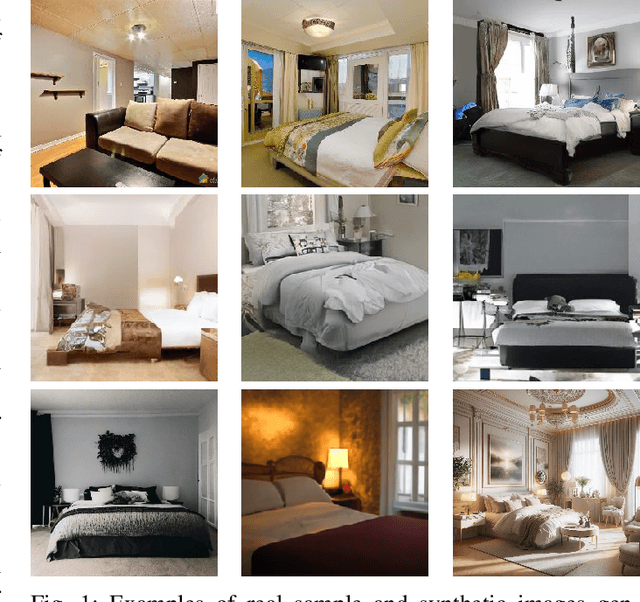
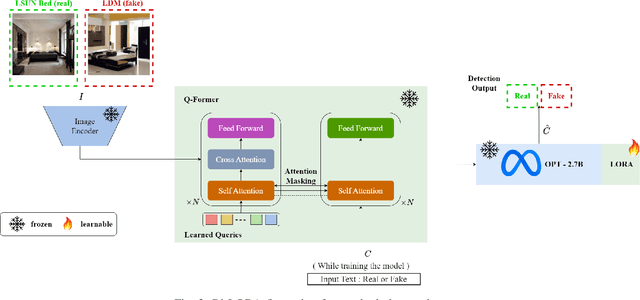
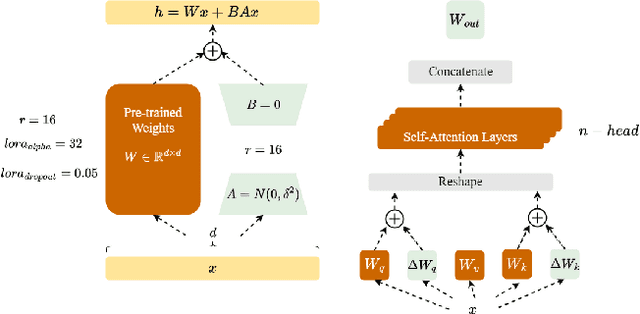
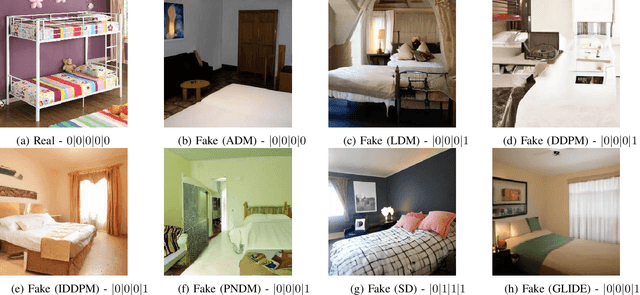
Advancements in deep image synthesis techniques, such as generative adversarial networks (GANs) and diffusion models (DMs), have ushered in an era of generating highly realistic images. While this technological progress has captured significant interest, it has also raised concerns about the potential difficulty in distinguishing real images from their synthetic counterparts. This paper takes inspiration from the potent convergence capabilities between vision and language, coupled with the zero-shot nature of vision-language models (VLMs). We introduce an innovative method called Bi-LORA that leverages VLMs, combined with low-rank adaptation (LORA) tuning techniques, to enhance the precision of synthetic image detection for unseen model-generated images. The pivotal conceptual shift in our methodology revolves around reframing binary classification as an image captioning task, leveraging the distinctive capabilities of cutting-edge VLM, notably bootstrapping language image pre-training (BLIP2). Rigorous and comprehensive experiments are conducted to validate the effectiveness of our proposed approach, particularly in detecting unseen diffusion-generated images from unknown diffusion-based generative models during training, showcasing robustness to noise, and demonstrating generalization capabilities to GANs. The obtained results showcase an impressive average accuracy of 93.41% in synthetic image detection on unseen generation models. The code and models associated with this research can be publicly accessed at https://github.com/Mamadou-Keita/VLM-DETECT.