 Add to Chrome
 Add to Firefox
 Add to Edge
Modular Multimodal Classification Without Fine-Tuning: A Simple Compositional Approach
May 20, 2026
We introduce CoMET, \textit{\textbf{C}omposing \textbf{M}odality \textbf{E}ncoders with \textbf{T}abular foundation models}, a simple yet highly competitive method for multimodal classification: pass each modality through a frozen pre-trained backbone, compress the resulting embeddings with PCA, and concatenate as input into a Tabular Foundation Model (TFM) for prediction. We show that PCA alone suffices to act as an adaptor yielding strong, robust performance across modalities. When the \texttt{CLS} tokens of the foundation model align poorly with downstream tasks, we propose \textbf{PALPooling}, a lightweight adaptive token pooler that consistently improves representation quality. By composing strong frozen representation learning backbones with TFMs, our approach achieves state-of-the-art results across diverse multimodal benchmarks without any training. On hierarchical tasks with large fine-grained class spaces, our approach enables fast and scalable classification, handling datasets with over 500,000 samples and 2,000 classes without any fine-tuning. Overall, our results show that the composition of foundation models is a simple, yet powerful, out-of-the-box solution for multimodal learning, challenging the necessity of complex, end-to-end training pipelines for new problems.

Active Preference Learning for Ordering Items In- and Out-of-sample
May 05, 2024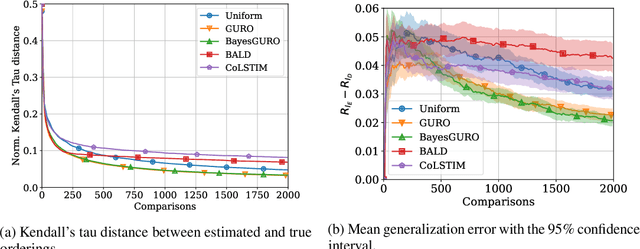
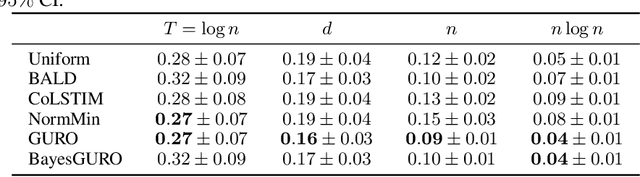
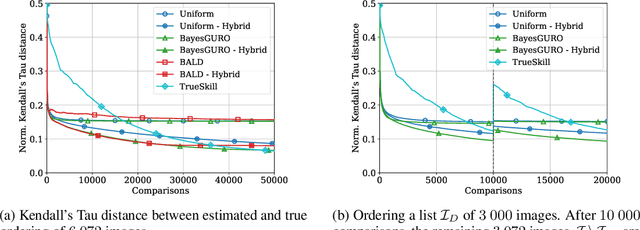
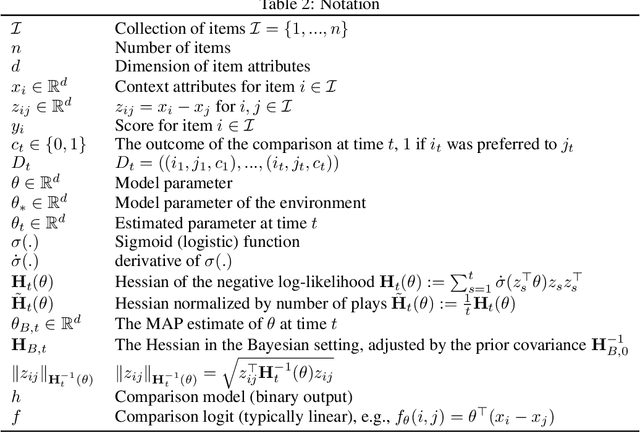
Learning an ordering of items based on noisy pairwise comparisons is useful when item-specific labels are difficult to assign, for example, when annotators have to make subjective assessments. Algorithms have been proposed for actively sampling comparisons of items to minimize the number of annotations necessary for learning an accurate ordering. However, many ignore shared structure between items, treating them as unrelated, limiting sample efficiency and precluding generalization to new items. In this work, we study active learning with pairwise preference feedback for ordering items with contextual attributes, both in- and out-of-sample. We give an upper bound on the expected ordering error incurred by active learning strategies under a logistic preference model, in terms of the aleatoric and epistemic uncertainty in comparisons, and propose two algorithms designed to greedily minimize this bound. We evaluate these algorithms in two realistic image ordering tasks, including one with comparisons made by human annotators, and demonstrate superior sample efficiency compared to non-contextual ranking approaches and active preference learning baselines.