 Add to Chrome
 Add to Firefox
 Add to Edge
A novel Information-Driven Strategy for Optimal Regression Assessment
Oct 16, 2025
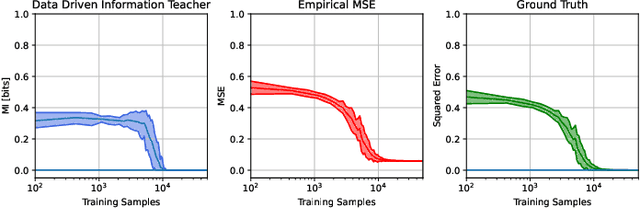
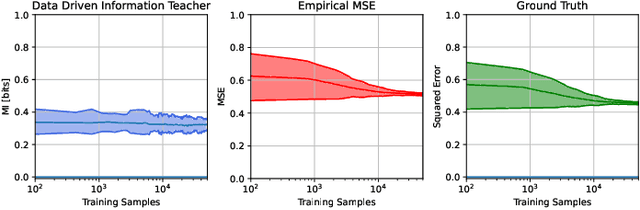
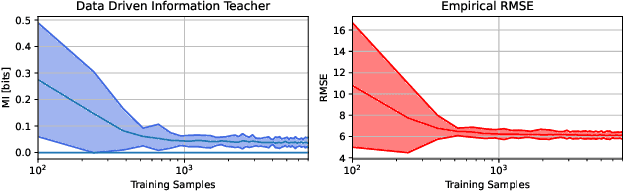
In Machine Learning (ML), a regression algorithm aims to minimize a loss function based on data. An assessment method in this context seeks to quantify the discrepancy between the optimal response for an input-output system and the estimate produced by a learned predictive model (the student). Evaluating the quality of a learned regressor remains challenging without access to the true data-generating mechanism, as no data-driven assessment method can ensure the achievability of global optimality. This work introduces the Information Teacher, a novel data-driven framework for evaluating regression algorithms with formal performance guarantees to assess global optimality. Our novel approach builds on estimating the Shannon mutual information (MI) between the input variables and the residuals and applies to a broad class of additive noise models. Through numerical experiments, we confirm that the Information Teacher is capable of detecting global optimality, which is aligned with the condition of zero estimation error with respect to the -- inaccessible, in practice -- true model, working as a surrogate measure of the ground truth assessment loss and offering a principled alternative to conventional empirical performance metrics.

A Federated Distributionally Robust Support Vector Machine with Mixture of Wasserstein Balls Ambiguity Set for Distributed Fault Diagnosis
Oct 04, 2024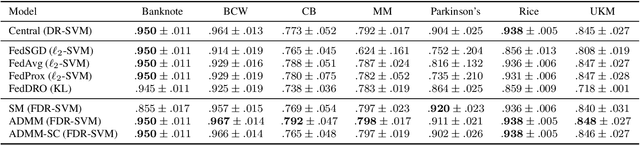
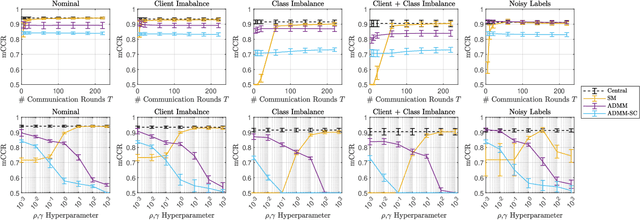
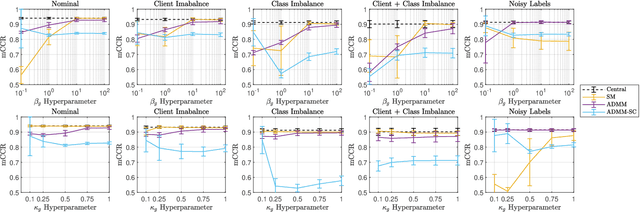
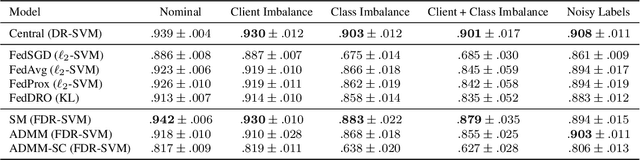
The training of classification models for fault diagnosis tasks using geographically dispersed data is a crucial task for original parts manufacturers (OEMs) seeking to provide long-term service contracts (LTSCs) to their customers. Due to privacy and bandwidth constraints, such models must be trained in a federated fashion. Moreover, due to harsh industrial settings the data often suffers from feature and label uncertainty. Therefore, we study the problem of training a distributionally robust (DR) support vector machine (SVM) in a federated fashion over a network comprised of a central server and $G$ clients without sharing data. We consider the setting where the local data of each client $g$ is sampled from a unique true distribution $\mathbb{P}_g$, and the clients can only communicate with the central server. We propose a novel Mixture of Wasserstein Balls (MoWB) ambiguity set that relies on local Wasserstein balls centered at the empirical distribution of the data at each client. We study theoretical aspects of the proposed ambiguity set, deriving its out-of-sample performance guarantees and demonstrating that it naturally allows for the separability of the DR problem. Subsequently, we propose two distributed optimization algorithms for training the global FDR-SVM: i) a subgradient method-based algorithm, and ii) an alternating direction method of multipliers (ADMM)-based algorithm. We derive the optimization problems to be solved by each client and provide closed-form expressions for the computations performed by the central server during each iteration for both algorithms. Finally, we thoroughly examine the performance of the proposed algorithms in a series of numerical experiments utilizing both simulation data and popular real-world datasets.