 Add to Chrome
 Add to Firefox
 Add to Edge
WILD-SAM: Phase-Aware Expert Adaptation of SAM for Landslide Detection in Wrapped InSAR Interferograms
Apr 16, 2026
Detecting slow-moving landslides directly from wrapped Interferometric Synthetic Aperture Radar (InSAR) interferograms is crucial for efficient geohazard monitoring, yet it remains fundamentally challenged by severe phase ambiguity and complex coherence noise. While the Segment Anything Model (SAM) offers a powerful foundation for segmentation, its direct transfer to wrapped phase data is hindered by a profound spectral domain shift, which suppresses the high-frequency fringes essential for boundary delineation. To bridge this gap, we propose WILD-SAM, a novel parameter-efficient fine-tuning framework specifically designed to adapt SAM for high-precision landslide detection on wrapped interferograms. Specifically, the architecture integrates a Phase-Aware Mixture-of-Experts (PA-MoE) Adapter into the frozen encoder to align spectral distributions and introduces a Wavelet-Guided Subband Enhancement (WGSE) strategy to generate frequency-aware dense prompts. The PA-MoE Adapter exploits a dynamic routing mechanism across heterogeneous convolutional experts to adaptively aggregate multi-scale spectral-textural priors, effectively aligning the distribution discrepancy between natural images and interferometric phase data. Meanwhile, the WGSE strategy leverages discrete wavelet transforms to explicitly disentangle high-frequency subbands and refine directional phase textures, injecting these structural cues as dense prompts to ensure topological integrity along sharp landslide boundaries. Extensive experiments on the ISSLIDE and ISSLIDE+ benchmarks demonstrate that WILD-SAM achieves state-of-the-art performance, significantly outperforming existing methods in both target completeness and contour fidelity.

Image Based Camera Localization: an Overview
May 03, 2018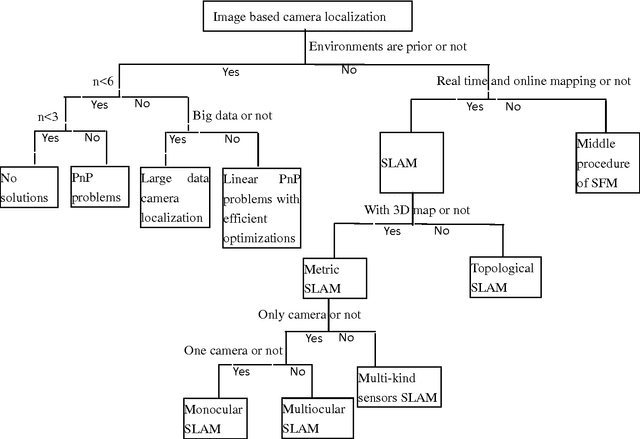
Recently, virtual reality, augmented reality, robotics, autonomous driving et al attract much attention of both academic and industrial community, in which image based camera localization is a key task. However, there has not been a complete review on image-based camera localization. It is urgent to map this topic to help people enter the field quickly. In this paper, an overview of image based camera localization is presented. A new and complete kind of classifications for image based camera localization is provided and the related techniques are introduced. Trends for the future development are also discussed. It will be useful to not only researchers but also engineers and other people interested.